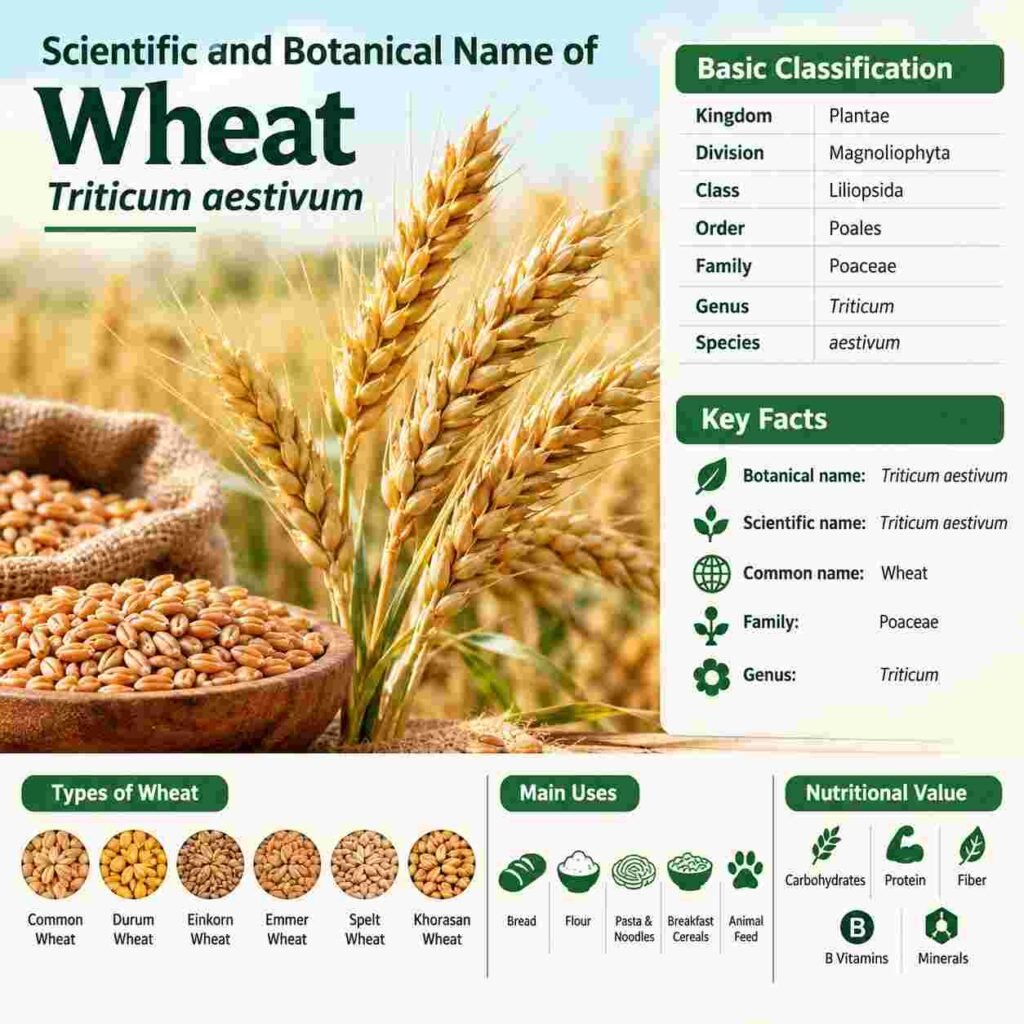
What is the botanical name of wheat? The wheat scientific name is Triticum aestivum.
Wheat is one of the most important cereal crops in the world. People grow wheat in many countries and use it to produce a variety of foods, including flour, bread, pasta, noodles, and more. Farmers cultivate wheat on large areas of land because the crop gives a stable yield and high food value. Many students and agriculture learners often ask one basic question: what is the botanical name of wheat, or what is the scientific name of wheat?
The botanical name of wheat is Triticum aestivum. Scientists use the scientific name of the wheat plant in agriculture, botany, and crop science. The plant belongs to the grass family called Poaceae. The wheat plant has played a major role in human food systems for thousands of years.
This article explains the botanical name of wheat, its biological name, wheat’s scientific name and family, the genus of wheat, various types of wheat, wheat variety names, the uses of wheat, and wheat’s nutritional value.
Table of Contents
What is the Botanical Name of Wheat?
Triticum aestivum is the scientific name of wheat. This name comes from the scientific classification system used in plant science. Scientists assign each plant a unique name so researchers around the world can identify the species without confusion.
Key facts about the wheat scientific name
- Botanical name of wheat: Triticum aestivum
- Scientific name of wheat plant: Triticum aestivum
- Latin name of wheat: Triticum aestivum
- Biological name of wheat: Triticum aestivum
- Common name of wheat: Wheat
- Genus: Triticum
- Family: Poaceae (grass family)
Wheat Scientific Name Pronunciation:
Many students also want to know the pronunciation of the scientific name. The correct pronunciation of Triticum aestivum is:
Try-ti-kum es-tee-vum
Breakdown:
- Triticum: Try-ti-kum
- Aestivum: es-tee-vum
Scientific Name Meaning of Wheat:
Understanding the meaning of the scientific name helps explain the origin of a plant’s name.
Meaning of Triticum:
The word Triticum comes from Latin. It means threshing grain. Ancient farmers used the term when they separated grain from husk.
Meaning of Aestivum:
- The word Aestivum means summer type or summer growing.
Therefore, the scientific name of wheat describes a grain crop harvested after warm-season growth.
Biological Classification of Wheat
| Taxonomic Rank | Classification |
|---|---|
| Kingdom | Plantae |
| Subkingdom | Tracheobionta |
| Division | Magnoliophyta |
| Class | Liliopsida |
| Subclass | Commelinidae |
| Order | Poales |
| Family | Poaceae |
| Subfamily | Pooideae |
| Tribe | Triticeae |
| Genus | Triticum |
| Species | aestivum |
This classification confirms that the scientific name of the wheat plant is Triticum aestivum and the family name of wheat is Poaceae.
Wheat Plant Characteristics
The wheat plant resembles grass. It has roots, stems, leaves, heads with flowers, and grain spikelets. There is a great deal of variation from one wheat plant to another depending on the species, cultivar, climate, and the techniques used in wheat production.
Wheat Plant Height:
Most wheat plants are in the 2-4 feet range. Some varieties can be taller, while others can be shorter. There are many reasons for height, among them: plant genetics, soil condition, water, temperature, and farm practices.
Wheat Leaves:
Wheat leaves are long and narrow, and they have a green color. Wheat leaves are made up of a blade and a sheath, which surrounds a portion of the stem. The primary purpose of leaves is to help the wheat plant grow and develop the grain by using energy captured from sunlight.
Wheat Stem:
The stem of the wheat plant, commonly called a culm, helps hold the developing head and leaves of the plant. Depending on the cultivar, the stem can be hollow or solid at each node.
Wheat Flowers and Grain Head:
A wheat head is made up of multiple small sections called spikelets, which are small structures that produce seeds after the grain is pollinated and fertilized.
Wheat grains grow best when they self-pollinate; however, cross-pollination is possible. The mature grain is then harvested and converted into food products.
Wheat Grain Structure:
Wheat grains have 3 components. They include:
- The Bran: This component includes the outermost layers of the wheat grain. The bran includes important fiber and some nutrients.
- The Germ: This is the embryonic part of the grain, which includes oils, vitamins, minerals, and protein.
- The Endosperm: This is the largest part of the wheat grain and consists primarily of starch and protein.
All three parts of the grain are contained in whole wheat flour. In white flour, only the endosperm part of the grain is present after most of the bran and germ are removed during the grain refining process.
Types of Wheat and Their Scientific Names
Wheat comes in several species, classes, and varieties. Agricultural names can describe a botanical species or a market class based on grain color, kernel hardness, protein content, and growing season.
In the United States, wheat is commonly divided into six market classes. Each class has different milling and food applications.
Common Types of Wheat
| Type of Wheat | Scientific or Botanical Name | Main Uses |
|---|---|---|
| Common wheat | Triticum aestivum | Bread, all-purpose flour, and baked goods |
| Durum wheat | Triticum durum | Pasta, semolina, and couscous |
| Einkorn wheat | Triticum monococcum | Specialty flour and traditional foods |
| Emmer wheat | Triticum dicoccum | Porridge, soups, and specialty grain products |
| Spelt wheat | Triticum spelta | Whole-grain flour, bread, and pasta |
| Khorasan wheat | Triticum turgidum subsp. turanicum | Specialty flour, bread, and grain dishes |
Wheat taxonomy varies across botanical references, especially for cultivated forms and subspecies. Common wheat and durum wheat are the two names most useful to distinguish in everyday food and agricultural discussions.
Six Major Wheat Classes Grown in the United States
The six major U.S. wheat classes are grouped by kernel color, hardness, growing season, and end use. These market classes are not the same as six separate botanical species. Most belong to common wheat, while durum is a distinct cultivated wheat species.
| Wheat Class | Main Growing Season or Group | Common Food Uses |
|---|---|---|
| Hard Red Winter | Winter wheat | Bread, rolls, flatbreads, and general-purpose flour |
| Hard Red Spring | Spring wheat | Bread, bagels, pizza crust, and rolls |
| Soft Red Winter | Winter wheat | Cakes, cookies, crackers, and pastries |
| Hard White | Hard-kernel wheat | Bread, flatbreads, and noodles |
| Soft White | Soft-kernel wheat | Cakes, pastries, crackers, and noodles |
| Durum | Primarily spring-grown in the northern United States | Pasta, semolina, and couscous |
Ways Wheat Is Used In Everyday Life
Wheat plays an important role in food manufacturing, agriculture, and industry. Wheat grain is made into various types of flour, semolina, and more to be used in many manufacturing processes.
Wheat for Bread and Bakery
One of the main products wheat is used to create is bread. Wheat flour, water, yeast, and more are used to make the dough from which bread is created. Gluten is one ingredient in bread making. Bread made from flour, including durum wheat, forms a structure in which the bread rises and is baked.
The wheat flour is also the main ingredient in the making of:
- Sandwich bread, rolls and more
- Pizza crust and bagels
- Cookies, crackers and more
- Cakes, pastries and more
- Flatbread and tortillas
Depending on the wheat flour, the structure and texture of the bread vary.
Wheat for Pasta and Noodles
The grain of durum wheat is one main ingredient in pasta. Durum wheat flour is semolina, and food manufacturers add water to it to make the pasta.
Common wheat is used to make noodles. Manufacturers can use common wheat for making noodles based on texture and manufacturing needs.
Wheat for Breakfast Foods
Wheat can be used in manufacturing various types of breakfast foods, including wheat flakes, breakfast cereal, and other foods in this category. Wheat products, including whole grain products, are rich sources of dietary fiber.
When refined grains lose their bran and germ, the fiber content decreases. Nutrition labels assist consumers in comparing products.
Wheat for Animal Feed
Depending on price, quality, and availability, wheat grain can be incorporated into livestock feed. By-products from the milling process, such as wheat bran, can also be used as animal feed.
It is up to farmers and feed manufacturers to assess the nutritional needs of their livestock and determine which combination of feed ingredients will be the best choice for the animals.
Wheat Nutrition Facts
The following table gives approximate values for 100 grams of whole-grain wheat flour. These values are for flour, not raw wheat kernels, and can vary by product.
| Nutrient | Approximate Amount per 100 g |
|---|---|
| Calories | 340 kcal |
| Carbohydrates | 72 g |
| Protein | 13.2 g |
| Total fat | 2.5 g |
| Dietary fiber | 10.7 g |
| Calcium | 34 mg |
| Iron | 3.6 mg |
| Magnesium | 137 mg |
| Potassium | 363 mg |
| Phosphorus | 357 mg |
Values are approximate and may vary by product and database entry. They should not be treated as the nutrition facts for every wheat grain or wheat flour product.
Also Read:
- Mustard Scientific Name, Genus, Uses, Benefits, and Types
- Pea Scientific Name, Genus, Uses, Benefits, and Types
- Rice Scientific Name, Genus, Habitat, Facts, Uses, and Types
- Corn Scientific Name, Genus, Types, Parts, Uses, and Benefits
FAQs
What is the botanical name of wheat?
The scientific name of wheat is Triticum aestivum, which refers to common wheat used to make bread and flour.
What is the wheat scientific name and family?
The wheat scientific name is Triticum aestivum, and its family is Poaceae, also known as the grass family.
What is the genus of wheat?
The genus of wheat is Triticum, which includes common wheat, durum wheat, and other cultivated wheat species.
What are the main types of wheat?
The main types of wheat include common wheat, durum wheat, einkorn, emmer, spelt, and Khorasan wheat.
What are the main uses of wheat?
The main uses of wheat include making bread, flour, pasta, noodles, breakfast cereals, and animal feed.