What is the scientific name of mustard plant? The mustard scientific name is Brassica (Genus).
The mustard plant is a cultivated plant that has been used for its seeds, leaves, and oil. The plant has a long history of usage in food preparation, traditional medicine, and agriculture. It is possible to learn about the scientific name of mustard, its biological identity, and the plant structure that has made mustard such a significant crop in different parts of the world.
Table of Contents
What is the Scientific Name of Mustard Plant?
The scientific name depends on the species, as mustard is not a single plant but a collection of closely related plants.
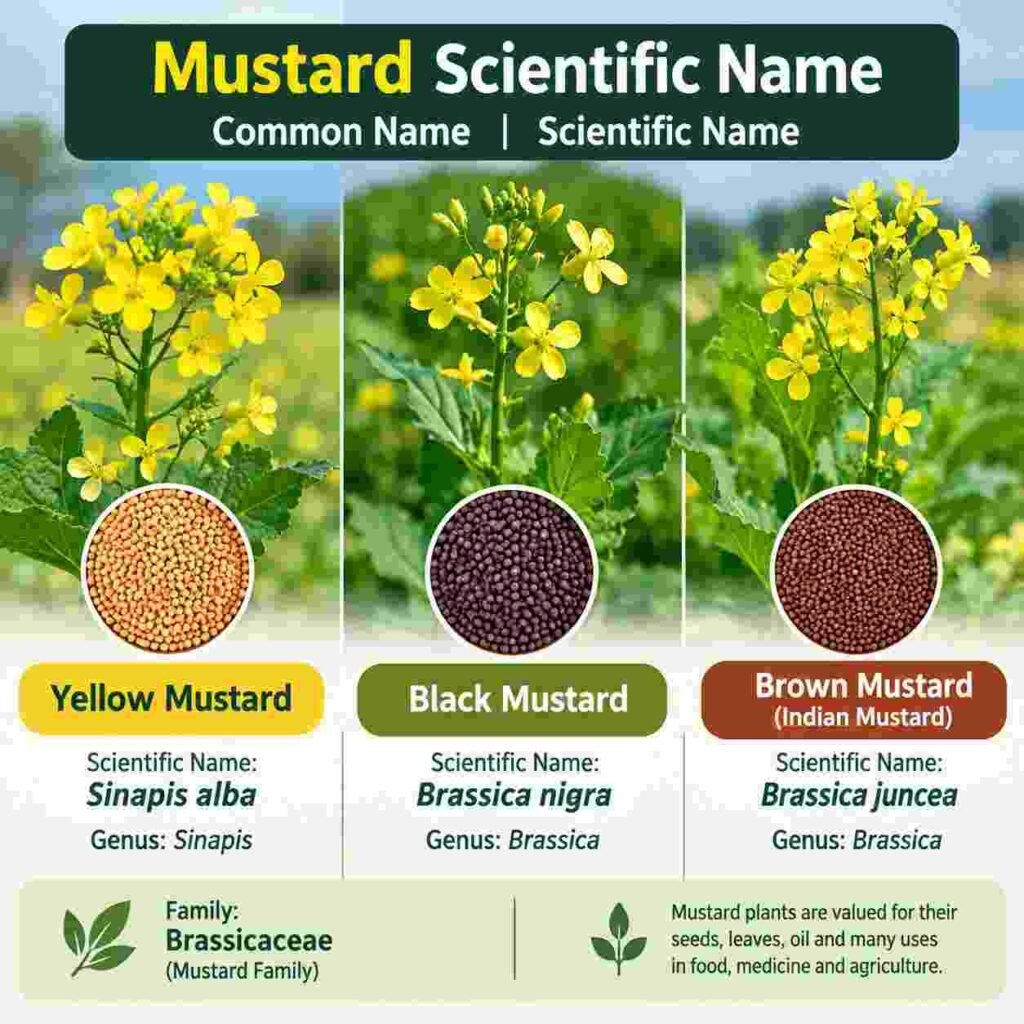
- Yellow mustard scientific name: Sinapis alba
- Black mustard scientific name: Brassica nigra
- Brown mustard scientific name: Brassica juncea
| Mustard Type | Scientific Name | Genus | Family |
|---|---|---|---|
| Yellow or White Mustard | Sinapis alba | Sinapis | Brassicaceae |
| Black Mustard | Brassica nigra | Brassica | Brassicaceae |
| Brown or Indian Mustard | Brassica juncea | Brassica | Brassicaceae |
Regardless of the names used, each of the aforementioned species has a valid scientific name.
Meaning of Mustard Scientific Name
Sinapis / Brassica were Latin names that had been historically assigned to mustard-like plants.
- alba denotes yellow or white
- nigra stands for black
- juncea means reed-like in growth
The names collectively describe the plant type, the color of its seeds, and its growth habit.
Pronunciation of Mustard
- Sinapis alba: si-NAP-iss AL-buh
- Brassica nigra: BRASS-ih-kuh NIGH-gruh
- Brassica juncea: BRASS-ih-kuh JUN-see-uh
These follow the commonly accepted botanical (Latinized) pronunciation used in biology and plant science.
Biological Classification of Mustard
| Rank | Classification |
|---|---|
| Kingdom | Plantae |
| Division | Angiosperms |
| Class | Eudicots |
| Order | Brassicales |
| Family | Brassicaceae |
| Genus | Brassica / Sinapis |
| Species | alba, nigra, juncea |
Mustard Plant Characteristics
Mustard plants have straight stems. Their leaves look different depending on the species and variety. Most kinds grow small yellow flowers. When the flowers finish, the plant forms seed pods. Those pods hold the mustard seeds.
The seeds do not all look the same. They differ in color and size. White mustard usually gives pale seeds. Black mustard gives dark seeds. Brown mustard seeds can range from light yellow-brown to dark brown.
One thing people link to mustard is glucosinolates. These compounds help create the pungent flavor found in many mustard plants. USDA crop notes also mention glucosinolates in mustard and describe uses in cover planting and biofumigation.
Types of Mustard Plant
Different mustard plants are grown for food, oil, farm use, and other roles.
1. White mustard
Scientific name: Sinapis alba
White mustard is sometimes called yellow mustard in food and farming. Its seeds are used for condiments like mustard and for other foods. USDA lists white mustard as a mustard crop. The agency reports that the seeds can have about 25% to 30% oil.
2. Black Mustard
Scientific name: Brassica nigra
Black mustard is an annual mustard species grown for its seeds. Its seeds have a strong flavor and have been used as a spice.
Black mustard belongs to the Brassica genus and the Brassicaceae family.
3. Brown Mustard
Scientific name: Brassica juncea
Brown mustard is also called Indian mustard or oriental mustard. It is widely used as a leafy vegetable, spice, and oilseed crop.
USDA sources list Brassica juncea as mustard greens and also identify it as an oilseed and vegetable crop.
4. Ethiopian Mustard
Scientific name: Brassica carinata
Ethiopian mustard is another mustard species in the Brassica genus. It is used as an oilseed and vegetable crop, particularly in parts of Africa and India.
Mustard Types and Scientific Names
| Common Mustard Types | Scientific Name | Main Use |
|---|---|---|
| White Mustard | Sinapis alba | Seeds, condiment, oil |
| Yellow Mustard | Sinapis alba | Condiment and seed |
| Black Mustard | Brassica nigra | Spice and seed |
| Brown Mustard | Brassica juncea | Greens, spice, oil |
| Indian Mustard | Brassica juncea | Oil, greens, spice |
| Oriental Mustard | Brassica juncea | Greens and seed |
| Ethiopian Mustard | Brassica carinata | Oilseed and vegetable |
Uses of Mustard Plant
The mustard plant has several uses in food and agriculture.
Mustard Seeds as a Spice
Mustard seeds are used as a spice in many cuisines. Whole seeds can be used in cooking, while ground seeds can be processed into mustard powder or mustard condiments.
The USDA Agricultural Research Service recognizes mustard seed, mustard condiment, mustard greens, mustard meal, and mustard oil as separate mustard products.
Mustard as a Condiment
Ground mustard seeds are used to prepare mustard condiments. Yellow mustard, brown mustard, and other mustard products are used with sandwiches, meats, vegetables, sauces, and other foods.
Mustard Greens
Some mustard species are grown specifically for their leaves.
Brassica juncea is commonly used as mustard greens. The USDA notes that mustard greens can be steamed or sautéed and that young leaves can also be added to salads.
Mustard Oil
Some mustard species are grown for their seeds and oil. Mustard seed oil is produced by processing the seeds.
The oil content and composition vary according to species, variety, and growing conditions. White mustard, for example, has been studied as an oilseed crop.
Mustard as a Cover Crop
Mustard can also be grown as a cover crop. USDA agricultural guidance lists mustard crops for uses such as erosion control, weed control, nutrient scavenging, and reduction of soil compaction.
Mustard plants can produce substantial root growth and plant residue. Some mustard crops are also used as biofumigants or trap crops in agricultural systems.
Benefits of Mustard Plants
The word benefits can refer to both nutritional value and agricultural value. The benefits depend on which part of the mustard plant is used.
Nutritional Benefits of Mustard Greens
Mustard greens provide several nutrients. USDA research describes mustard greens as a source of vitamins and minerals, including vitamin C and other nutrients.
Mustard greens also contain fiber, vitamins, minerals, carotenoids, and other plant compounds. USDA information on dark green leafy vegetables includes mustard among greens that provide vitamins A, C, E, and K, along with fiber and minerals.
Glucosinolates in Mustard
Mustard plants contain glucosinolates, a group of sulfur-containing plant compounds. These compounds contribute to the characteristic flavor of mustard vegetables and seeds.
Research by scientists at the USDA Agricultural Research Service examined glucosinolates and other compounds found in mustard greens.
Agricultural Benefits of Mustard
Mustard can provide several functions in crop production.
USDA guidance lists mustard cover crops for:
- Weed control
- Erosion control
- Nitrogen scavenging
- Phosphorus and potassium scavenging
- Compaction reduction
- Nematode control
- Attracting beneficial organisms
These agricultural uses make mustard useful beyond its role as a food crop.
Mustard Scientific Name in Short
The main mustard scientific names can be summarized as follows:
- Yellow or white mustard: Sinapis alba
- Black mustard: Brassica nigra
- Brown or Indian mustard: Brassica juncea
- Ethiopian mustard: Brassica carinata
- Mustard family: Brassicaceae
- Main mustard genera: Brassica and Sinapis
This distinction matters because mustard is a common name, not the scientific name of a single species.
Also Read:
- Pea Scientific Name, Genus, Uses, Benefits, and Types
- Scientific and Botanical Name of Wheat, Types, Uses, and Nutrition
- Rice Scientific Name, Genus, Habitat, Facts, Uses, and Types
- Corn Scientific Name, Genus, Types, Parts, Uses, and Benefits
FAQs
What is the scientific name of mustard plant?
The scientific name depends on the species. Common mustard species include Sinapis alba, Brassica nigra, and Brassica juncea.
What is the genus of mustard?
Mustard belongs mainly to the genera Brassica and Sinapis, depending on the species.
What is the family of mustard?
Mustard belongs to the Brassicaceae family, also known as the mustard family.
What is the scientific name of Indian mustard?
The scientific name of Indian or brown mustard is Brassica juncea.
What is the scientific name of black mustard?
The scientific name of black mustard is Brassica nigra.