
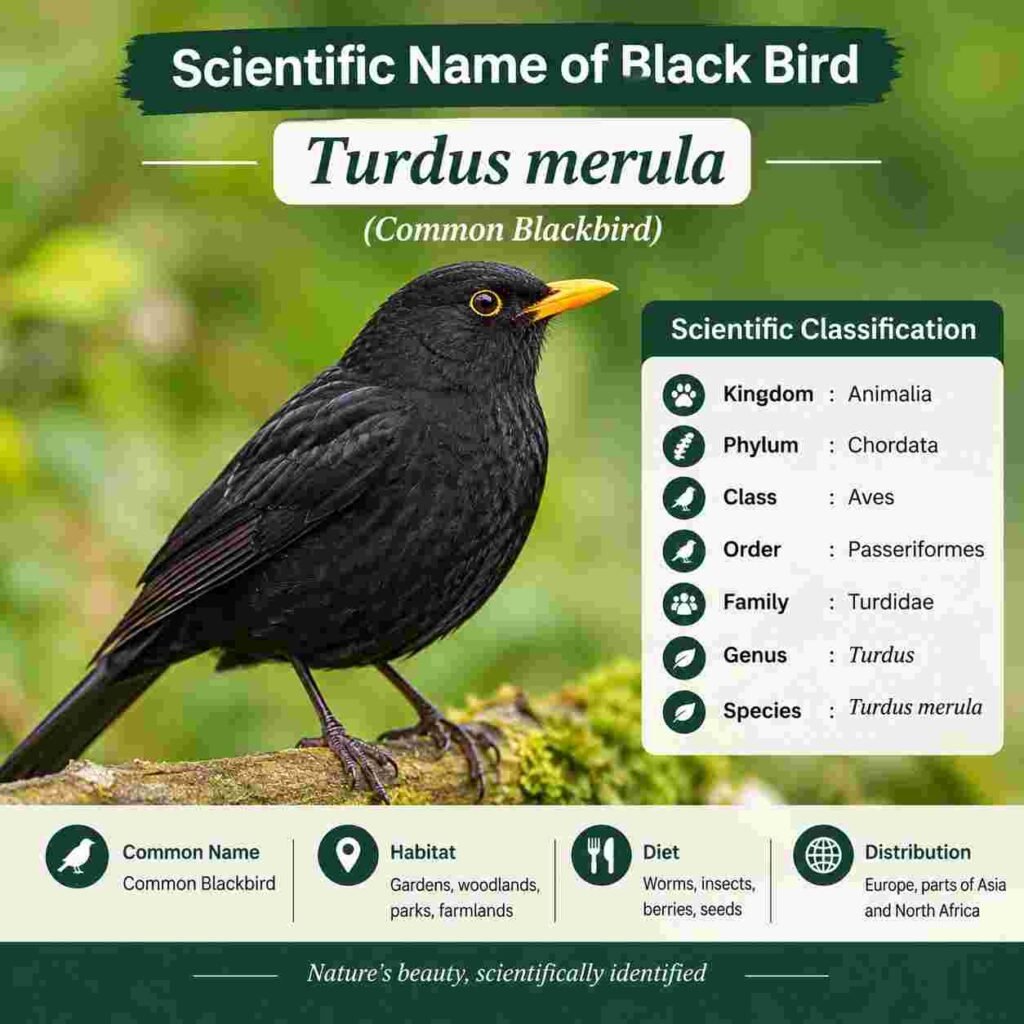
What is the scientific name of the Black bird? The common black bird scientific name is Turdus merula.
Black birds live in forests, gardens, grassy fields, wetlands, and cities across the globe. Many people spot them quickly because their feathers are dark. Still, “black bird” does not always mean the same species. Some birds look fully black, while others show spots or bright marks on their wings or body.
A black bird scientific name depends on which species you mean. The common blackbird, also called the Eurasian blackbird, is Turdus merula. In North America, the red-winged blackbird is not the same animal. Its scientific name is Agelaius phoeniceus. Sources include the British Trust for Ornithology and the Cornell Lab of Ornithology.
This guide covers black bird scientific names and how scientists group these birds. You will also see notes on body traits, where they live, what they eat, and examples of different black-colored species.
Table of Contents
What is the scientific name of the black bird?
If you mean the common blackbird, the scientific name is Turdus merula. It belongs to the thrush family, Turdidae. It also falls under the order Passeriformes, which is the group that includes perching birds.
The phrase “black bird” is about color, not one fixed species. Many birds that are not closely related can share dark feathers. Each one has its own scientific name.
For example:
- Common blackbird: Turdus merula
- Red-winged blackbird: Agelaius phoeniceus
- American crow: Corvus brachyrhynchos
These birds differ in their body size, behavior, habitat, and classification.
Blackbird scientific name pronunciation and meaning
If you mean the scientific name of the common blackbird, Turdus merula, here is its pronunciation and meaning.
Pronunciation:
- Turdus merula: ˈtɜːrdəs məˈruːlə
Meaning:
Turdus is Latin for “thrush,” while merula is a Latin word for “blackbird.”
What do the two words mean?
- Turdus: Thrush; the genus name
- merula: Blackbird; the species epithet
- Turdus merula: The common or Eurasian blackbird
Common Blackbird Body Traits
A common blackbird is a medium-sized bird. It has sturdy legs and a pointed bill.
Adult males look mostly black. Their feathers can look shiny. Their bill is yellow or orange-yellow. They also have a bright yellow ring near the eyes. Adult females are not as dark. They usually have brown feathers. Their bill is less bright than the males.
Young blackbirds
Young birds often have brown feathers. Some of them show light patches on the chest.
Important Physical Clues
- Feather color: Males tend to be black. Females tend to be brown.
- Bill: The male often has a yellow or orange-yellow bill.
- Form: The body is round. The tail is fairly long. The legs are strong.
- Song: The call is clear and tuneful. It is often heard from above.
- Foraging: It commonly checks the ground for worms and other food.
Why these points matter
These signs can help tell the common blackbird apart from other birds that look dark.
Types of Black birds
Many kinds of birds have black feathers. Some species are called blackbirds in their everyday names. Others are in other groups, like crows and ravens.
| Common Name | Scientific Name | Family |
|---|---|---|
| Common Blackbird | Turdus merula | Turdidae |
| Red-winged Blackbird | Agelaius phoeniceus | Icteridae |
| Brewer’s Blackbird | Euphagus cyanocephalus | Icteridae |
| Yellow-headed Blackbird | Xanthocephalus xanthocephalus | Icteridae |
| Rusty Blackbird | Euphagus carolinus | Icteridae |
| Tricolored Blackbird | Agelaius tricolor | Icteridae |
| Tawny-shouldered Blackbird | Agelaius humeralis | Icteridae |
| Bobolink | Dolichonyx oryzivorus | Icteridae |
| Shiny Cowbird | Molothrus bonariensis | Icteridae |
| Common Grackle | Quiscalus quiscula | Icteridae |
Note: These are examples of black or predominantly dark-plumaged birds, not all members of one taxonomic group.
Habitat and Distribution of Blackbirds
The common blackbird can live in many places. You might see it in woods, gardens, parks, and farmland. It also uses spots with thick shrubs. It usually stays close to areas with food and safe places to nest.
- Woodlands: Open forests, timbered edges, and mixed tree areas.
- Gardens and Parks: Residential lawns, backyards, and city greenspaces.
- Shrublands: Dense thickets, scrubby areas, and hedgerows.
- Farmlands: Crop fields, orchards, and vineyards.
- Urban Areas: Town centers, city parks, and green spaces.
In Europe, the common blackbird is widespread. Its range also reaches parts of Asia. It is found in North Africa too. In some other areas, people introduced it and new groups formed.
Other birds that are black or mostly black, but not all black birds, use the same habitats. Red-winged blackbirds often live in wet places. They are seen in swamps and reed beds throughout North America. Crows and ravens can handle a wide mix of settings. They may live in forests, open fields, mountain areas, and cities.
Why habitat matters for identification
Habitat can help you tell species apart. Many birds prefer certain environments more than others.
What Do Blackbirds Eat?
A black bird’s diet depends on the species and its home. The common blackbird eats what it can find. It takes both animal food and plant food.
Its diet may include:
- Earthworms
- Insects and their larvae
- Small snails
- Berries and other fruits
- Seeds and other available plant foods
Common blackbirds often probe soil and leaf litter for worms and bugs. They may also come into gardens to eat berries. Some will use bird feeders if food is available.
Red-winged blackbirds eat both insects and seeds. Crows and ravens take a wider range of foods. They may eat insects, fruit, small animals, and carrion.
Difference Between Blackbirds, Crows, and Ravens
Although blackbirds, crows, and ravens can all have black feathers, they are not the same kind of bird.
| Feature | Common Blackbird | Crow | Raven |
|---|---|---|---|
| Scientific name | Turdus merula | Corvus brachyrhynchos (American crow) | Corvus corax (common raven) |
| Family | Turdidae | Corvidae | Corvidae |
| Body size | Medium | Large | Very large |
| Typical bill | Relatively slender | Strong | Large and heavy |
| Diet | Worms, insects, fruits | Omnivorous | Omnivorous |
| Common habitat | Gardens, woods, parks | Cities, fields, forests | Mountains, forests, open country |
The most useful distinction is taxonomy: the common blackbird is a thrush, while crows and ravens belong to the family Corvidae.

