
What is the scientific name for a red fox? The red fox scientific name is Vulpes vulpes.
The scientific name for the red fox is one of the most searched terms in animal taxonomy because the red fox is one of the most widely distributed wild mammals on Earth. Many students, wildlife enthusiasts, and bloggers seek the red fox’s scientific name, biological classification, characteristics, habitat, diet, size, age, and color details in a single, clear source. This guide presents verified biological facts using simple language.
The red fox lives across several continents and adapts to forests, grasslands, mountains, and cities. Scientists classify the red fox using a formal taxonomy system that gives each species a universal Latin name. That name helps researchers avoid confusion across regions and languages.
Table of Contents
What is the Scientific Name for a Red Fox?
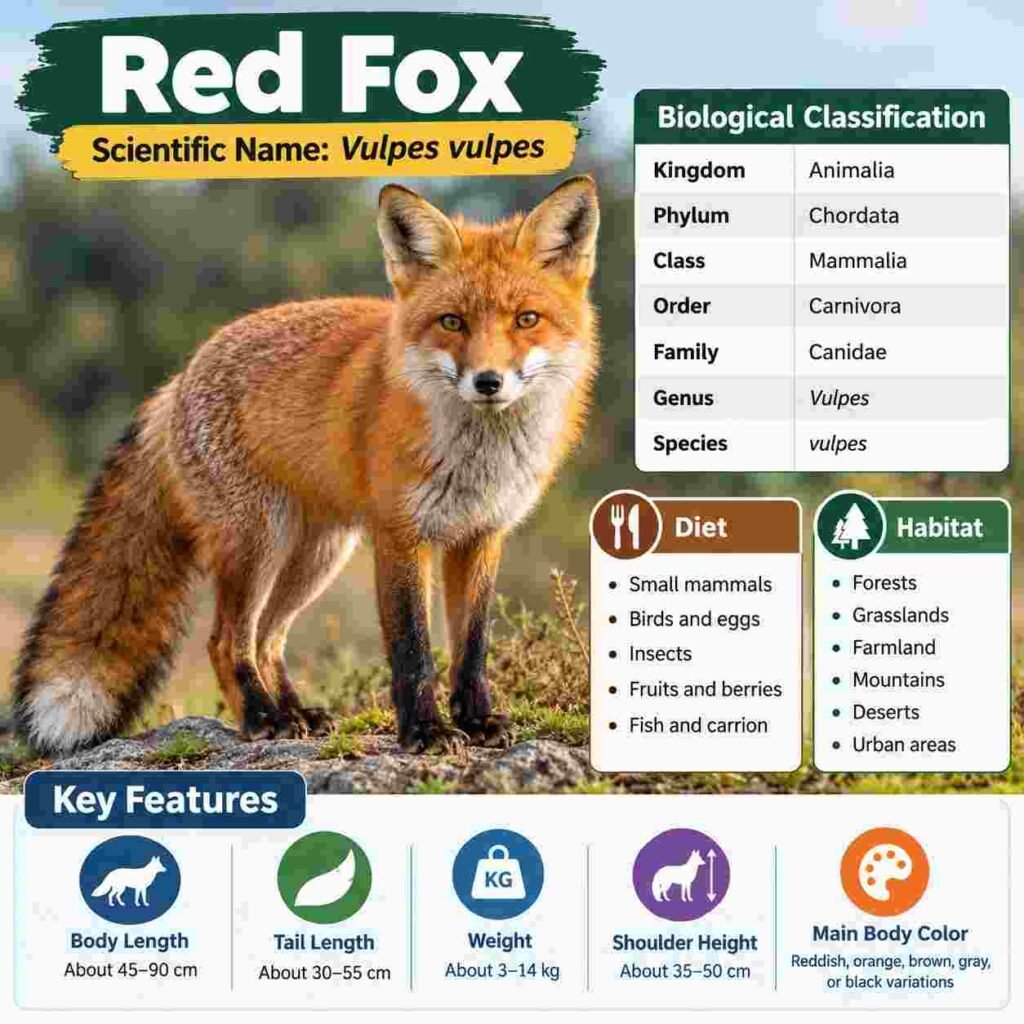
The red fox scientific name is Vulpes vulpes. This binomial name comes from Latin taxonomy rules used in zoology. The first term shows the genus. The second term shows the species.
Red Fox Scientific Name Pronunciation and Meaning
- Pronunciation: VUL-peez VUL-peez
- Language origin: Latin
- Meaning: “Vulpes” means fox. The repeated term shows the base species of that genus.
Scientists follow binomial nomenclature rules set by the International Code of Zoological Nomenclature. This system ensures that each animal has an accepted scientific label.
Biological Classification of Red Fox
| Taxonomic Rank | Red Fox Classification |
|---|---|
| Kingdom | Animalia |
| Phylum | Chordata |
| Class | Mammalia |
| Order | Carnivora |
| Family | Canidae |
| Genus | Vulpes |
| Species | vulpes |
The genus Vulpes includes true fox species. The red fox’s scientific name appears in wildlife databases, zoology books, and conservation records. Researchers use the scientific name of the red fox instead of common names to maintain accuracy.
Red Fox Taxonomy: Genus and Family
A red fox is placed in the genus Vulpes. It also belongs to the family Canidae.
Vulpes is grouped with the foxes that are often called the true foxes. Canidae includes foxes, wolves, coyotes, jackals, and domestic dogs. It also includes other nearby species.
So, a red fox is closer in relation to dogs, wolves, and coyotes than to cats, raccoons, or other small animals.
This rank in the classification helps explain why the red fox looks a lot like a dog. It has a long muzzle and canine teeth. It also has four legs built for moving fast. Its body shape is suited for long walking and travel.
Red Fox Physical Characteristics
A red fox has a narrow build. It has pointed ears. It has a long muzzle too. Its tail is long and bushy. The body is built for travel, hunting, and staying alive in different places.
The coat is often a reddish orange on the top. Still, the shade can change. The throat, chest, belly, and lower parts are usually lighter.
Common traits include:
- Long pointed muzzle
- Big pointed ears
- Slender body
- Long bushy tail
- Sharp canine teeth
- Strong sense of smell
- Good hearing
- Thick fur
- Four legs for walking and running
The tail is often called a brush. It helps with balance. It can also help hold heat when the fox rests in cold weather.
Red Fox Size and Weight
Red fox size varies by region, sex, age, and individual animal. Males are often slightly larger than females.
An adult red fox commonly has a body length of about 45 to 90 cm, while the tail can add another 30 to 55 cm. Adult weight can vary considerably, often falling within roughly 3 to 14 kg.
| Feature | Typical Range |
|---|---|
| Body Length | About 45–90 cm |
| Tail Length | About 30–55 cm |
| Weight | About 3–14 kg |
| Shoulder Height | About 35–50 cm |
| Main Body Color | Reddish, orange, brown, gray, or black variations |
These ranges are general. Red fox populations can vary by area.
What Does a Red Fox Eat?
The diet of a red fox is not fixed. Red foxes are omnivores. They also feed when the chance comes up. That means they take in different foods based on what is available.
Their diet may include:
- Mice
- Rats
- Voles
- Rabbits
- Birds
- Eggs
- Insects
- Earthworms
- Amphibians
- Reptiles
- Fish
- Carrion
- Fruits
- Berries
- Other plant material
Small mammals can form an important part of the diet in many areas. The red fox may also eat insects and other invertebrates when they are available.
In human-dominated areas, foxes may feed on food waste or other accessible sources. What they eat shifts with the time of year, where they are, and what prey is nearby.
Where Do Red Foxes Live?
Red foxes fit into many kinds of habitats.
You can find them in:
- Forests
- Grasslands
- Farmland
- Mountains
- Deserts
- Coastal areas
- Shrublands
- Suburban areas
- Urban areas
They tend to choose spots that offer food and cover. A fox may rest or raise young in plants, ground cover, rocky areas, old burrows, or other places that provide shelter.
This species covers a large area. It lives across much of Europe, Asia, and North America. It has also been brought to places beyond its original range.
Red fox colors and coat types
The term red fox comes from its typically reddish fur. Yet not all red foxes look the same. Fur can be reddish-orange, brown, gray, or close to black. Some animals show darker patches. Others have paler coats.
Common color forms are listed below:
| Feature | Typical Range |
|---|---|
| Body Length | About 45–90 cm |
| Tail Length | About 30–55 cm |
| Weight | About 3–14 kg |
| Shoulder Height | About 35–50 cm |
| Main Body Color | Reddish, orange, brown, gray, or black variations |
These color forms are variations within the red fox species rather than separate species.
Red Fox vs. Gray Fox
The red fox and gray fox are two different fox species found in North America.
| Feature | Red Fox | Gray Fox |
|---|---|---|
| Scientific Name | Vulpes vulpes | Urocyon cinereoargenteus |
| Family | Canidae | Canidae |
| Genus | Vulpes | Urocyon |
| Coat | Often reddish | Mainly gray |
| Tail | Long and bushy | Long with dark markings |
| Climbing Ability | Limited | Strong tree-climbing ability |
The red fox’s scientific name is Vulpes vulpes, while the gray fox’s scientific name is Urocyon cinereoargenteus. They belong to the same family but different genera.
Coyote Scientific Name, Classification, Meaning And Facts
FAQs
What is the scientific name of a red fox?
The scientific name of the red fox is Vulpes vulpes.
What family does the red fox belong to?
The red fox belongs to the Canidae family, also known as the dog family.
What does a red fox eat?
A red fox is an omnivore that eats small mammals, birds, insects, fruits, berries, and other foods.
Where do red foxes live?
Red foxes live in forests, grasslands, farmland, mountains, suburbs, and urban areas.
What genus is the red fox in?
The red fox belongs to the genus Vulpes.

