
What is the scientific name for a kiwi bird? The kiwi bird scientific name is Apteryx (Genus).
The kiwi bird is one of the most unique and iconic birds in the world. The kiwi is native to New Zealand, where its distinctive characteristics include a large, round body, feather-like hair, a long nose, and unusual habits. Although the kiwi is often identified by its cute appearance, its scientific name, biological background, and zoological classification are relatively unknown to the majority of people. This guide explains the scientific name of the kiwi bird along with its meaning, pronunciation, genus, species, diet, habitat, age, and the 5 main types found in the wild.
Table of Contents
What Is the Scientific Name for a Kiwi Bird?
Apteryx spp is the scientific name of the kiwi bird.
- Genus: Apteryx
Kiwi Bird Scientific Name Meaning & Pronunciation:
Kiwi bird scientific name means is a greek word:
- a: without
- pteryx: wing
Thus Apteryx translates to “without wings.”
Pronunciation of kiwi bird scientific name:
- Ap-ter-iks
The scientific name refers to the kiwi’s extremely short, inactive wings that make it a completely flightless bird.
Biological Classification of Kiwi Bird (Taxonomy)
Here is the full zoological classification:
| Rank | Classification |
|---|---|
| Kingdom | Animalia |
| Phylum | Chordata |
| Class | Aves |
| Order | Apterygiformes |
| Family | Apterygidae |
| Genus | Apteryx |
| Species | Multiple (listed below) |
This classification shows the kiwi’s position among birds and highlights how biologically different it is from other species.
Types of Kiwi Birds
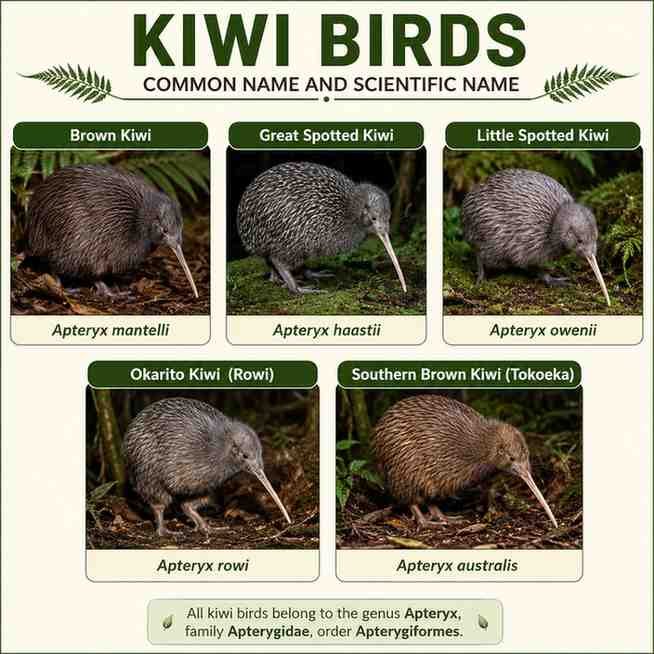
There are five living kiwi species, each found in different parts of New Zealand.
1. Brown Kiwi
Scientific Name: Apteryx mantelli
The brown kiwi is the most common kiwi species. It lives mainly in the North Island and inhabits native forests, scrublands, and fields with dense vegetation.
Key features
- Brown feathers
- Long bill
- Excellent sense of smell
- Nocturnal behavior
2. Great Spotted Kiwi
Scientific Name: Apteryx haastii
The great spotted kiwi is the largest kiwi species. It lives in mountainous forests and alpine areas of the South Island.
Key features
- The largest kiwi species
- Gray-brown spotted feathers
- Lives at higher elevations
- Mainly active at night
3. Little Spotted Kiwi
Scientific Name: Apteryx owenii
The little spotted kiwi is the smallest living kiwi species. Most populations survive on predator-free islands and protected reserves.
Key features
- Small size
- Pale gray feathers
- Rare in the wild
- Protected through conservation programs
4. Okarito Kiwi (Rowi)
Scientific Name: Apteryx rowi
The rowi is one of the rarest kiwi species. It is found naturally only in the Okarito Forest on New Zealand’s South Island.
Key features
- Gray plumage
- Limited distribution
- Endangered population
- Intensive conservation efforts
5. Southern Brown Kiwi (Tokoeka)
Scientific Name: Apteryx australis
The southern brown kiwi inhabits forests and coastal regions of the South Island and Stewart Island.
Key features
- Variable feather color
- Strong legs
- Excellent climber
- Mostly nocturnal
Kiwi Bird Habitat
Kiwi birds are endemic to New Zealand, meaning they occur naturally nowhere else on Earth.
Their preferred habitats include:
- Native forests
- Temperate rainforests
- Shrublands
- Grasslands
- Coastal forests
- Mountain forests
During the day, kiwi birds rest inside:
- Burrows
- Hollow logs
- Dense vegetation
- Tree root cavities
At night, they leave their shelters to search for food.
Where Do Kiwi Birds Live?
| Species | Distribution |
|---|---|
| Brown Kiwi | North Island |
| Great Spotted Kiwi | Northwest South Island |
| Little Spotted Kiwi | Offshore islands and reserves |
| Rowi | Okarito Forest |
| Southern Brown Kiwi | South Island and Stewart Island |
Kiwi Birds Diets
Kiwi bird eats, well, that’s how it is, the kiwi is a type of herbivorous bird that feeds mostly on the ground, and it actually searches for food with its long bill, in a kind of slow and cautious way.
Its nostrils sit at the end of its bill so that it can see prey under the soil.
What Do Kiwi Birds Eat?
The diet of kiwi birds includes earthworms, beetles, worms, larvae, centipedes, snails, spiders, slugs, as well as fruits and seeds. In addition, small berries and fungi occasionally appear in their diet.
Earthworms are often one of their favorite foods.
How Kiwi Birds Find Food
Unlike other birds, kiwi birds rely more on smell than you might think. They find prey by doing things like:
- Sniffing for buried insects
- Listening for rustling sounds
- Probing the soil with their long bills
- Scratching and digging in the ground using their strong feet
This hunting style is unusual among birds, as most others rely more on sight than on smell.
Physical Characteristics of Kiwi Bird
| Feature | Description |
|---|---|
| Scientific Name | Apteryx |
| Common Name | Kiwi |
| Average Length | 35–65 cm (14–26 in) |
| Weight | 0.9–3.5 kg (2–7.7 lb), depending on species |
| Wings | Tiny and non-functional |
| Tail | Absent |
| Activity | Nocturnal |
| Lifespan | Up to 40–50 years in protected conditions |
Interesting Facts About Kiwi Birds
Kiwis, cool-natured birds, are found only in New Zealand, not really anywhere else. They are also the national symbol of New Zealand, which is neat because you don’t see something like that very often. Their “feathers” don’t look like normal bird feathers, more like coarse hairs. And the nostrils are right at the end of the bill, which is a rare setup among birds; most have them somewhere else.
Kiwis also have strong legs, like really strong, and those legs weigh about a third of their entire body weight. Their eggs are large relative to their body size, the largest of any living bird. They can’t fly because their wings are small and kind of useless there. They also make loud calls, especially when the breeding season is on, so you can hear them at night.
Conclusion
The scientific name for a kiwi bird is Apteryx, a genus that includes five species of flightless birds, and yes, they all live only in New Zealand. With their long bills, hair-like plumage, muscular legs, and nocturnal lifestyle, kiwi birds are truly unlike any other bird out there. Learning about the classification, habitat, diet, and different species, in addition to the scientific name, helps you understand why they are such a special part of nature. Conservation work is still ongoing, and it aims to protect these remarkable birds, so they continue to be a timeless symbol of New Zealand’s natural heritage.
Also Read:
- Discover Dodo Bird Scientific Name and Proper Classification
- High Flying Birds Scientific Name | Top Highest Flying Birds Names List
- Turkey Scientific Name, Genus, Meaning, Types, and Facts
- Owl Scientific Name, Genus, Habitats, Diets, and Types
FAQs
What is the scientific name of a kiwi bird?
The scientific name of the kiwi bird is Apteryx, which is the genus containing all five living kiwi species.
What does Apteryx mean?
Apteryx comes from Greek words meaning “without wings.”
How many kiwi species are there?
There are five recognized living species of kiwi.
Where do kiwi birds live?
Kiwi birds are native to New Zealand, where they inhabit forests, shrublands, and protected reserves.
What do kiwi birds eat?
Their diet includes earthworms, insects, beetles, larvae, spiders, snails, fruits, seeds, and berries.
Can kiwi birds fly?
No. Kiwi birds are completely flightless and have very small, non-functional wings hidden beneath their feathers.

