What is the scientific name of peacock? The peacock scientific name is Pavo cristatus.
The peacock, a bird famous for its magnificent tail feathers, plays an important role worldwide and is widely recognized in various cultures. The scientific name of the peacock is a frequent search query for people who want to get a clearer idea of the bird’s biological identity. This bird is classified within the pheasant family and exhibits characteristics of both ground-living and forest-habitat preferences. The peacock can be seen in many contexts; it is, in fact, a common subject throughout history, religion, and wildlife studies.
Table of Contents
The article discusses the scientific name of the peacock, as well as its species, habitat, diet, and different types in detail, using authoritative and accurate biological information.
What is the scientific name of the peacock?
The Pavo cristatus is the scientific name of the peacock.
The scientific name has been given according to the binomial nomenclature system, which consists of two parts:
- Genus: Pavo
- Species: cristatus
The scientific name of the peacock is an important tool in biological classification and scientific research to identify the bird. The name Pavo cristatus is exclusively for the Indian peafowl, which is the most common species of peacock.
Meaning of the Scientific Name of Peacock
The scientific name of the peacock is derived from Latin.
- Pavo: peafowl
- Cristatus: crested
This term describes the bird’s head and general appearance. The scientific name of the peacock accurately identifies its physical characteristics.
Biological Classification of Peacock
Birds classified in this genus possess the same body structure, behavior, and feather patterns. The species of the pavo genus are found primarily in Asia, and they include peacocks.
The biological classification describes the peacock’s place in the kingdom of animals.
| Rank | Classification |
|---|---|
| Kingdom | Animalia |
| Phylum | Chordata |
| Class | Aves |
| Order | Galliformes |
| Family | Phasianidae |
| Genus | Pavo |
| Species | cristatus |
The classification also reiterates that the peacock is closely related to pheasants and junglefowl, as they all belong to the same family.
Genus of the Peacock
The genus of the peacock is Pavo. The genus Pavo contains two living species:
- Pavo cristatus: Indian peafowl
- Pavo muticus: Green peafowl
The Indian peafowl is native to the Indian subcontinent, while the green peafowl is native to parts of Southeast Asia.
The term peacock is often used as a general name for peafowl, but scientifically it is more accurate to identify the species by its scientific name.
Peafowl Body Features
The Indian peafowl has features that make it easy to find. The male has a long set of upper tail feathers that are well developed. He displays these feathers during courtship.
The male also has a crest on his head. Its neck and chest are blue, and its wing pattern is detailed. Females are usually lighter in color. They do not have the long train that males have. This difference is called sexual dimorphism.
| Physical Trait | Male (Peacock) | Female (Peahen) |
|---|---|---|
| Age & Lifespan | 15–20 years (wild), 25+ years (captivity). Matures at 3 years. | 15–20 years (wild), 25+ years (captivity). Matures at 2 years. |
| Weight | 3.8 to 6 kg (8.5 to 13 lbs) | 2.8 to 4 kg (6 to 9 lbs) |
| Total Length | 1.8 to 2.5 meters (70 to 98 inches) | 0.9 to 1.1 meters (35 to 43 inches) |
| Tail Length | 1.4 to 1.6 meters (55 to 63 inches) | Short, stiff dark brown feathers |
| Height | 0.9 to 1.3 meters (3 to 4.2 feet) | 0.7 to 0.9 meters (2.3 to 3 feet) |
| Wingspan | 1.3 to 1.6 meters (51 to 63 inches) | 0.8 to 1.3 meters (31 to 51 inches) |
| Coloration | Iridescent blue or green head, neck, and breast | Muted brown, grey, and cream with green neck sheen |
| Head Features | White eye patches, blue-tipped fan crest | White eye patches, dull brown/green tufted crest |
| Legs & Feet | Grey-brown legs with 2.5 cm fighting spurs | Grey-brown legs, usually no spurs |
Male Peacock and Female Peahen
A male peafowl is called a peacock, while a female is called a peahen. Together, they are called peafowl.
The main differences include:
| Feature | Peacock | Peahen |
|---|---|---|
| Sex | Male | Female |
| Display train | Long and developed | Much shorter |
| Color | Bright blue and green | More subdued |
| Courtship display | Performs display | Observes potential mates |
| Crest | Present | Present but less prominent |
Peacock Habitat
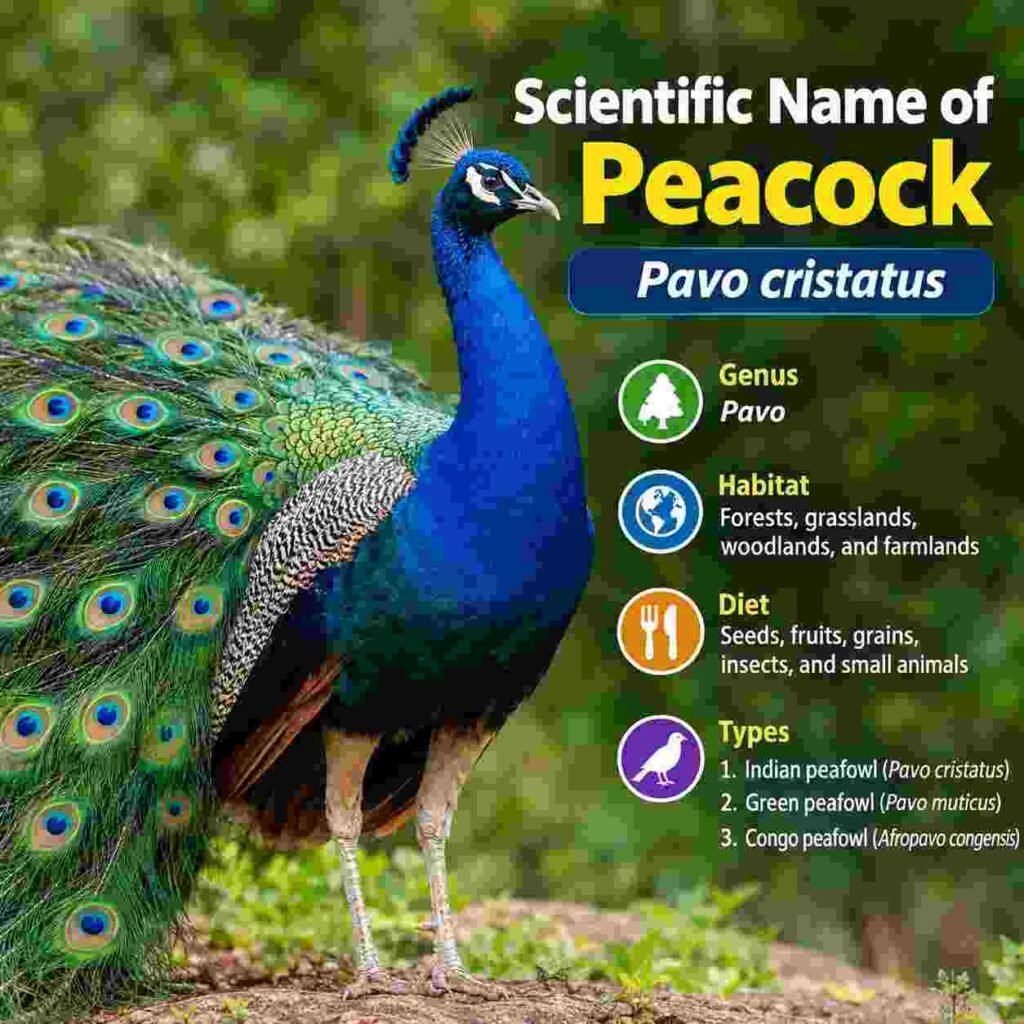
The Indian peafowl lives in a variety of habitats. You can find it in deciduous forests, scrublands, grasslands, farmlands, and forest edges. In some regions, it also lives near villages and towns.
Peafowl usually look for three things.
- Food
- Water
- Safe cover from predators
They do a lot of moving on the ground. Still, they also use trees to sleep. At night, peafowl may fly up into trees. This helps keep them out of reach of many ground hunters.
Indian peafowl can live near people too. This happens when food, water, and shelter are nearby.
Where Does the Peacock Live?
Most Indian peafowl are found in the Indian subcontinent. Their native range covers parts of India, Pakistan, Sri Lanka, Nepal, and nearby areas.
India holds a large share of their natural range. People have also placed the species in other parts of the world outside its original area.
In general, peafowl are often seen in dry and wet forests. They also use forest margins, fields, and open spaces near woodland.
Peacock Habitat in the Wild
In the wild, peafowl use their surroundings in different ways.
During daylight hours, they often walk through open areas. They search for food there. When they need to hide, they may use dense plants for protection. For night roosting, trees matter a lot.
Water can change where peafowl spend time. Even so, they can handle different conditions. They can live in places that vary in weather and plant cover.
What Does a Peacock Eat?
The peacock is an omnivore. It eats both plant and animal items.
Common foods include:
- Seeds
- Grains
- Fruits
- Berries
- Young shoots
- Leaves
- Flower parts
- Insects
- Termites
- Ants
- Small reptiles
- Other small animals
What it eats can shift with the season. It also depends on what is present in its local habitat. Feeding plans vary with the season and what food is available nearby in their habitat.
Peacocks often forage on the ground. They use their beaks to collect seeds, plant fragments, insects, and other small objects. A peacock’s diet changes throughout the year.
The diet is not the same each month. During times when insects are easier to find, the peacock may eat more insects and other small animals. When seeds, fruits, and plant parts are more common, they may eat more of these foods.
This method of varying what they eat helps the Indian peafowl adapt to different habitats.
Peacock Types
There are three recognized living species of peafowl. Two belong to the genus Pavo, while the third belongs to the genus Afropavo.
Peacock Types Listed Table
| Type of Peacock / Peafowl | Scientific Name | Main Feature |
|---|---|---|
| Indian Peafowl | Pavo cristatus | Blue neck and long train |
| Green Peafowl | Pavo muticus | Green body and train |
| Congo Peafowl | Afropavo congensis | Smaller African peafowl |
| Blue Peacock | Pavo cristatus | Common blue-colored variety |
| White Peacock | Pavo cristatus | White plumage caused by a color mutation |
| Black-Shouldered Peacock | Pavo cristatus | Darker wing and shoulder pattern |
| Spalding Peacock | Pavo muticus hybrid lineage | Green-based ornamental type |
| Indian Blue Peacock | Pavo cristatus | Blue body and colorful train |
| Pied Peacock | Pavo cristatus | White patches mixed with normal plumage |
| Midnight Peacock | Pavo cristatus | Dark blue and black appearance |
| Cameo Peacock | Pavo cristatus | Brown and bronze color pattern |
| Purple Peacock | Pavo cristatus | Purple-toned plumage |
| Bronze Peacock | Pavo cristatus | Bronze-colored feather pattern |
| Opal Peacock | Pavo cristatus | Gray-blue and opal-like coloration |
| Peach Peacock | Pavo cristatus | Peach or light tan coloration |
Also Read:
- Turkey Scientific Name, Genus, Meaning, Types, and Facts
- Discover Chicken Scientific Name, Species, and Hen Biological Classification
- Ground Birds Scientific Names
FAQs:
What is the scientific name of a peacock?
The scientific name of the Indian peacock is Pavo cristatus.
What is the genus of peacock?
The genus of the Indian peafowl is Pavo.
What family does the peacock belong to?
The Indian peafowl belongs to the Phasianidae family.
Where does the peacock live?
The Indian peafowl is native to the Indian subcontinent and lives in forests, woodland, grasslands, agricultural areas, and areas near human settlements.
What does a peacock eat?
Peafowl are omnivores. They eat seeds, grains, fruits, plant material, insects, and other small animals.
What are the types of peafowl?
The three living peafowl species are Indian peafowl (Pavo cristatus), green peafowl (Pavo muticus), and Congo peafowl (Afropavo congensis).