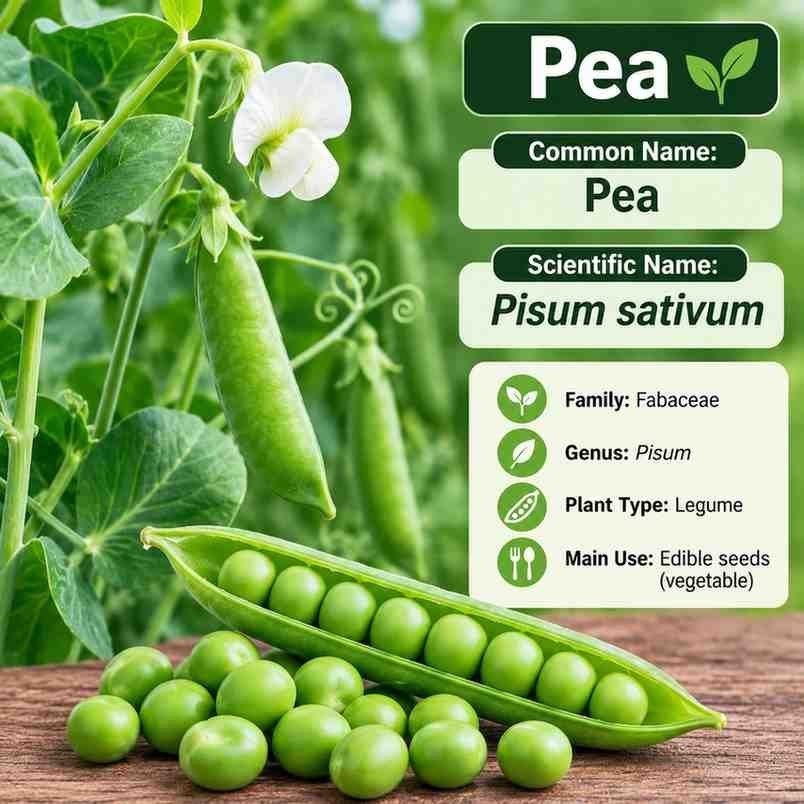
What is the scientific name of a pea? The garden pea scientific name is Pisum sativum.
Peas are one of the most significant food plants and are grown in various regions around the world. It is considered a vegetable in many uses and is prized for its nutritional value, ease of cultivation, and its role in the ecosystem. The pea’s scientific name, botanical details, classification, and health benefits are some of the topics that students, gardeners, and general readers often search for. This piece of writing, with the help of easy language and accurate biological knowledge, outlines everything in detail.
Table of Contents
What Is the Pea Scientific Name?
The scientific name of a pea (Pisum sativum) is the one under which the plant is recognized globally in botany, biology, and agriculture.
Scientific Name Meaning and Pronunciation
Meaning:
- Pisum is the Latin term for pea
- Sativum denotes cultivated or grown by humans
Thus, Pisum sativum translates to “cultivated pea.”
Pronunciation:
- PIE-sum suh-TEE-vum
Biological Classification of Pea Plants
| Rank | Classification |
|---|---|
| Kingdom | Plantae |
| Division | Magnoliophyta |
| Class | Magnoliopsida |
| Order | Fabales |
| Family | Fabaceae |
| Genus | Pisum |
| Species | Pisum sativum |
Peas are part of the legume family, known for their seed pods and ability to improve soil.
What is the genus of peas?
You know that the genus of peas is Pisum. I mean, that’s what you usually see first in scientific labeling. The full scientific name of a peas is Pisum sativum, and there it breaks down like this:
- Pisum = genus
- sativum = species name
Therefore, the genus Pisum includes the pea plant and other closely related groups of plants. And the cultivated pea, Pisum sativum, is a related species of pea grown primarily in gardens and fields for food.
What is the pea family?
Peas are in the Fabaceae family. Fabaceae is one of the major plant families and includes many economically important crops. In fact, members of this family are often called legumes.
For example, you can find:
- Pea: Pisum sativum
- Chickpea: Cicer arietinum
- Lentil: Lens clinaris
- Soybean: Glycine max
- Common bean: Phaseolus vulgaris
- Peanut: Arachis hypogaea
In addition, many legumes form a helpful partnership with nitrogen-fixing bacteria. These bacteria live in the roots as well as in the nodules. As a result, the availability of nitrogen in the field soil can be improved, which is a major reason for the importance of these plants.
Characteristics of the Pea Plant
The pea plant is a small herbaceous plant that is usually grown as an annual crop.
Its main characteristics include:
- Green stems
- Compound leaves
- Tendrils in wide cultivated varieties
- White, pink or purple flowers
- Elongated seed pods
- Round or slightly irregular seeds
- Shallow to moderately deep roots.
Pea plants can grow as a climber or as a shrub, depending on the variety.
Pea plant leaves:
Pea plant leaves are compound and have multiple leaflets. The upper portions of many pea plants send out tendrils (thin, curling structures) that help them climb and support themselves.
Those tendrils can grab onto nearby structures, other plants, or any sturdy object around it.
Pea Plant Flowers:
Pea plants produce flowers that are typically white, pink, or purple, depending on the variety.
The flowers develop into pods after successful pollination and fertilization.
Pea Pods:
Pea pods contain the seeds that people typically eat, primarily the peas themselves. The shape, size, color, and even texture of the pods can vary greatly depending on the variety. Some varieties are grown mostly for their seeds, while others are grown primarily for their edible pods, not just the seeds.
Types of Peas
There are a few major types of peas grown for food and farming purposes. They vary widely in the character of the pod, how the seeds ripen, when they are picked, and even how you cook them.
1. Garden Peas
Garden peas are sometimes called English peas or shelling peas.
Typically, you remove the seeds from the pod, as mature pods are not generally considered a vegetable. Garden peas can be eaten fresh, frozen, canned, or dried.
Common things you may notice.
- The seeds may be round or wrinkled.
- Fresh produce often shows green seeds.
- The pods usually have shells.
- A sweet flavor if picked at the right time.
2. Snow peas
Snow peas are grown for their flat, soft pods. The entire pod is eaten, including the tiny seeds that are still developing inside.
Snow peas often appear in:
- Stir-fries
- Salads
- Vegetable dishes
- Asian-style cooking
3. Snap peas
Snap peas are also known as sugar snap peas.
They form thick, crunchy pods with fairly well-formed seeds. Both the pod and the seeds are safe to eat. Snap peas are usually eaten immediately, as they stay crisp and have a slightly sweet flavor.
4. Field peas
Field peas are grown primarily for a wide range of agricultural and food uses. Some varieties are grown as dry peas, while others are used as animal feed, cover crops, or for soil management.
Field pea production is important in many temperate farming areas, such as those with fairly consistent growing seasons.
5. Dry peas
Dried peas are harvested after the seed has matured and then dried.
They can be used in such foods as:
- Pea soups
- Stews
- Purees
- Dried bean dishes
Green and yellow are common forms of dried peas.
Popular types of Peas
| Type of Pea | Scientific Name |
|---|---|
| Garden Pea | Pisum sativum |
| English Pea | Pisum sativum |
| Green Pea | Pisum sativum |
| Shelling Pea | Pisum sativum |
| Snow Pea | Pisum sativum var. saccharatum |
| Sugar Snap Pea | Pisum sativum var. macrocarpon |
| Field Pea | Pisum sativum |
| Dried Pea | Pisum sativum |
| Yellow Pea | Pisum sativum |
| Marrowfat Pea | Pisum sativum |
| Split Pea | Pisum sativum |
| Wrinkled Pea | Pisum sativum |
| Dwarf Pea | Pisum sativum |
| Climbing Pea | Pisum sativum |
| Purple-Podded Pea | Pisum sativum |
| White-Podded Pea | Pisum sativum |
| Edible-Pod Pea | Pisum sativum |
| Field Garden Pea | Pisum sativum |
| Spring Pea | Pisum sativum |
| Winter Pea | Pisum sativum |
Peas Varietes
Different varieties of Pisum sativum have been developed for different climates, planting windows, pod characteristics, and farming goals, depending on where and why they are grown.
Some common pea cultivar names include:
- Alaska
- Green Arrow
- Lincoln
- Little Marvel
- Wando
- Progress No. 9
- Alderman
- Oregon Sugar Pod
- Sugar Ann
- Cascadia
Uses of Pea Plant
So, when it comes to food production, land work, and even home gardening, the pea plant has many uses. It is useful in many ways, not only as a snack-type thing but also more practically.
1. For human consumption
Peas are commonly eaten as a vegetable as well as a legume. People often eat fresh peas either cooked or added to other foods such as soups, rice dishes, pasta, salads, stews, curries, or mixed vegetables. Sometimes they are used as a kind of ingredient filler, but they still have value.
2. Frozen Peas
After harvesting, peas are often frozen. This keeps them fresh for a longer period of time, while still maintaining their texture and nutritional quality. So you could say that freezing is a storage method that helps keep things “fresh” for later.
3. Canned Peas
There are also canned peas. This processing is easy because you can easily store the peas and then use them throughout the year, no big fuss.
4. Dried Peas
Ripe pea seeds can be preserved by drying them. The dried peas are then featured in soups, stews, and other cooked dishes where they can be rehydrated and softened.
5. Animal Feed
Some pea crops and some byproducts are also used for livestock. Pea seeds contain protein and other nutrients, so they can straightforwardly contribute to animal diets.
6. Cover Cropping
Field peas can be used as a cover crop. Growing them can help protect the soil from erosion and add organic matter when the plant residues are returned to the soil.
Benefits of Peas
The benefits of peas really come from what they carry inside, like nutrients, fiber, plant protein, vitamins, and minerals. At the same time, peas are easy to incorporate into meals, so it makes sense that people keep them around.
1. Peas Provide Plant Protein
Peas contain a bit more protein than many common non-legume vegetables. Protein helps maintain, repair, and even rebuild body tissues as the body grows and moves.
Pea protein is also extracted commercially and is used in some plant-based foods.
2. Peas Provide Dietary Fiber
Peas come with dietary fiber, which supports normal digestion.
If one eats enough fiber, it can support steady bowel movements and generally help keep digestive health on track in a calm manner.
3. Peas provide vitamin C
Fresh green peas contain vitamin C. Vitamin C supports normal immune function, and it also helps protect cells from oxidative stress.
4. Peas support a balanced diet
Peas pack a punch of carbohydrates, protein, fiber, as well as vitamins and minerals. So if you add peas to a variety of dishes, it can boost a variety of nutrients without any fuss.
5. Peas provide folate
Peas contain folate, which is a B vitamin. Folate matters for normal cell division and for the formation of DNA; that part is very important.
6. Peas contain antioxidant compounds
Peas contain several plant compounds, such as polyphenols and carotenoids.
These types of compounds increase the overall antioxidant capacity of the food, and these vegetables help with the protective angle of eating.
Nutritional Value of Peas
Peas provide several important nutrients.
They contain:
- Protein
- Dietary fiber
- Carbohydrates
- Vitamin C
- Vitamin K
- Folate
- Vitamin A
- Iron
- Potassium
- Manganese
The exact nutritional content varies according to the type of pea, maturity, preparation method, and serving size.
Interesting Facts About Peas
Here are some useful facts about the pea plant:
- The scientific name of pea is Pisum sativum.
- Peas belong to the Fabaceae family.
- The genus of pea is Pisum.
- Peas are legumes.
- Garden peas are also called English peas or shelling peas.
- Snow peas are harvested for their edible pods.
- Sugar snap peas have edible pods and developed seeds.
- Pea plants can form root nodules containing nitrogen-fixing bacteria.
- Peas are a source of plant protein and dietary fiber.
- Peas are widely used fresh, frozen, canned, and dried.
Also Read:
- Corn Scientific Name, Genus, Types, Parts, Uses, and Benefits
- Rice Scientific Name, Genus, Habitat, Facts, Uses, and Types
- Mustard Scientific Name, Genus, Uses, Benefits, and Types
- Scientific and Botanical Name of Wheat, Types, Uses, and Nutrition
FAQs
What is the scientific name of pea?
The scientific name of a pea is Pisum sativum.
What is the genus of pea?
The genus of pea is Pisum.
What is the family of pea?
The pea belongs to the Fabaceae family.
Is pea a legume?
Yes. Pea is a legume because it belongs to the Fabaceae family.
What are the main types of peas?
The main types of peas include garden peas, snow peas, snap peas, field peas, and dried peas.
Are green peas vegetables?
Fresh green peas are commonly classified as vegetables in culinary use, but botanically they are legumes.
What are the uses of peas?
Peas are used as fresh vegetables, frozen foods, canned foods, dried legumes, animal feed, and agricultural cover crops.