What is the scientific name of garlic? The garlic scientific name is Allium sativum.
Garlic is one of the most beneficial and healing plants worldwide, valued for its flavor, biological properties, and health benefits. By learning about its biological classification, binomial name, the meaning of the scientific name, and its nutritional value, one gains a comprehensive understanding of this robust plant.
Table of Contents
What is the Scientific Name of Garlic?
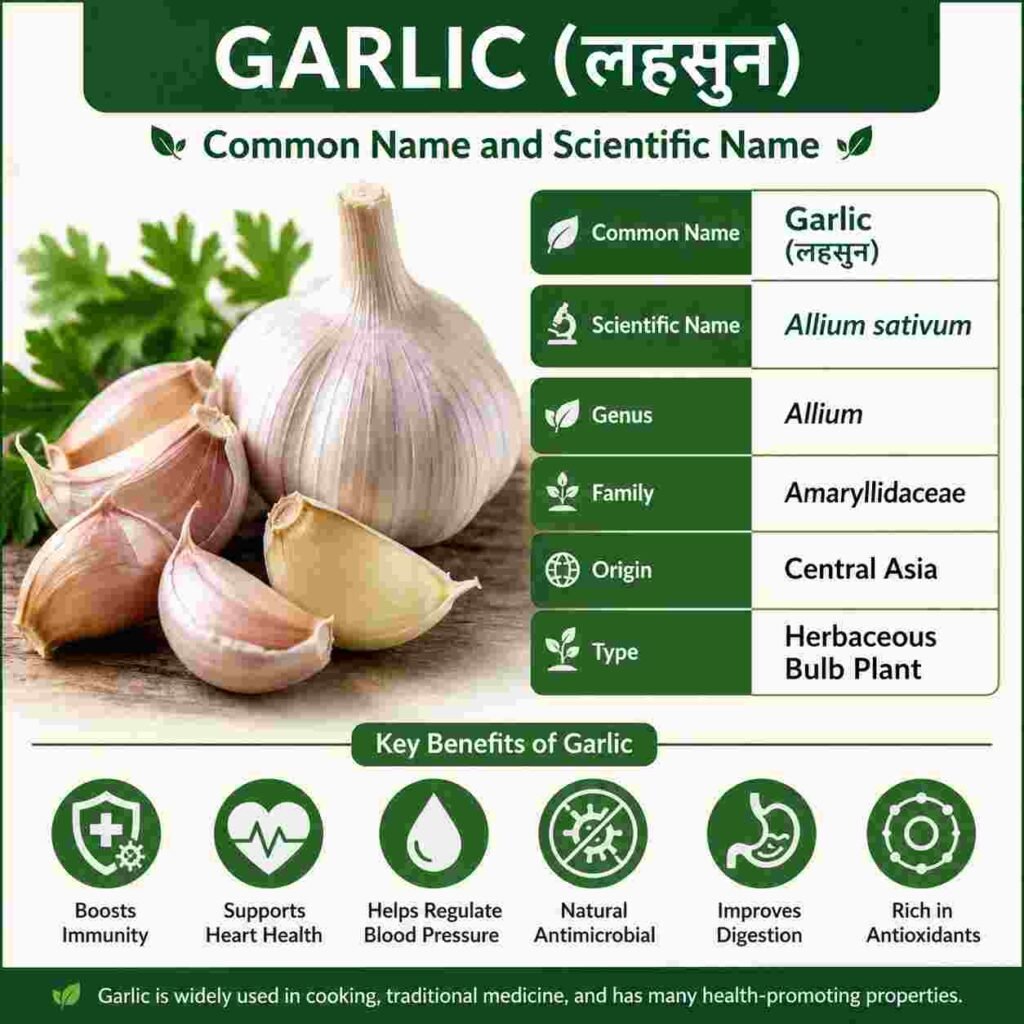
Allium sativum is the scientific name of garlic.
- Genus: Allium
- Species: sativum
Garlic scientific name means:
- Allium: The genus name, which is shared with onions, leeks, and chives, comes from an Indo-European root that is interpreted as “to bend or turn,” perhaps indicating the shape of the leaf.
- sativum: A Latin term which implies “planted” or “cultivated,” asserting that garlic is a crop that has been purposely grown.
Pronunciation of scientific name of garlic:
Garlic’s binomial name is Allium sativum, pronounced as AL-ee-əm sah-TIE-vəm.
The following is a pronunciation breakdown:
- Allium is pronounced as AL-ee-əm, where the stress is on the first syllable.
- sativum is pronounced as sah-TIE-vəm.
Biological Classification Of Garlic
The biological classification of garlic helps identify its position in the plant kingdom.
| Kingdom | Plantae |
| Division | Magnoliophyta |
| Class | Liliopsida |
| Order | Asparagales |
| Family | Amaryllidaceae |
| Subfamily | Allioideae |
| Genus | Allium |
| Species | Allium sativum |
Origin and Distribution of Garlic
Garlic is believed to have originated in Central Asia, where it has been cultivated without interruption for thousands of years. From there, it spread to the Middle East, then Europe, Africa, and later the Americas.
Today, garlic can be found in almost every region of the world. If you look at where it is most widely grown, the main garlic-producing countries are generally listed as China, India, Bangladesh, Egypt, South Korea, Spain, Argentina, and the United States.
For best growth, garlic likes well-drained soil, plenty of sunlight, and temperatures that are moderate, not too hot.
Common Names of Garlic
Different names around the world are used for garlic.
| Language | Common Name |
|---|---|
| English | Garlic |
| Scientific Name | Allium sativum |
| Botanical Name | Allium sativum |
| Hindi | Lahsun |
| Urdu | Lehsan |
| Spanish | Ajo |
| French | Ail |
| Chinese | Suàn (蒜) |
Characteristics of Garlic Plants
Garlic is a perennial bulbous plant that people commonly grow as if it were an annual vegetable, so it behaves as such in gardens.
Bulb:
The underground bulb is essentially made up of several separate cloves, each wrapped in a thin papery skin. Depending on the variety, a bulb usually contains 8 to 20 cloves.
Leaves:
Garlic produces long, narrow, flat green leaves that grow straight from the bulb, almost like little blades that stay straight.
Flowers:
Some garlic varieties send up flower stalks, often called scapes. This scape bears small white or pink flowers. However, widely cultivated varieties of garlic will not really produce seeds that you can rely on, or any viable seeds at all.
Height:
Garlic plants are typically about 30-90 cm (12-36 in) tall.
Types of Garlic
Two major types of garlic are grown around the world.
1. Hardneck Garlic (Allium sativum var. ophioscorodon)
Hardneck garlic produces one central flower stalk, the scape, and it does well in cool weather. It is also said to have a deep flavor, rich in a way that people often overlook.
Popular hardneck varieties include:
- Rocambole
- Porcelain
- Purple Stripe
- Marbled Purple Stripe
- Glazed Purple Stripe
- Asiatic
- Turban
- Creole
2. Softneck Garlic (Allium sativum var. sativum)
Softneck garlic does not produce a rigid flower stalk and stores longer than hardneck garlic.
Popular softneck varieties include:
- Artichoke Garlic
- Silverskin Garlic
Nutritional Value of Garlic
Garlic is rich in vitamins, minerals, and natural sulfur-containing compounds.
- Nutrients Found in Garlic
- Vitamin C
- Vitamin B6
- Manganese
- Selenium
- Calcium
- Potassium
- Phosphorus
- Iron
- Copper
- Fiber
Garlic also contains allicin, a sulfur compound formed when garlic is crushed or chopped, which contributes to its characteristic aroma and biological activity.
Uses of Garlic
Garlic is one of the most versatile plants and is used in many ways.
Culinary Uses of Garlic:
- Flavoring soups and sauces
- Cooking meat and seafood
- Vegetable dishes
- Pickles
- Salad dressings
- Bread and pasta recipes
Traditional Uses of Garlic:
Garlic has been used for centuries in traditional medicine systems across many cultures.
Agricultural Uses of Garlic:
- Natural pest management
- Companion planting
- Organic gardening
Industrial Uses of Garlic:
Garlic extracts are also used in dietary supplements, cosmetics, and food processing.
Health Benefits of Garlic
Garlic has been studied extensively, and yes, for its nutritional and biological properties, in great detail. Research shows that garlic provides antioxidant compounds and also supports what we might call normal immune function. If consumed as part of a balanced diet, it may help maintain cardiovascular health. Some studies have suggested that it contains natural antimicrobial compounds. In some individuals, garlic may contribute to normal cholesterol management, and it may also support healthy blood pressure when everything else, such as diet and lifestyle, stays on track. Well-being may also benefit when garlic is consumed regularly as part of this balanced diet.
That said, the actual health effects are not always the same for everyone. They may vary based on the amount consumed, how it is prepared, and individual health conditions.
Interesting Facts About Garlic
- Garlic has been cultivated for over 5,000 years.
- It belongs to the same genus (Allium) as onions, shallots, leeks, and chives.
- China is the largest garlic producer in the world.
- Garlic bulbs are made up of several cloves wrapped in a protective skin.
- Fresh garlic acquires its distinctive aroma when the cloves are cut or crushed, as allicin is formed during this process
Also Read:
- Scientific Names of Vegetables: Cruciferous, Leafy, and Root List
- Tomato Scientific Name, Types, Uses, Benefits, and Plant
- Chili Scientific Name, Genus, Types, Uses, and its Benefits
- Ginger Scientific Name, Genus, Uses, Benefits, and Types
FAQs
What is the scientific name of garlic?
The botanical name of garlic is Allium sativum.
What family does garlic belong to?
Garlic belongs to the Amaryllidaceae family.
What is the genus of garlic?
The genus of garlic is Allium.
What are the main types of garlic?
No. Elephant garlic belongs to the species Allium ampeloprasum and is more closely related to true garlic (Allium sativum).