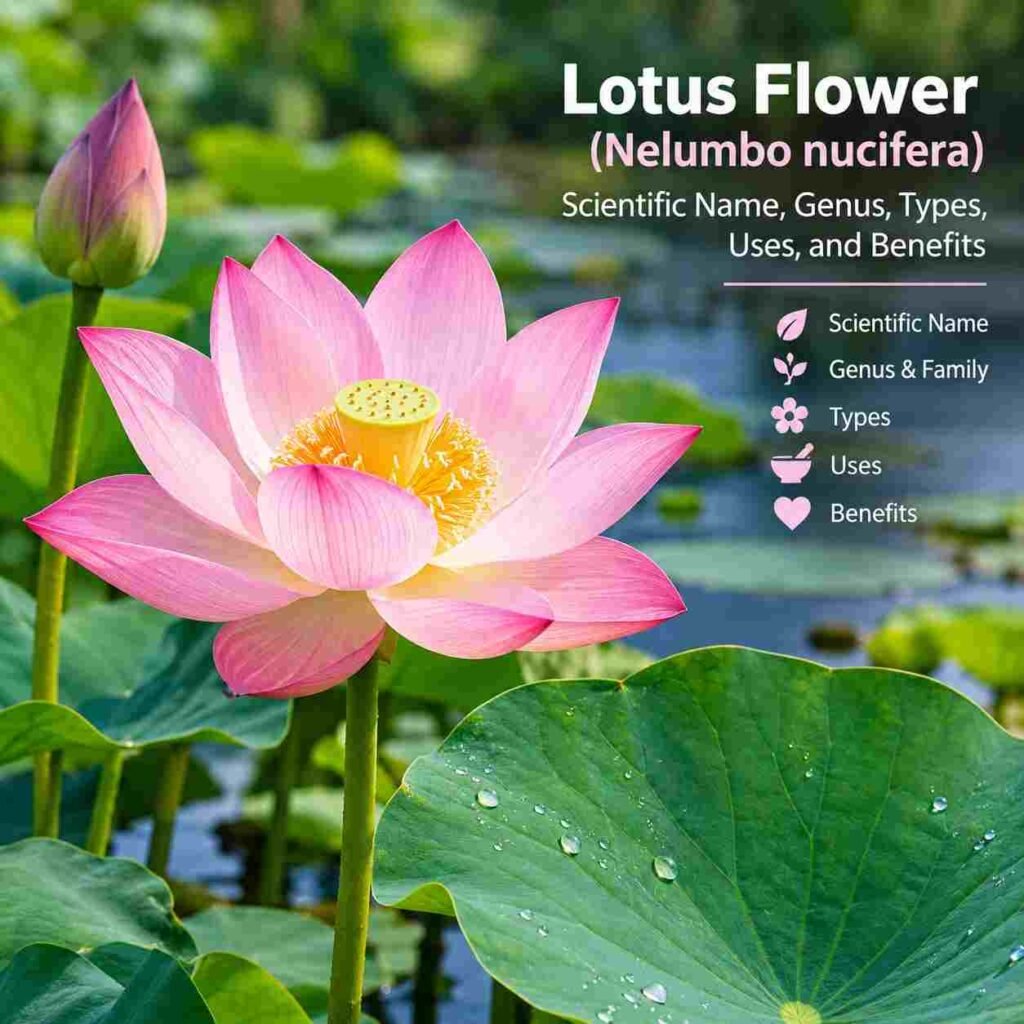
What is the scientific name of lotus flower? The Lotus flower scientific name is Nelumbo nucifera.
The lotus flower, whose scientific name is Nelumbo nucifera, is a remarkable and primitive plant that has been recognized for its spiritual, medicinal, and ecological advantages. Sacred lotus is the most preferred name to refer to this plant, which is still widely used in Asian culture, medicine, and cuisine. Knowing the lotus scientific name, Latin origin, and botanical classification sheds light on the exceptional characteristics of this flower.
Table of Contents
What is the scientific name of lotus flower?
The lotus scientific name is Nelumbo nucifera. Nelumbo is derived from a Sinhala word that means “blue water lily.”
Nucifera is a Latin term that means “nut-bearing,” and it refers to the plant’s seed pods.
| Word | Meaning |
|---|---|
| Nelumbo | Derived from a Sri Lankan word meaning aquatic plant |
| Nucifera | A Latin word meaning “nut-bearing” |
Thus, the lotus flower’s scientific name refers to a water plant that yields edible seeds.
Pronunciation:
- Nelumbo nucifera is pronounced as:
- neh-LUM-bo new-SI-fe-rah
Biological Classification of Lotus Flower
| Taxonomic Rank | Classification |
|---|---|
| Kingdom | Plantae |
| Clade | Tracheophytes |
| Clade | Angiosperms |
| Clade | Eudicots |
| Order | Proteales |
| Family | Nelumbonaceae |
| Genus | Nelumbo |
| Species | nucifera |
The lotus flower is kept in its own separate family.
Lotus Flower Age and History
How Old Is the Lotus Flower?
The lotus has the honor of being one of the most ancient plants still existing on our planet; it has been around for more than 140 million years.
Why Lotus Is Not a Water Lily:
Despite their resemblance, lotus and water lily are different. The former is classified as Nelumbonaceae, and the latter is in Nymphaeaceae, which is the family of water lilies.
Cultural History
- In Egypt, the lotus was a symbol of rebirth
- In India, it was a symbol of purity
- In Buddhism, it was a symbol of enlightenment
Lotus Flower Size and Physical Features
Average Size of Lotus Plant:
- Height: 3 to 6 feet
- Leaf diameter: up to 24 inches
- Flower width: 8 to 12 inches
Unique Structure:
The lotus plant develops in mud, yet its petals remain spotless because of a naturally occurring self-cleaning surface phenomenon known as the lotus effect.
| Feature | Description |
|---|---|
| Plant type | Aquatic perennial |
| Growth form | Herbaceous aquatic plant |
| Rhizomes | Grow in mud below the water |
| Leaves | Large, round, peltate leaves |
| Leaf stalks | Long stalks that can rise above the water |
| Flowers | Large, showy flowers |
| Flower colors | Commonly pink, white, or related shades |
| Fruit structure | Distinctive seed-bearing receptacle |
| Habitat | Ponds, lakes, marshes, lagoons, and wetlands |
Lotus leaves:
Lotus leaves are easy to notice. They are usually round. The stalk attaches close to the middle. It does not join at the rim.
In many cases, the leaves stand up from the pond. They sit on long stems. The leaf skin helps keep water from sticking. This is why people talk about the lotus effect.
Lotus flowers:
Lotus flowers are big. They grow up above the water line. Colors can vary. The shade depends on the type of lotus and the specific plant line.
Inside the flower, there is a central part. It holds many carpels. This center looks different from what you see in water lilies. That is one clear sign for many people.
Lotus seeds:
Lotus makes seeds in a special seed pod. The seeds are eaten in parts of Asia. People use them as a food ingredient.
You can eat lotus seeds in more than one way. Some are eaten fresh. Others are dried or roasted. They can also be turned into other foods. Lotus seed paste shows up in Chinese dishes too. It is also used in pastries.
What Are the Types of Lotus Flowers?
There are many cultivated lotus varieties, but at the species level, the genus Nelumbo has two accepted species according to Kew:
| Lotus Species | Common Name |
|---|---|
| Nelumbo nucifera | Sacred lotus or Asian lotus |
| Nelumbo lutea | American lotus |
Sacred Lotus
Scientific name: Nelumbo nucifera
The sacred lotus is the lotus species most commonly associated with Asia. It grows naturally across parts of Asia and Australia and has a long cultivation history. It is used as an ornamental plant and for food and cultural purposes.
American Lotus
Scientific name: Nelumbo lutea
The American lotus is native to eastern and central parts of North America. It is another accepted species in the genus Nelumbo.
Cultivated Lotus Varieties
Beyond the two accepted species, gardeners have developed many cultivated lotus varieties. They can vary in flower color, flower shape, size, number of petals, and growth habit.
Cultivars may produce single, double, or more complex flower forms. Garden centers and botanical collections may use different cultivar names, so cultivar lists are much longer than the list of accepted species.
Lotus Flower Habitat
The natural habitat of the lotus includes shallow freshwater wetlands.
It can grow in:
- Ponds
- Lakes
- Marshes
- Lagoons
- Swamps
- Floodplains
- Reservoir backwaters
Flooded agricultural areas
Kew describes Nelumbo nucifera as an aquatic perennial that grows mainly in warm-temperate to tropical regions. Its rhizomes grow in mud beneath shallow water, while leaves and flowers rise toward or above the water surface.
Lotus generally thrives in full sunlight and nutrient-rich, wet soil. In cultivation, it is often grown in water gardens, ponds, and containers designed for aquatic plants.
Uses of Lotus Flower
The lotus plant shows up in daily food, garden work, cultural life, and older medicine practices.
Ornamental use
Lotus plants are often kept in ponds and water gardens. They have big leaves and showy blooms. People also use the flowers in simple decorations.
Food use:
In parts of Asia, people eat several lotus parts. The underground rhizomes are a common choice. They are sliced and then cooked in many ways, like frying, roasting, or pickling. Lotus seeds also get used in meals. Kew notes that rhizomes, seeds, young leaves, leaf stalks, and flowers show up across different cooking styles.
Lotus seed uses:
Lotus seeds go into soups and desserts. They also appear in snacks and in pastes. In Chinese cooking, lotus seed paste is used in some traditional pastries as a filling.
Traditional medicine:
Nelumbo nucifera has been used in traditional medicine for a long time. Lotus leaves, seeds, flowers, and rhizomes have been part of older preparations. Still, using a plant in traditional ways is not the same as proving it can stop, treat, or cure a health problem.
Cultural and religious use:
Lotus blooms matter in religious and cultural traditions. This is seen across South Asia and East Asia. Many people link the flower to purity, beauty, fresh beginnings, and spiritual growth.
Lotus flower benefits
There are practical and environmental upsides tied to the lotus.
Food source:
The lotus gives edible rhizomes, seeds, leaves, and flowers. It also offers other plant parts used in regional cooking.
Ornamental value:
The plant brings large leaves and flowers to ponds and water gardens. It can also fit in other outdoor landscape setups.
Cultural value:
The lotus has deep cultural weight in several Asian societies. It appears in religious art, architecture, ceremonies, and traditional practices.
Wetland Habitat:
Aquatic plants such as lotus contribute to wetland environments by providing structure and cover within shallow-water habitats.
Traditional Plant Use:
Lotus has been used in traditional medicine and food systems for centuries. Modern scientific research continues to examine compounds found in different parts of the plant.
Why Is Lotus Not a Water Lily?
Lotus and water lilies look similar because both are aquatic flowering plants. However, they are not the same plant. The lotus belongs to the family Nelumbonaceae, while true water lilies belong to the family Nymphaeaceae.
| Feature | Lotus | Water Lily |
|---|---|---|
| Lotus scientific name | Nelumbo nucifera | Different species in Nymphaeaceae |
| Family | Nelumbonaceae | Nymphaeaceae |
| Genus | Nelumbo | Several genera |
| Flowers | Usually rise above water | Often float on water |
| Leaves | Usually peltate and often elevated | Usually float on water |
| Center structure | Distinctive raised receptacle | Different flower structure |
| Plant group | Aquatic flowering plant | Aquatic flowering plant |
Also Read:
- Scientific Name of Flowers: Botanical, Latin & Biological Flower Names List
- Coneflower Scientific Name, Uses, Benefits, Types, Family, Genus, and Facts
- Sunflower Scientific Name, Genus, Types, Uses, and Benefits
- Jasmine Scientific Name, Genus Types, Uses, and Benefits
- Hibiscus Scientific Name and Uses: Benefits, Growth, and Meaning
FAQs
What is the scientific name of lotus flower?
The scientific name of lotus flower is Nelumbo nucifera.
What is the genus of lotus?
The genus of lotus is Nelumbo.
What is the family of lotus flower?
The lotus flower belongs to the Nelumbonaceae family.
Is lotus a water lily?
No, lotus and water lilies are different plants. Lotus belongs to Nelumbonaceae, while water lilies belong to Nymphaeaceae.
What are the main uses of lotus flower?
Lotus is used for food, ornamental gardening, cultural practices, and traditional medicine.
What are the types of lotus flower?
The two accepted lotus species are Nelumbo nucifera (sacred lotus) and Nelumbo lutea (American lotus). There are also many cultivated lotus varieties.