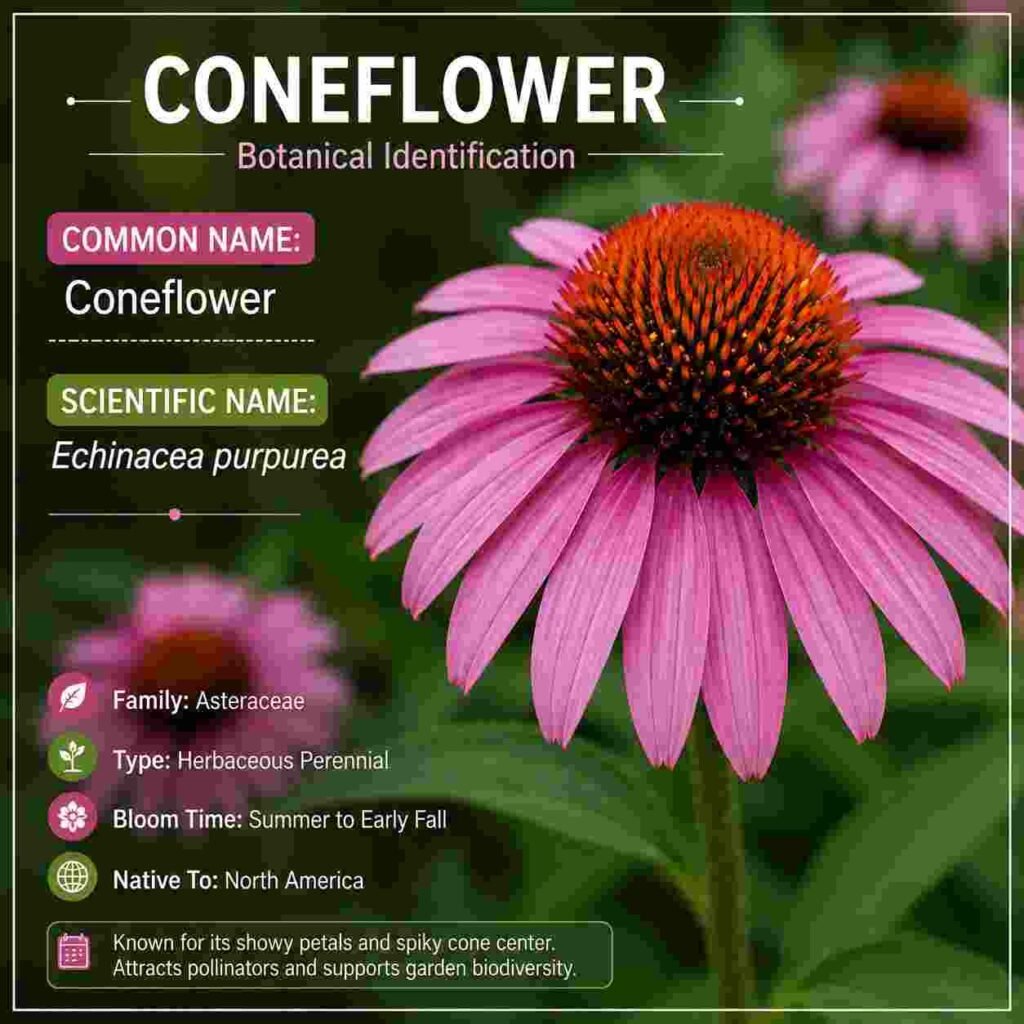
What is the scientific name of coneflowers? The common coneflower scientific name is Echinacea purpurea.
Coneflowers get a lot of attention because of their colorful blooms, how long they keep flowering, plus the fact that they can pull in pollinators. They are also among the easiest perennial flowers to grow, making them a favorite choice for home gardens, landscapes, and natural prairie plantings.
Although many people know this plant simply as coneflower, its botanical identity belongs primarily to the genus Echinacea, a group of flowering plants native to North America. The one you’ll see most, and the one most people recognize, is Echinacea purpurea, also called the purple coneflower.
Table of Contents
In this guide, we cover the coneflower scientific name and its botanical classification, family, genus, the various types, and its key characteristics. We also cover habitat, identification, and a bunch of other useful details. The latter sections go into the uses and benefits, as well as what they need to grow well.
What Is the Coneflower Scientific Name?
The scientific name of the common purple coneflower is Echinacea purpurea.
This is the most popular species grown in gardens around the world. However, the term coneflower refers to several species in the genus Echinacea.
Meaning:
The name Echinacea comes from the Greek word echinos, meaning hedgehog or sea urchin, referring to the plant’s spiny, cone-shaped central disk.
- Echinacea: From the Greek word echinos, meaning hedgehog or sea urchin (describing the spiky central cone).
- purpurea: Latin for purple.
Pronunciation:
The scientific name for the purple coneflower is Echinacea purpurea.
- Echinacea: pronounced eck-in-AY-sha
- Purpurea: pronounced per-per-EE-uh
Biological Classification of Coneflowers
| Classification Category | Details |
|---|---|
| Kingdom | Plantae |
| Division | Magnoliophyta |
| Class | Magnoliopsida |
| Order | Asterales |
| Family | Asteraceae |
| Genus | Echinacea |
| Most Common Species | Echinacea purpurea |
| Common Name | Coneflower |
| Plant Type | Herbaceous Perennial |
Coneflower family
The scientific name of coneflowers is tied to the Asteraceae family, which is one of the biggest flowering plant families in the world, like really huge.
The Asteraceae family covers a bunch of familiar flowering plants, for example:
- Sunflowers
- Daisies
- Marigolds
- Chrysanthemums
- Zinnias
- Asters
Plants in this family usually form flower heads that are made from lots of tiny, separate flowers grouped closely, so it looks like one big bloom, even though it’s more or less modular than that.
Coneflower genus
The genus Echinacea includes several species that naturally show up across the prairies, grasslands, and open woodlands in North America.
Most species also tend to have these kinds of shared traits:
- Raised cone-shaped flower center
- Drooping petals
- Strong stems
- Deep root systems
- Long blooming season
- High drought tolerance
Because of those traits, coneflowers are useful ornamental and ecological plants for pollinators and similar species.
Physical Characteristics of Coneflowers
Understanding the plant’s characteristics helps identify different species.
Plant Height
Most coneflowers grow between:
- 2–5 feet (60–150 cm)
Some cultivars remain compact, while others grow taller depending on the variety.
Leaves
Coneflower leaves are:
- Dark green
- Rough-textured
- Lance-shaped
- Slightly hairy
- Alternately arranged
Basal leaves are generally larger than those higher on the stem.
Flowers
The flowers are the plant’s most recognizable feature.
Each bloom includes:
- Drooping petals
- Large raised central cone
- Hundreds of tiny disk flowers
- Bright colors that attract pollinators
Flower colors include:
- Purple
- Pink
- White
- Yellow
- Orange
- Red
- Green
- Coral
Roots
Coneflowers develop deep taproots that:
- Improve drought tolerance
- Help plants survive dry periods
- Support perennial growth
Seeds
The central cone produces numerous seeds after flowering.
These seeds are:
- Dark brown
- Small
- Easy to collect
- Attractive to birds, especially goldfinches
Origin and Native Habitat
Coneflowers are native to North America, where they grow naturally in parts of the central and eastern United States and southern Canada.
They thrive in:
- Open meadows
- Grasslands
- Grassfields
- Woodland edges
- Roadsides
- Arid hillsides
Due to their adaptability, coneflowers have become popular ornamental plants around the world.
Types of Coneflowers
Although many gardeners recognize only the purple coneflower, there are several species and widely cultivated varieties.
Types of Coneflowers with Scientific Names
| Common Name | Scientific Name | Flower Color | Native Range |
|---|---|---|---|
| Purple Coneflower | Echinacea purpurea | Purple to Pink | Central and Eastern North America |
| Narrow-Leaved Coneflower | Echinacea angustifolia | Pink to Purple | Great Plains, North America |
| Pale Purple Coneflower | Echinacea pallida | Pale Pink to Lavender | Central United States |
| Yellow Coneflower | Echinacea paradoxa | Yellow | Ozark Region, United States |
| Tennessee Coneflower | Echinacea tennesseensis | Pink | Tennessee, United States |
| Smooth Purple Coneflower | Echinacea laevigata | Pink to Purple | Southeastern United States |
| Sanguine Purple Coneflower | Echinacea sanguinea | Pink to Purple | Central United States |
| Topeka Purple Coneflower | Echinacea atrorubens | Purple-Rose | Great Plains, United States |
| Wavy-Leaf Purple Coneflower | Echinacea simulata | Pale Pink | Central and Eastern United States |
| Mexican Hat Coneflower | Ratibida columnifera | Red and Yellow | North America |
| Gray-Headed Coneflower | Ratibida pinnata | Bright Yellow | North America |
| Prairie Coneflower | Ratibida columnifera | Yellow with Red | North America |
| Cutleaf Coneflower | Rudbeckia laciniata | Yellow | Eastern North America |
| Green-Headed Coneflower | Rudbeckia occidentalis | Greenish Brown | Western North America |
| Black-Eyed Susan Coneflower | Rudbeckia hirta | Yellow with Dark Brown Center | North America |
1. Purple Coneflower (Echinacea purpurea)
The most popular species.
Features:
- Purple-pink petals
- Large central cone
- Long blooming season
- Easy to grow
- Widely cultivated
2. Pale Purple Coneflower (Echinacea pallida)
Characteristics include:
- Long narrow petals
- Light lavender flowers
- Tall stems
- Prairie habitat
3. Narrow-Leaved Coneflower (Echinacea angustifolia)
Known for:
- Narrow leaves
- Compact growth
- Strong drought resistance
- Traditional herbal importance
4. Yellow Coneflower (Echinacea paradoxa)
Unlike most species, this coneflower produces:
- Bright yellow petals
- Golden flowers
- Unique ornamental appearance
5. Tennessee Coneflower (Echinacea tennesseensis)
A rare species native to Tennessee with:
- Upright petals
- Pink flowers
- Conservation significance
Uses of Coneflower
Coneflowers are known for their ornamental appeal, ecological role, and use as a traditional herbal backdrop. While some related species besides Echinacea purpurea have a long history of herbal care, most ornamental cultivars are grown primarily for landscaping or for that “garden look” people want. Before using Echinacea supplements for any medical reason, you should always talk to a qualified healthcare professional, just to be safe.
1. Ornamental Garden Plant
One of the primary uses of coneflowers is as an ornamental perennial. Their vivid flowers bloom for months, adding texture and extra vertical presence to flower beds.
Common landscaping uses include:
- Cottage gardens
- Pollinator gardens
- Prairie-style landscapes
- Mixed perennial borders
- Wildflower gardens
- Urban landscapes
- Container gardens (compact varieties)
2. Pollinator Plant
Coneflowers produce nectar and pollen that attract beneficial insects.
They support:
- Honey bees
- Native bees
- Bumblebees
- Butterflies
- Hoverflies
Planting coneflowers helps increase pollinator activity and contributes to healthy garden ecosystems.
3. Wildlife Plant
After flowering, the seed heads remain on the plant and provide food for birds.
Birds that commonly feed on coneflower seeds include:
- Goldfinches
- Chickadees
- Sparrows
Leaving seed heads through autumn and winter also adds seasonal interest to the garden.
4. Cut Flower
Coneflowers make excellent cut flowers because they:
- Have long, sturdy stems
- Last well in floral arrangements
- Pair well with many summer flowers
- Retain their color for several days in water
5. Dried Flower Arrangements
The seed heads and blooms are also used in dried flower displays, wreaths, and seasonal decorations.
6. Traditional Herbal Uses of Echinacea
Several Echinacea species, particularly Echinacea purpurea, Echinacea angustifolia, and Echinacea pallida, have been used traditionally by Indigenous peoples of North America and later in herbal medicine.
Today, Echinacea is commonly sold as:
- Herbal tea
- Capsules
- Tablets
- Liquid extracts
- Tinctures
Benefits of Coneflower
1. Attracts Pollinators
Coneflowers are among the best perennial flowers to attract:
- Honeybees
- Butterflies
- Beneficial insects
This helps improve pollination for nearby flowering plants and vegetables.
2. Drought-Tolerant
Once established, coneflowers tolerate dry conditions due to their deep root system.
This makes them ideal for:
- Water-wise gardens
- Xeriscaping
- Low rainfall areas
3. Low maintenance
Coneflowers require relatively little maintenance.
They generally need:
- Full sun
- Occasional watering during long dry spells
- Seasonal pruning
- Divide every few years if clumps become crowded.
4. Long Blooming Season
Cones bloom from early summer to early fall, providing continuous color after many spring flowers have bloomed.
5. Supports biodiversity
Growing native species of coneflowers supports local ecosystems by providing food and habitat for insects and birds.
6. Deer Resistance
Cones are considered moderately deer-resistant due to their thick foliage, although hungry deer may find them in some areas.
7. Rabbit Resistance
Mature plants are less attractive to rabbits than many tender-flowering plants, although young growth may occasionally be eaten.
8. Excellent Companion Plant
Cones pair well with many other perennials, including:
- Black-eyed Lily
- Bee Balm
- Salvia
- Yarrow
- Lavender
- Coreopsis
- Ornamental Grasses
Interesting Facts About Coneflowers
- Coneflowers are native to North America.
- The name Echinacea comes from the Greek word for hedgehog.
- Most species are herbaceous perennials.
- Goldfinches commonly eat the seeds of mature coneflowers.
- Coneflowers are among the best flowers for attracting butterflies and bees.
- Their deep roots help them withstand drought.
- They are widely used in ornamental landscaping due to their long-lasting flowers.
Conclusion
The coneflower scientific name is Echinacea purpurea. It is one of the most popular and widely grown perennial flowering plants. Since it belongs to the Asteraceae family, it’s often noted for that very distinctive cone-shaped flower center, with colorful petals, and for the way it can survive and thrive across a broad mix of garden conditions.
And beyond how it looks, coneflower is beneficial to pollinators. It can support hungry bees and butterflies, and it also provides some food for birds, which feels beautiful in a simple, “nature-centric” way. It also has a long history of traditional herbaceous uses. So whether you place coneflower in a cottage garden, prairie landscape, or pollinator border, it provides consistent blooms, solid ecological value, and low maintenance without too much fuss.
Also Read:
- 100 Medicinal Plants Scientific Names List and Common Uses
- Garlic Scientific Name, Genus, Uses, Benefits, and Types
- Tulsi Scientific Name, Uses, Benefits, and Holy Basil Types
- Hibiscus Scientific Name and Uses: Benefits, Growth, and Meaning
- Neem Scientific Name, Genus, Types, Uses, and it’s Benefits
Frequently Asked Questions
What is the coneflower scientific name?
The scientific name of coneflower is Echinacea purpurea.
What family does coneflower belong to?
Coneflowers belong to the Asteraceae family.
Is coneflower a perennial?
Yes, Most Echinacea species are herbaceous perennial plants.
Where is coneflower native?
Coneflowers are native to North America.