
What is the high flying birds scientific name? Rüppell’s vulture (Gyps rueppellii) is the highest-flying bird in the world.
Birds are the most beautiful animals that exist throughout the world, yet some bird species demonstrate their extreme ability to survive by climbing to remarkable heights. The scientific names of these species, which scientists understand as Latin or biological names, enable researchers to identify them correctly while conducting their studies and organizing their findings.
Table of Contents
The guide provides information on high-flying birds through their scientific names, which will teach readers about bird classification and the species that fly at extreme heights.
What Are High Flying Birds?
High-altitude birds are species that can reach thousands of meters above sea level as they fly in mountain ranges such as the Himalayas. These birds have unique physiological adaptations, which include:
- Their bodies use oxygen in an efficient manner
- Their bodies possess powerful muscles for wing movement
- Their bodies contain extensive lung capacity
- Their bodies have developed specific types of hemoglobin
Researchers use these characteristics to include birds in their studies of avian species names and aerial birds classification.
1. Soaring Raptors (High Altitude Gliders)
Large predatory birds that glide effortlessly at high altitudes use thermal air currents to search wide areas for prey while they conserve their energy.
| Common Name | Scientific Name |
|---|---|
| Golden Eagle | Aquila chrysaetos |
| Steppe Eagle | Aquila nipalensis |
| Bald Eagle | Haliaeetus leucocephalus |
| White-tailed Eagle | Haliaeetus albicilla |
| Bonelli’s Eagle | Aquila fasciata |
| Verreaux’s Eagle | Aquila verreauxii |
| Tawny Eagle | Aquila rapax |
| Eastern Imperial Eagle | Aquila heliaca |
| Spanish Imperial Eagle | Aquila adalberti |
| Martial Eagle | Polemaetus bellicosus |
| Booted Eagle | Hieraaetus pennatus |
| Black Eagle | Ictinaetus malaiensis |
| Wedge-tailed Eagle | Aquila audax |
| Lesser Spotted Eagle | Clanga pomarina |
| Greater Spotted Eagle | Clanga clanga |
2. High Flying Vultures Names List
Scavenger birds that soar at extreme heights use warm air currents to find carrion across large territories, which they can cover with their efficient flying abilities.
| Common Name | Scientific Name |
|---|---|
| Rüppell’s Griffon Vulture | Gyps rueppelli |
| Himalayan Griffon | Gyps himalayensis |
| Eurasian Griffon | Gyps fulvus |
| White-rumped Vulture | Gyps bengalensis |
| Indian Vulture | Gyps indicus |
| Cape Vulture | Gyps coprotheres |
| Lappet-faced Vulture | Torgos tracheliotos |
| Cinereous Vulture | Aegypius monachus |
| Bearded Vulture | Gypaetus barbatus |
| Egyptian Vulture | Neophron percnopterus |
| Hooded Vulture | Necrosyrtes monachus |
| White-headed Vulture | Trigonoceps occipitalis |
| Palm-nut Vulture | Gypohierax angolensis |
| Andean Condor | Vultur gryphus |
| California Condor | Gymnogyps californianus |
3. High Altitude Migratory Birds
Birds that migrate during seasonal changes travel at high altitudes across long distances, which often requires them to fly over mountains while they handle low oxygen environments.
| Common Name | Scientific Name |
|---|---|
| Bar-headed Goose | Anser indicus |
| Greylag Goose | Anser anser |
| Snow Goose | Anser caerulescens |
| Greater White-fronted Goose | Anser albifrons |
| Common Crane | Grus grus |
| Demoiselle Crane | Grus virgo |
| Sandhill Crane | Antigone canadensis |
| Whooper Swan | Cygnus cygnus |
| Tundra Swan | Cygnus columbianus |
| Mute Swan | Cygnus olor |
| Northern Pintail | Anas acuta |
| Mallard | Anas platyrhynchos |
| Eurasian Wigeon | Mareca penelope |
| Northern Shoveler | Spatula clypeata |
| Ruddy Shelduck | Tadorna ferruginea |
4. Mountain and Alpine Flyers
Species that live in mountainous areas have developed the ability to fly in low air pressure conditions and extreme weather while they build nests and find food at high altitudes.
| Common Name | Scientific Name |
|---|---|
| Alpine Chough | Pyrrhocorax graculus |
| Red-billed Chough | Pyrrhocorax pyrrhocorax |
| Snow Pigeon | Columba leuconota |
| Hill Pigeon | Columba rupestris |
| Himalayan Snowcock | Tetraogallus himalayensis |
| Tibetan Snowcock | Tetraogallus tibetanus |
| Bearded Vulture | Gypaetus barbatus |
| Himalayan Griffon | Gyps himalayensis |
| Altai Accentor | Prunella himalayana |
| Alpine Accentor | Prunella collaris |
| Wallcreeper | Tichodroma muraria |
| Snow Finch | Montifringilla nivalis |
| White-winged Snowfinch | Montifringilla nivalis |
| Brown Accentor | Prunella fulvescens |
| Plain Mountain Finch | Leucosticte nemoricola |
5. Fast High-Speed Flyers
Birds that exist to fly at high velocities use their powerful wings to reach both fast speeds and high altitudes, which they need to catch their prey or fly huge distances.
| Common Name | Scientific Name |
|---|---|
| Peregrine Falcon | Falco peregrinus |
| Saker Falcon | Falco cherrug |
| Lanner Falcon | Falco biarmicus |
| Gyrfalcon | Falco rusticolus |
| Merlin | Falco columbarius |
| Eurasian Hobby | Falco subbuteo |
| Eleonora’s Falcon | Falco eleonorae |
| Amur Falcon | Falco amurensis |
| Red-footed Falcon | Falco vespertinus |
| Prairie Falcon | Falco mexicanus |
| Bat Falcon | Falco rufigularis |
| Aplomado Falcon | Falco femoralis |
| Taita Falcon | Falco fasciinucha |
| Laggar Falcon | Falco jugger |
| Orange-breasted Falcon | Falco deiroleucus |
6. Large Soaring Water Birds
Water-associated birds that possess wide wingspans use air currents to fly at high altitudes above lakes, rivers, and oceans.
| Common Name | Scientific Name |
|---|---|
| Great White Pelican | Pelecanus onocrotalus |
| Dalmatian Pelican | Pelecanus crispus |
| American White Pelican | Pelecanus erythrorhynchos |
| Brown Pelican | Pelecanus occidentalis |
| Australian Pelican | Pelecanus conspicillatus |
| Great Cormorant | Phalacrocorax carbo |
| Double-crested Cormorant | Phalacrocorax auritus |
| Magnificent Frigatebird | Fregata magnificens |
| Great Frigatebird | Fregata minor |
| Lesser Frigatebird | Fregata ariel |
| Northern Gannet | Morus bassanus |
| Cape Gannet | Morus capensis |
| Masked Booby | Sula dactylatra |
| Blue-footed Booby | Sula nebouxii |
| Red-footed Booby | Sula sula |
7. High Flying Passerines (Songbirds)
Small to medium-sized songbirds can maintain high-altitude flight for extended periods, which they demonstrate during their migration and long-distance flights through open skies.
| Common Name | Scientific Name |
|---|---|
| Skylark | Alauda arvensis |
| Horned Lark | Eremophila alpestris |
| Barn Swallow | Hirundo rustica |
| House Martin | Delichon urbicum |
| Common Swift | Apus apus |
| Alpine Swift | Tachymarptis melba |
| Wire-tailed Swallow | Hirundo smithii |
| Red-rumped Swallow | Cecropis daurica |
| Sand Martin | Riparia riparia |
| Tree Swallow | Tachycineta bicolor |
| Violet-green Swallow | Tachycineta thalassina |
| Cliff Swallow | Petrochelidon pyrrhonota |
| Bank Swallow | Riparia riparia |
| Eurasian Crag Martin | Ptyonoprogne rupestris |
| Plain Martin | Riparia paludicola |
8. Seabirds with High Soaring Ability
Ocean-dwelling birds that glide at high altitudes over open waters use wind patterns to travel vast distances with minimal energy.
| Common Name | Scientific Name |
|---|---|
| Wandering Albatross | Diomedea exulans |
| Black-browed Albatross | Thalassarche melanophris |
| Royal Albatross | Diomedea epomophora |
| Sooty Albatross | Phoebetria fusca |
| Northern Fulmar | Fulmarus glacialis |
| Southern Fulmar | Fulmarus glacialoides |
| Cape Petrel | Daption capense |
| Giant Petrel | Macronectes giganteus |
| Snow Petrel | Pagodroma nivea |
| Wilson’s Storm Petrel | Oceanites oceanicus |
| Leach’s Storm Petrel | Hydrobates leucorhous |
| Cory’s Shearwater | Calonectris borealis |
| Sooty Shearwater | Ardenna grisea |
| Manx Shearwater | Puffinus puffinus |
| Great Shearwater | Ardenna gravis |
9. High Flying Storks and Large Waders
Tall birds with long legs fly at high altitudes during their migration, which helps them cross continents by using thermal currents for efficient travel.
| Common Name | Scientific Name |
|---|---|
| White Stork | Ciconia ciconia |
| Black Stork | Ciconia nigra |
| Marabou Stork | Leptoptilos crumenifer |
| Jabiru | Jabiru mycteria |
| Painted Stork | Mycteria leucocephala |
| Asian Openbill | Anastomus oscitans |
| Saddle-billed Stork | Ephippiorhynchus senegalensis |
| Woolly-necked Stork | Ciconia episcopus |
| Greater Adjutant | Leptoptilos dubius |
| Lesser Adjutant | Leptoptilos javanicus |
| Yellow-billed Stork | Mycteria ibis |
| Black-necked Stork | Ephippiorhynchus asiaticus |
| Abdim’s Stork | Ciconia abdimii |
| Storm’s Stork | Ciconia stormi |
| Oriental Stork | Ciconia boyciana |
10. High Altitude Owls and Night Flyers
Nocturnal birds that live at high altitudes use their silent flight and keen eyesight to catch prey in low-light conditions.
| Common Name | Scientific Name |
|---|---|
| Eurasian Eagle-Owl | Bubo bubo |
| Snowy Owl | Bubo scandiacus |
| Great Horned Owl | Bubo virginianus |
| Himalayan Owl | Strix nivicolum |
| Ural Owl | Strix uralensis |
| Tawny Owl | Strix aluco |
| Barn Owl | Tyto alba |
| Short-eared Owl | Asio flammeus |
| Long-eared Owl | Asio otus |
| Northern Hawk Owl | Surnia ulula |
| Little Owl | Athene noctua |
| Spotted Owl | Strix occidentalis |
| Brown Fish Owl | Ketupa zeylonensis |
| Blakiston’s Fish Owl | Ketupa blakistoni |
| Oriental Scops Owl | Otus sunia |
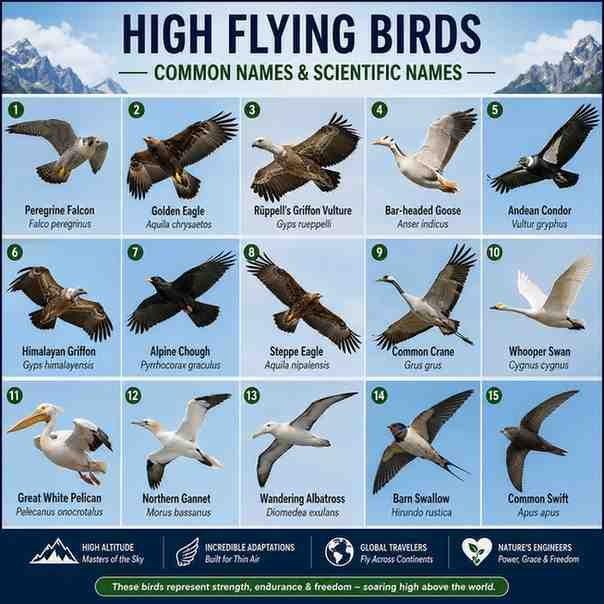
Conclusion
High-flying birds demonstrate nature’s engineering skills through their exceptional design. Learning their scientific names not only improves your knowledge about birds but also helps in improving an accurate system of animal classification. The guide establishes a basic framework that allows you to study three different areas: bird names, scientific names of birds, and high-altitude bird names.
Also read:
- Hawk Scientific Name, Genus, Habitat, Diet, and Types
- Owl Scientific Name, Genus, Habitats, Diets, and Types
- Scientific Name of National Birds of All Countries – Official List Guide
- Discover Bald Eagle Scientific Name And Eagle Species List
- Explore 100 Amazing Scientific Names of Birds Species
FAQ: High Flying Birds Scientific Names
What is the highest flying bird in the world?
Rüppell’s Griffon Vulture (Gyps rueppelli) holds the record for the highest flight altitude.
Why do birds fly at high altitudes?
To migrate long distances, avoid predators, and take advantage of air currents.
What is the scientific name of the Bar-headed Goose?
The scientific name is Anser indicus.
Are all birds capable of high altitude flight?
No, only specific species adapted to low oxygen environments can fly at extreme heights.

