
What are the scientific names for reptiles? The reptiles scientific name is Reptilia (class).
Reptiles are ancient animals known for their scaly skin and cold-blooded nature. They rely on external heat sources to control body temperature and have evolved to survive in many different environments. The search for scientific names of reptiles by students, researchers, and wildlife enthusiasts provides them with a method to identify the correct biological identity of these animals.
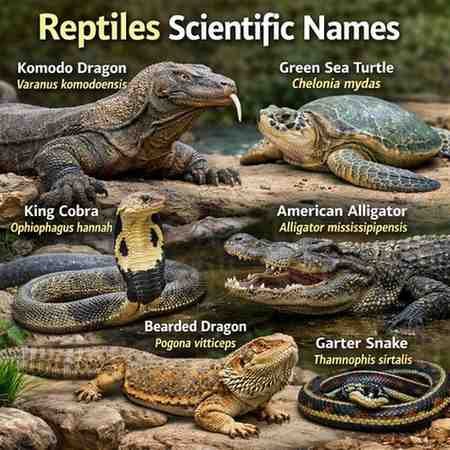
This article presents a clear, well-organized, and professional guide to reptile scientific names, divided into four major categories: lizards, snakes, turtles (including tortoises), and crocodilians. The information provided in this document follows standard zoological classification, which makes it appropriate for academic and educational purposes.
Table of Contents
What Is a Reptile?
Reptiles are vertebrate animals that belong to the class Reptilia. They exhibit the following traits: their skin is dry and covered with scales, and they rely on external sources to regulate their body temperature.
Key Characteristics of Reptiles:
- Reptiles function as ectothermic organisms that require outside temperatures to maintain their body warmth.
- Their bodies display a covering of scales or bony plates.
- They breathe through their lungs.
- The majority of their species reproduce through egg laying.
- They inhabit both land-based and water-based environments.
Biological Classification of Reptiles
| Taxonomic Rank | Classification |
|---|---|
| Kingdom | Animalia |
| Phylum | Chordata |
| Class | Reptilia |
The class Reptilia includes four major living reptile groups: lizards, snakes, turtles, and crocodiles.
Reptile Scientific Names by Major Categories
Lizards’ Scientific Names:
Lizards display their reptilian nature through their four-legged structure, which includes two movable eyelids and two external ear openings. They inhabit diverse environments, including deserts, rainforests, and areas transformed by human activity.
Common Lizards and Their Scientific Names
| Common Name | Scientific Name |
|---|---|
| House Gecko | Hemidactylus frenatus |
| Green Iguana | Iguana iguana |
| Komodo Dragon | Varanus komodoensis |
| Common Chameleon | Chamaeleo chamaeleon |
| Asian Water Monitor | Varanus salvator |
| Bearded Dragon | Pogona vitticeps |
| Sand Skink | Scincus scincus |
| Green Anole | Anolis carolinensis |
| Gila Monster | Heloderma suspectum |
| European Wall Lizard | Podarcis muralis |
Snakes’ Scientific Names:
Snakes belong to a group of reptiles that lack legs, while their flexible jaws enable them to consume entire animals. The species can adapt to different environments, which allows them to inhabit all areas of the planet except Antarctica.
Common Snakes and Their Scientific Names
| Common Name | Scientific Name |
|---|---|
| King Cobra | Ophiophagus hannah |
| Indian Cobra | Naja naja |
| Indian Python | Python molurus |
| Green Anaconda | Eunectes murinus |
| Timber Rattlesnake | Crotalus horridus |
| European Adder | Vipera berus |
| Boa Constrictor | Boa constrictor |
| Black Mamba | Dendroaspis polylepis |
| Common Garter Snake | Thamnophis sirtalis |
| Corn Snake | Pantherophis guttatus |
Turtles and Tortoises Scientific Names:
Turtles and tortoises are reptiles that possess a protective shell. Turtles spend most of their time in water, while tortoises are terrestrial reptiles that move on their powerful legs.
Turtles and Tortoises with Scientific Names
| Common Name | Scientific Name |
|---|---|
| Green Sea Turtle | Chelonia mydas |
| Leatherback Sea Turtle | Dermochelys coriacea |
| Loggerhead Turtle | Caretta caretta |
| Hawksbill Turtle | Eretmochelys imbricata |
| Eastern Box Turtle | Terrapene carolina |
| Red-eared Slider | Trachemys scripta elegans |
| Indian Star Tortoise | Geochelone elegans |
| Aldabra Giant Tortoise | Aldabrachelys gigantea |
| Ganges Softshell Turtle | Nilssonia gangetica |
| Common Snapping Turtle | Chelydra serpentina |
Crocodiles, Alligators, and Caimans Scientific Names:
Crocodilians are large reptiles that inhabit water bodies and possess strong jaws, which trace back to their ancient ancestry. They function as top predators that dominate both freshwater and coastal ecosystems.
Crocodilians and Their Scientific Names
| Common Name | Scientific Name |
|---|---|
| Saltwater Crocodile | Crocodylus porosus |
| Nile Crocodile | Crocodylus niloticus |
| American Crocodile | Crocodylus acutus |
| Mugger Crocodile | Crocodylus palustris |
| Gharial | Gavialis gangeticus |
| American Alligator | Alligator mississippiensis |
| Chinese Alligator | Alligator sinensis |
| Spectacled Caiman | Caiman crocodilus |
| Black Caiman | Melanosuchus niger |
| False Gharial | Tomistoma schlegelii |
Natural Habitat of Reptiles
Reptiles exhibit extraordinary adaptability, enabling them to occupy a variety of global environments. Reptiles have developed distinct physical characteristics and behavioral patterns that enable them to thrive in all environments, from deserts to humid rainforests and oceanic regions.
Where are reptiles found
Deserts and Arid Regions:
Desert environments provide an ideal habitat for reptiles because they can survive in extreme temperature conditions. These species exhibit lizard and snake behavior through their development of thick scaly skin, which helps them reduce water loss. They become active during the cooler periods of the day, using burrows and rock shelters to protect themselves from the extreme heat.
Tropical and Temperate Forests:
The forest ecosystem serves as an excellent habitat for a variety of reptiles, as it provides them with protection and food resources and maintains humidity levels. Chameleons, geckos, snakes, and forest turtles commonly live among trees, leaf litter, and forest floors. The reptiles use dense plant cover because it helps them hide from predators while protecting them from danger.
Rivers, Lakes, and Wetlands:
Freshwater environments provide habitat to multiple reptile species, which include crocodiles, alligators, softshell turtles, and water snakes. Reptiles use water bodies for three essential activities, including hunting, cooling the body, and reproduction. Wetlands provide birds and other animals with both food sources and safe places to build their nests.
Grasslands and Savannas:
Open landscapes such as grasslands and savannas are home to many ground-dwelling reptiles. Monitor lizards, turtles, and some species of snakes use burrows of tall grass and mud for shelter. The habitats offer ample sunlight, which enables the animals to regulate their body temperature while searching for food.
Coastal Waters and Oceans:
Certain reptiles, particularly sea turtles, make their homes in ocean waters. Sea turtles spend most of their lives in oceans, feeding on jellyfish, seagrass, and algae. The creatures exhibit strong ties to both ocean and land environments because they return to sandy beaches for egg laying.
Diet of Reptiles
The species of reptiles, along with their environmental setting and physical characteristics, determine their different methods of obtaining food. The dietary patterns of some reptiles involve strict meat consumption, while others eat both plants and animal products or only plant materials.
Feeding Habits of Reptiles
Insects and Invertebrates:
Geckos, skinks, and chameleons represent small reptile species that depend on insects as their main food source. The common prey species of these animals include ants, beetles, grasshoppers, worms, and spiders. This food provides essential protein, which enables growth and provides energy to the body.
Fish and Amphibians:
Aquatic reptiles and semi-aquatic reptiles use their hunting skills to catch fish, along with amphibian species. The three species of reptiles, which include crocodiles, water snakes, and freshwater turtles, have developed speed and stealth abilities to hunt their prey in rivers and lakes. Frogs and other amphibians serve as a vital food source for various animals.
Small Mammals and Birds:
Larger reptiles, which include snakes and monitor lizards, use their hunting skills to capture both rodents and birds, as well as their eggs. Snakes use various hunting techniques, such as constriction or venom, to subdue their prey before swallowing it whole.
Eggs of Other Animals:
Many reptiles consume eggs, including those of ground-nesting birds and reptiles. The high-energy food source, which exists in this form, serves as a primary nutritional component for certain species because it provides essential nutrients.
Leaves, Fruits, and Aquatic Plants:
Certain reptile species, which include tortoises and iguanas, and some turtles, establish their primary diet through plant-based food. The animals consume leaves together with flowers, fruits, grasses, and aquatic vegetation. The herbivorous reptile diet produces slow digestion, which contributes to their extended lifespans.
Why Reptiles Scientific Names Matter
Scientific names serve essential functions in biology and conservation because they provide a universal identification system that prevents confusion from regional common names while supporting scientific research and classification, and helping to track endangered and protected species.
The scientific name of each reptile species consists of two parts, which include a genus name and a species name.
Conclusion
Reptiles represent an ancient and fascinating group of animals with incredible diversity. The ability to understand scientific names for reptiles enables people to identify reptiles correctly, which benefits educational programs and conservation activities.

