
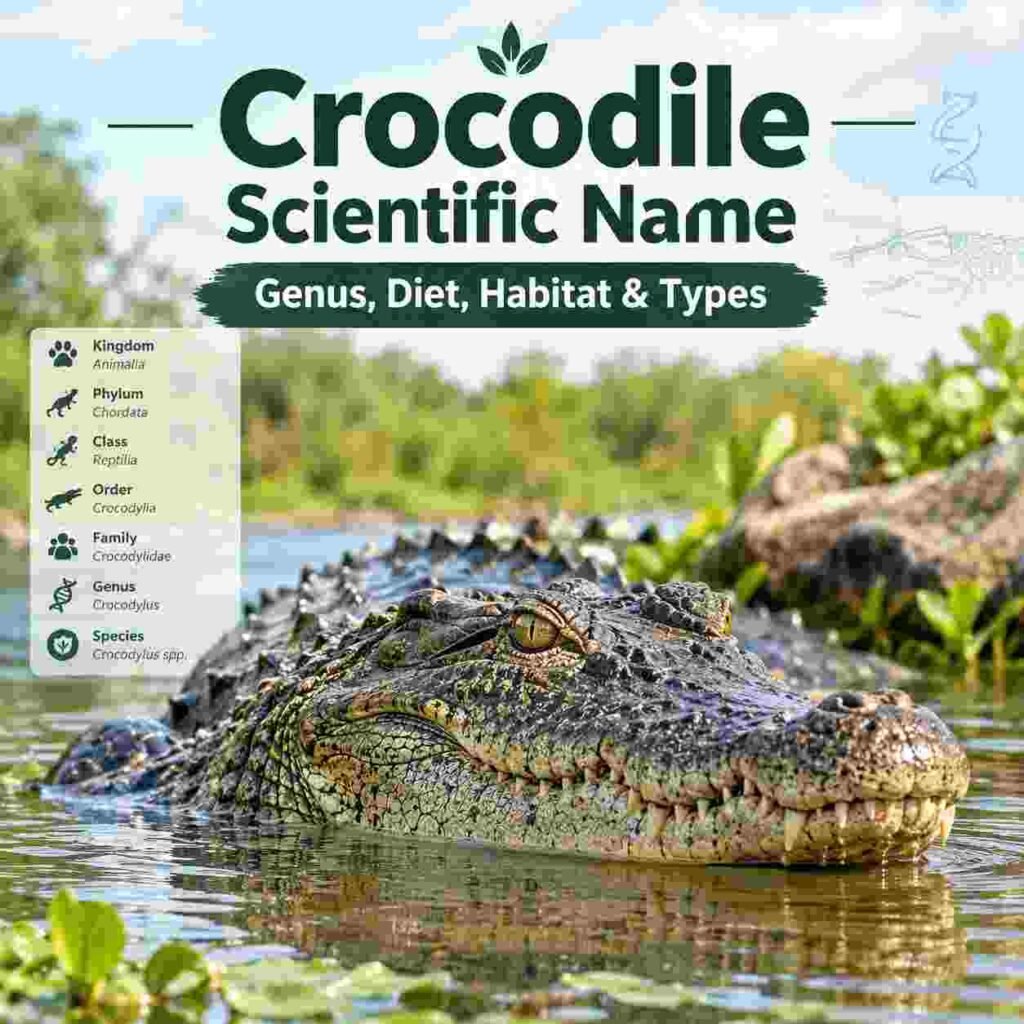
What is the scientific name for a crocodile? The crocodile scientific name is Crocodylus (Genus).
The crocodile’s scientific name refers to a group of large reptiles that belong to one of the oldest living animal lineages on Earth. Crocodiles live in water and on land, hunt using ambush methods, and survive in warm regions across several continents. Scientists study the scientific name of crocodiles to understand the reptile’s evolution, animal behavior, and ecosystem balance. This article explains the scientific name of crocodiles, crocodile species, crocodile diet, crocodile habitat, and types of crocodiles.
Table of Contents
What is the Scientific Name for a Crocodile?
The general crocodile scientific name at the genus level is:
- Genus: Crocodylus
Each crocodile species adds a second word to form the full scientific name.
Examples of Crocodile Scientific Names:
- Nile crocodile: Crocodylus niloticus
- Saltwater crocodile: Crocodylus porosus
- American crocodile: Crocodylus acutus
- Mugger crocodile: Crocodylus palustris
Each crocodile scientific name follows global zoological naming rules.
Crocodile Scientific Name Meaning
The word Crocodylus comes from the ancient Greek word krokódilos.
- Krokódilos = stone lizard or river reptile
- The word later entered Latin as Crocodylus.
Therefore, the scientific name crocodile refers to a large reptile that lives near water with a strong, lizard-like body.
Crocodile Scientific Name Pronunciation
- Crocodylus: krok-uh-DY-lus
- Crocodylus niloticus: krok-uh-DY-lus ny-LOT-ih-kus
- Crocodylus porosus: krok-uh-DY-lus puh-ROH-sus
The pronunciation stays the same in scientific use worldwide.
Biological Classification of Crocodile
| Rank | Classification |
|---|---|
| Kingdom | Animalia |
| Phylum | Chordata |
| Class | Reptilia |
| Order | Crocodylia |
| Family | Crocodylidae |
| Genus | Crocodylus |
The scientific classification identifies the crocodile species by its scientific name, which shows its relationship to the study of animal life.
Genus of Crocodile (Crocodylus):
The basic genus of crocodiles exists under the name Crocodylus, which contains all other species of crocodiles that inhabit Africa, Asia, Australia, and the Americas.
Characteristics of the Crocodile Genus:
The creature has a long body with protective armor. The creature possesses powerful muscles in its jaws. The creature displays cone-shaped teeth. The animal spends its life between land and water environments. The organism depends on external temperatures to regulate its body temperature.
The crocodile genus Crocodylus exhibits different salt tolerance and skull structure from crocodiles and caimans.
Crocodile Physical Characteristics
Crocodiles have several physical adaptations that help them survive in aquatic environments.
| Feature | Description |
|---|---|
| Body | Long and muscular |
| Skin | Thick and covered with scales |
| Tail | Long, strong, and used for swimming |
| Legs | Short but powerful |
| Teeth | Sharp and conical |
| Jaws | Strong and adapted for capturing prey |
| Eyes | Located high on the head |
| Nostrils | Positioned near the top of the snout |
| Body Temperature | Regulated through external heat |
| Lifestyle | Semi-aquatic |
Their body shape allows them to move efficiently through water, while their strong legs help them move on land.
Crocodile Diet Based on Scientific Research
What Do Crocodiles Eat?
The crocodile’s scientific name follows a carnivorous diet. Crocodiles consume all animals that exist in proximity to water bodies.
- Fish
- Birds
- Frogs
- Turtles
- Snakes
- Lizards
- Small mammals
- Large mammals
- Crustaceans
- Insects and other small animals
Crocodile Diet Includes:
The crocodile diet consists of three types of animals: fish, birds, mammals, amphibians, and reptiles. The young crocodile’s diet consists of insects and tiny fish. The adult crocodile species pursues bigger animals for food.
Feeding Behavior:
Crocodiles use ambush hunting. The creature stays motionless until it attacks. The crocodile’s scientific name does not indicate that it chews food. The animal rips apart meat and swallows chunks of food without chewing.
Crocodile Habitat and Environmental Range
Natural Habitat of Crocodiles:
Crocodiles, the scientific name for the species, live in warm climates. Animals need water sources to hunt and regulate their body temperature.
Types of Crocodile Habitats:
Crocodiles live in a variety of environments, including rivers and lakes, swamps and marshes, wetlands and mangrove forests, and coastal waters. Saltwater crocodiles can survive in ocean water, while other crocodile species choose to live in freshwater environments.
Crocodiles can live in:
- Rivers
- Lakes
- Swamps
- Marshes
- Wetlands
- Estuaries
- Mangrove forests
- Floodplains
- Coastal waters
- Slow-moving streams
The exact habitat depends on the species.
The saltwater crocodile, Crocodylus porosus, can travel through coastal waters and tolerate saltwater environments. Other crocodile species spend much of their lives in freshwater habitats. Crocodiles often use land near water for basking, resting, nesting, and moving between different areas.
Types of Crocodiles and Their Scientific Names
There are several living species of crocodiles in the genus Crocodylus. Each species has its own scientific name and geographic distribution.
The following table lists common crocodile species and their scientific names:
| Type of Crocodile | Scientific Name | Main Range |
|---|---|---|
| Nile Crocodile | Crocodylus niloticus | Africa |
| Saltwater Crocodile | Crocodylus porosus | South and Southeast Asia, Australia |
| American Crocodile | Crocodylus acutus | Americas and Caribbean |
| Mugger Crocodile | Crocodylus palustris | Indian subcontinent |
| Morelet’s Crocodile | Crocodylus moreletii | Mexico, Belize, Guatemala |
| Cuban Crocodile | Crocodylus rhombifer | Cuba |
| Philippine Crocodile | Crocodylus mindorensis | Philippines |
| New Guinea Crocodile | Crocodylus novaeguineae | New Guinea |
| Siamese Crocodile | Crocodylus siamensis | Southeast Asia |
| Orinoco Crocodile | Crocodylus intermedius | Colombia and Venezuela |
| West African Crocodile | Crocodylus suchus | West and Central Africa |
| Australian Freshwater Crocodile | Crocodylus johnstoni | Northern Australia |
Taxonomic classifications can change as scientists revise species relationships. The table uses commonly recognized modern species names.
Crocodile vs Alligator
Crocodiles and alligators are in the same order, Crocodylia, but in different families.
| Feature | Crocodile | Alligator |
|---|---|---|
| Family | Crocodylidae | Alligatoridae |
| Snout | Usually longer and narrower | Usually broader |
| Lower teeth | Some visible when mouth is closed | Usually less visible |
| Salt tolerance | Some species tolerate saltwater well | Generally less tolerant of saltwater |
| Habitat | Freshwater, coastal, and marine areas depending on species | Mainly freshwater |
These are general differences, and individual species can vary.
Final note
At the genus level, the crocodile’s scientific name is Crocodylus. Each species also has its own two-part scientific name. Crocodiles fall under the family Crocodylidae. They are in the order Crocodylia. Their class is Reptilia.
Crocodiles are meat-eating reptiles. They spend time in and near water, and they prefer warm places. They eat fish, birds, reptiles, amphibians, and mammals. They live in rivers and lakes. You may also find them in wetlands and swamps. Some live in estuaries, mangroves, and along coasts.
FAQs
What is the scientific name of a crocodile?
The scientific genus of true crocodiles is Crocodylus.
What is the genus of a crocodile?
The genus of crocodiles is Crocodylus.
What do crocodiles eat?
Crocodiles eat fish, birds, reptiles, amphibians, and mammals.
Where do crocodiles live?
Crocodiles live in rivers, lakes, wetlands, swamps, estuaries, and coastal areas.
What is the scientific name of a saltwater crocodile?
The scientific name of the saltwater crocodile is Crocodylus porosus.

