What is the scientific name for a sunflower? The common sunflower scientific name is Helianthus annuus.
Sunflowers are one of the best-known flowering plants in the world. Bright yellow petals with a large, round head characterize it. For centuries, it has been the symbol of warmth, energy, and positivity. Nevertheless, the sunflower has its fair share of agricultural, nutritional, and cultural importance. In this guide, we intend to discuss the sunflower scientific name, its meaning, pronunciation, classification, habitat, age, types, uses, and benefits.
Table of Contents
What is the Scientific Name for a Sunflower?
Helianthus annuus is the botanical name set for the common sunflower.
- Genus: Helianthus
- Species: annuus
Meaning and Pronunciation of Scientific Name
Meaning:
Apparently, Helianthus derives from two Greek words: Helios (meaning “sun”) and anthos (meaning “flower”), which describe the plant as a sunflower.
- Annuus means annual, describing its life span as one year.
- Pronunciation: He-lee-AN-thus ANN-yoo-us
In simple terms, the scientific name of the sunflower means “the annual flower of the sun.”
Biological Classification of Sunflower
| Taxonomic Rank | Classification |
|---|---|
| Kingdom | Plantae (Plants) |
| Clade | Angiosperms |
| Clade | Eudicots |
| Clade | Asterids |
| Order | Asterales |
| Family | Asteraceae (Sunflower family) |
| Genus | Helianthus |
| Species | annuus |
Habitat and Life Span of Sunflowers
Natural Habitat of Sunflowers:
Sunflowers are native to North America, and their natural habitats were:
- Warm, sunny open fields
- Dry grasslands and prairies
- Fertile soils with good drainage
- Light forest borders and open woodland
The world still benefits from the hardiness of this plant and the simplicity of its flowering.
Sunflower Life Span / Age:
- Most varieties of sunflowers are annuals, and they will perform the complete life cycle in 70 to 100 days.
- Some wild types, like Maximilian sunflower, are perennial, coming back every year.
Height and Size:
Sunflower height varies according to the variety:
- Dwarf types: 1.5 to 3 feet (45-90 cm)
- Garden varieties: 4 to 6 feet (1.2-1.8 m)
- Giant types: More than 12 feet (3.6 m)
The flower heads are from 3 inches for the smallest ones to over 1 foot for the largest ones.
Growth Behavior:
- Heliotropism is one of the features exhibited by young sunflowers, as they rotate their heads to follow the sun during the day.
- The mature flowers usually face east, which not only helps to warm the flowers early in the morning but also attracts pollinators.
Types Of Sunflowers
Sunflowers have a variety of colors, shapes, and sizes. The following ones are the most famous and suitable for gardens.
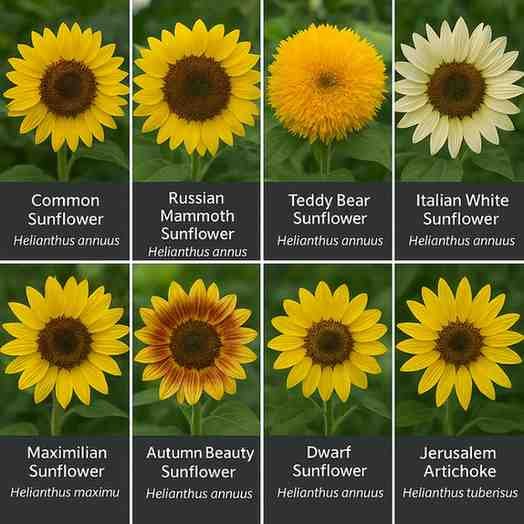
- Common Sunflower (Helianthus annuus): The typical tall sunflower, which is cultivated all over the world for its seeds and oil.
- Russian Mammoth Sunflower: The largest sunflower is famous for its size and the number of seeds it can hold.
- Teddy Bear Sunflower: A tiny, soft, double-petaled ornamental variety.
- Italian White Sunflower: A variety with soft, ivory petals that is perfect for cutting and has a long life in vases.
- Maximilian Sunflower (Helianthus maximiliani): A very tall perennial type that flourishes over vast parts of the US.
- Autumn Beauty Sunflower: Its petals are a combination of red, orange, and yellow, which is characteristic of it.
- Dwarf Sunflower: Small kinds perfect for pots, balconies, and little gardens.
- Jerusalem Artichoke (Helianthus tuberosus): Grown mainly for its edible tubers, not for its attractive flowers.
Types of Sunflowers with Biological Names
| Common Name | Latin Name |
|---|---|
| Common Sunflower | Helianthus annuus |
| Russian Mammoth Sunflower | Helianthus annuus (cultivar) |
| Teddy Bear Sunflower | Helianthus annuus (cultivar) |
| Italian White Sunflower | Helianthus debilis |
| Autumn Beauty Sunflower | Helianthus annuus (cultivar) |
| Dwarf Sunflower | Helianthus annuus (dwarf cultivars) |
| Maximilian Sunflower | Helianthus maximiliani |
| Jerusalem Artichoke | Helianthus tuberosus |
| Prairie Sunflower | Helianthus petiolaris |
| Beach Sunflower | Helianthus debilis subsp. debilis |
| Silverleaf Sunflower | Helianthus argophyllus |
| Sawtooth Sunflower | Helianthus grossesseratus |
| Woodland Sunflower | Helianthus divaricatus |
| Ashy Sunflower | Helianthus mollis |
| Swamp Sunflower | Helianthus angustifolius |
Nutritional and Biological Value of Sunflowers
Sunflower seeds are rich in nutrients and good for health in several ways.
Key Nutrients:
- Vitamin E: Keeps skin and immune system healthy
- Magnesium & Selenium: Speed metabolism and lower oxidative stress in the body
- Healthy Unsaturated Fats: Lower the risk of heart disease
- Protein & Fiber: Aid digestion and provide energy that lasts longer
The mentioned nutrients are the reason why sunflower seeds are highly regarded and recommended by nutritionists as part of a balanced diet.
The Uses of Sunflowers
Sunflowers are beneficial to agriculture, health, the environment, and different cultures.
Agricultural Uses:
- Food, snacks, and baked goods made from seeds
- Sunflower oil, the most dominant cooking oil in the world
- Sunflower seed meal, a supplement for animal feed
Medicinal Uses:
- Sunflower oil, a skin product, not only heals but also nourishes the skin
- Sunflower tea, made from petals or leaves, is a calming drink in some regions
- Nature’s support for antioxidants, through this, the body gets total wellness
Environmental Uses:
- Great for phytoremediation; they remove not only toxins but also heavy metals
- Pollinators like bees and butterflies visit them, and thus they help in the health of pollinators.
- Due to their considerable height, they can prevent soil erosion and act as windbreaks
Cultural Uses:
- The flower of happiness, fidelity, and positivity
- Their presence in paintings, festivals, floral decorations, and celebrations has been a long-standing practice
- Their being in homes as decorative elements lights the house up with a cheerful and bright mood
Sunflower Common Names in Different Countries
| Country | Local Name for Sunflower |
|---|---|
| United States / UK | Sunflower |
| India | Surajmukhi |
| Pakistan | Surajmukhi |
| Bangladesh | Surjomukhi |
| Sri Lanka | Suriya Kantha |
| Nepal | Suryamukhi Phool |
| China | 向日葵 (Xiàngrìkuí) |
| Japan | ひまわり (Himawari) |
| South Korea | 해바라기 (Haebaragi) |
| Thailand | ทานตะวัน (Than Tawan) |
| Vietnam | Hoa Hướng Dương |
| Philippines | Mirasol |
| Indonesia | Bunga Matahari |
| Malaysia | Bunga Matahari |
| Saudi Arabia | دوار الشمس (Dawar Al-Shams) |
| UAE | دوار الشمس (Dawar Al-Shams) |
| Turkey | Ayçiçeği |
| Iran | آفتابگردان (Aftab Gardān) |
| Egypt | دوار الشمس (Dawar Al-Shams) |
| France | Tournesol |
| Spain | Girasol |
| Italy | Girasole |
| Germany | Sonnenblume |
| Russia | Подсолнечник (Podsolnechnik) |
| Brazil | Girassol |
| Argentina | Girasol |
| South Africa | Sonblom / Sunflower |
| Kenya | Sunflower |
| Nigeria | Sunflower |
Final Thoughts
Helianthus annuus is scientific for a sunflower. Sunflowers are not only a visual delight in gardens. They are the plants that maintain ecosystems, yield healthy seeds, provide healing benefits, and have a rich cultural significance. Their ability to thrive almost anywhere and their lively appearance make them one of the most important flowering plants in the world.
Also Read:
- Jasmine Scientific Name, Genus Types, Uses, and Benefits
- Hibiscus Scientific Name and Uses: Benefits, Growth, and Meaning
- Garlic Scientific Name, Genus, Uses, Benefits, and Types
FAQs About Sunflower
What is the scientific name for a sunflower?
The binomial name of a sunflower is Helianthus annuus.
What does the sunflower scientific name mean?
Helianthus comes from Greek words “helios” (sun) and “anthos” (flower), meaning “sun flower.”
How do you pronounce the scientific name of sunflower?
It is pronounced as: hee-lee-AN-thus AN-yoo-us.
What is the habitat of sunflowers?
Sunflowers grow naturally in warm, sunny regions, open fields, prairies, and well-drained soils, especially across North America.
What are the biological characteristics of sunflower (age, height, size, classification)?
Sunflowers live 70–100 days, grow 1.5 to 12+ feet tall, and belong to:
Kingdom: Plantae, Genus: Helianthus, Family: Asteraceae