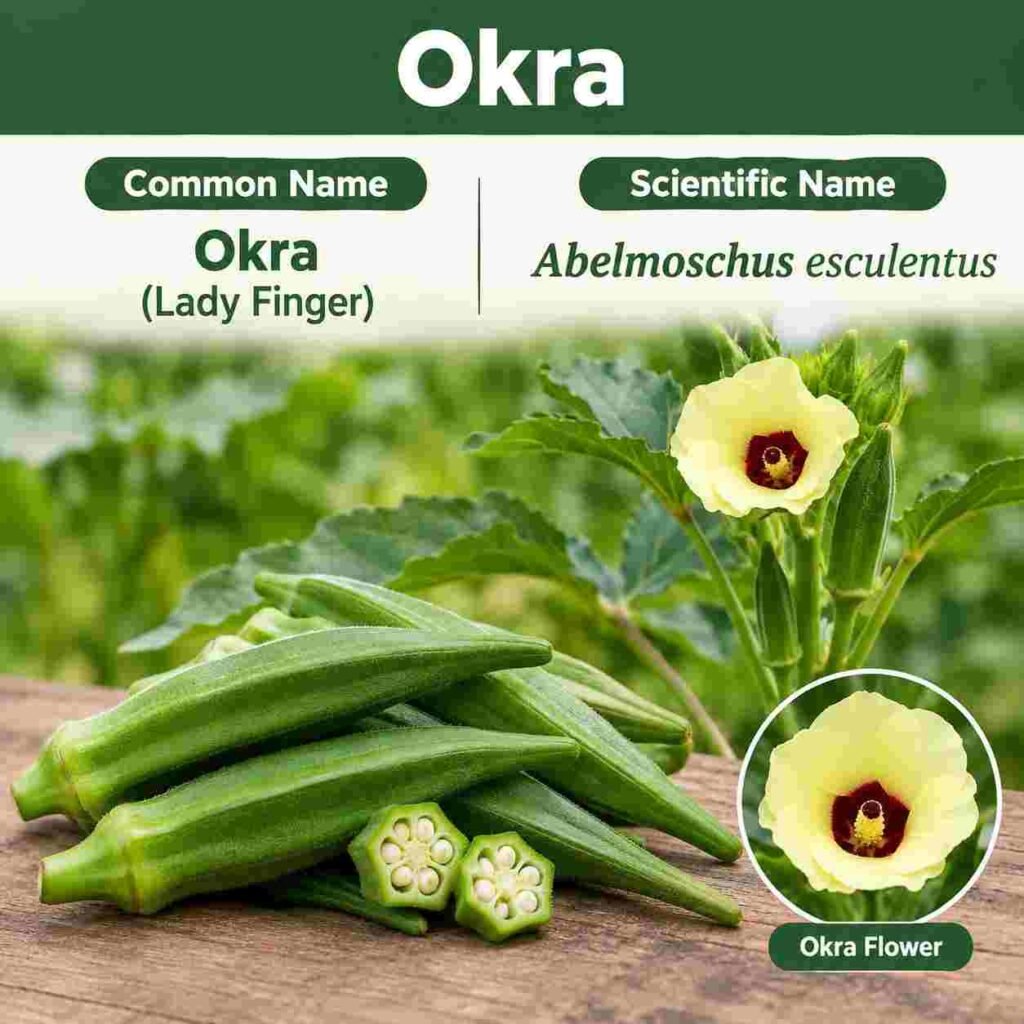
What is the scientific name of okra plant? The okra scientific name is Abelmoschus esculentus.
The scientific name of the lady-finger is one of the most searched plant classification topics because okra is a common vegetable used in many diets. Farmers, students, and food researchers often search for the scientific name of okra, the botanical name of okra, and the scientific name of lady finger to understand the plant’s biological classification and plant family. Okra is known as lady finger in many countries, and the plant belongs to a well-known flowering plant group.
The vegetable grows in warm climates and produces edible green pods that people cook in many dishes. Agricultural science uses the okra scientific name to identify the plant in research, seed catalogs, plant databases, and botanical records. This guide explains the okra scientific name, okra family, biological classification, plant structure, leaf name, pest scientific names, types, nutrition, uses, and benefits.
Table of Contents
What Is the Scientific Name of Okra?
The scientific name for okra is Abelmoschus esculentus. Botanists use this name to identify the species and distinguish it from other plants.
Okra belongs to the genus Abelmoschus and the family Malvaceae. The plant grows as an annual crop in many farming regions. Its edible pods are harvested while they are still young and tender.
The common name varies by region. In the United States, people generally call it okra. In India, Pakistan, and several other countries, it is widely known as lady finger or ladies’ finger. These common names refer to the same vegetable.
Okra scientific name meaning and pronunciation
The scientific name for okra is Abelmoschus esculentus. It translates from Neo-Latin and Arabic as “father of musk” (Abelmoschus)—referring to the musky scent of its crushed seeds—and “edible” (esculentus). It is pronounced: ay-bul-MOS-kus es-KYOO-len-tus (or ah-bel-MOS-kus e-SKOO-len-tus).
Scientific Name Breakdown
- Abelmoschus (ay-bul-MOS-kus): Derived from the Arabic phrase abū l-misk, meaning “father of musk”.
- esculentus (es-KYOO-len-tus): A Latin word meaning “edible” or “fit for human consumption”.
Botanical Classification of Okra
Okra is a flowering plant related to other plants in the botanical classification, sharing common evolutionary lineages.
Scientific Classification of Okra
| Taxonomic Rank | Classification |
|---|---|
| Kingdom | Plantae |
| Clade | Angiosperms |
| Clade | Eudicots |
| Order | Malvales |
| Family | Malvaceae |
| Genus | Abelmoschus |
| Species | esculentus |
Family of Okra (Lady Finger)
It is necessary to learn the scientific name and family to understand okra’s identity from a botanical perspective. Okra’s species name is Abelmoschus esculentus, and it belongs to the Malvaceae family.
Cotton and hibiscus (Gossypium and Hibiscus species, respectively) also belong to the Malvaceae family, although they can be grown differently and used differently.
Okra plants have large leaves, distinct flowers, and seed-filled pods. Its flowers have reproductive organs similar to those of flowering plants, and okra flowers develop into pods after fertilization.
The Physical Traits of Okra
Okra features characteristics that differentiate it from other vegetable plants.
Physical Characteristics of the Okra Plant
| Plant Part | Description |
|---|---|
| Roots | A main taproot with smaller roots that absorb water and nutrients from the soil. |
| Stem | An upright green stem that may become woody as the plant grows. |
| Leaves | Broad, green leaves with several lobes and visible veins. |
| Flowers | Yellow flowers with a dark red or purple center. |
| Fruit Pods | Long, green or red pods with ridges along the sides. |
| Seeds | Small, round seeds found inside the pods. |
| Plant Height | Usually 3–6 feet, depending on the variety and growing conditions. |
| Growth Habit | An upright plant with branches that produce flowers and pods. |
| Pod Texture | Young pods are tender, while mature pods become hard and fibrous. |
| Life Cycle | Usually grown as an annual vegetable crop. |
Common Types of Okra
There are many types of okra, and growers select them based on climate, pod quality, plant size, maturity, and intended use. Below are examples of commonly popular varieties.
| Types of Okra | Scientific Name |
|---|---|
| Clemson Spineless Okra | Abelmoschus esculentus |
| Emerald Okra | Abelmoschus esculentus |
| Burgundy Okra | Abelmoschus esculentus |
| Annie Oakley II Okra | Abelmoschus esculentus |
| Baby Bubba Okra | Abelmoschus esculentus |
| Louisiana Green Velvet Okra | Abelmoschus esculentus |
| Jambalaya Okra | Abelmoschus esculentus |
| Hill Country Red Okra | Abelmoschus esculentus |
| Perkins Long Pod Okra | Abelmoschus esculentus |
| Cow Horn Okra | Abelmoschus esculentus |
| Red Burgundy Okra | Abelmoschus esculentus |
| Spineless Okra | Abelmoschus esculentus |
| Dwarf Okra | Abelmoschus esculentus |
| Green Velvet Okra | Abelmoschus esculentus |
| White Velvet Okra | Abelmoschus esculentus |
Note: These names refer to cultivars or growing varieties of okra, not separate species. Their scientific name is usually Abelmoschus esculentus. Cultivar names may vary depending on the seed supplier and region.
Cultivar availability varies by seed supplier and region. Names and characteristics may also vary between seed catalogs, so growers should check the variety description before purchasing seeds.
Uses of Okra
Okra is an important crop in both the kitchen and the garden, as well as being useful in agriculture.
1. Cooking and Eating
Okra is often used in several recipes. Examples of preparations are:
- Okra soup or vegetable stew
- Fried okra
- Roasted or grilled okra
- Okra curry
- Stir-fried okra
- Gumbo, among many other recipes where the goal is thickening.
The pods contain a substance called mucilage, which turns into a thick, slippery substance when heated. This mucilage is excellent at thickening soups and stews.
2. Growing and Producing Seeds
It is possible to collect okra seeds. When seed producers decide to collect seeds, they select the best okra and leave the pods on the plant until they are completely mature, then collect them.
Okra can also be grown and used to produce seeds by gardeners. Gardeners can use open-pollinated varieties of okra, although it is possible that these okra can become cross-pollinated by another variety.
3. Home Gardening
It is an ideal addition to the home garden because of how easily it can be grown in warm gardens and beds. Depending on the size of the cultivar, it is also very easy to grow in containers.
Okra can also be grown, and gardeners can use it to make seeds. Gardeners can use open-pollinated varieties of okra, although it is possible for this okra to cross-pollinate with another variety.
4. Agricultural Research
Research is also conducted on okra. Studies on the improvement of okra focus on several areas, including agronomic improvement, pest management, breeding, and disease resistance. Okra is classified as Abelmoschus esculentus for both scientific research and botanical record-keeping.
The Nutritional Benefits of Okra
Okra has many nutritional benefits, including its dietary fiber and plant compounds. Okra contains some essential minerals and vitamins. It is important to know that these benefits vary based on the preparation, serving size, and condition of the okra (fresh, frozen, or cooked).
For example, 100g or 1 cup of raw okra is about 33 calories.
Nutritional Value of ladyfinger per 100 g
| Nutrient | Amount per 100 g of Raw Okra |
|---|---|
| Calories | 33 kcal |
| Carbohydrates | 7.5 g |
| Dietary Fiber | 3.2 g |
| Protein | 1.9 g |
| Fat | 0.2 g |
| Vitamin C | 23 mg |
| Vitamin K | 31 mg |
| Folate | 60 µg |
| Potassium | 299 mg |
These values are approximate and may vary with samples and nutritional databases. Cooking methods can also change the nutrient content per serving.
Quick Facts About the Okra Plant
| Plant Feature | Information |
|---|---|
| Common Name | Okra |
| Other Common Name | Lady Finger |
| Scientific Name | Abelmoschus esculentus |
| Botanical Name | Abelmoschus esculentus |
| Plant Family | Malvaceae |
| Genus | Abelmoschus |
| Species | Abelmoschus esculentus |
| Plant Type | Flowering plant |
| Life Cycle | Usually grown as an annual vegetable crop |
| Edible Part | Immature fruit pods |
| Flower Color | Usually yellow or cream with a darker center |
| Growing Season | Warm season |
| Main Uses | Food, seed production, and agricultural research |
Also Read:
- Brinjal Scientific Name, Family, Genus, and Classification (Eggplant)
- Cucumber Scientific Name, Genus, Uses, Benefits, and Types
- Scientific Names of Vegetables: Cruciferous, Leafy, and Root List
- Chili Scientific Name, Genus, Types, Uses, and its Benefits
FAQs
What is the scientific name of okra?
The scientific name of okra is Abelmoschus esculentus. It is the accepted botanical name used to identify the cultivated okra species.
What is the family name of okra?
Okra belongs to the family Malvaceae, also known as the mallow family. Cotton and hibiscus are other examples of plants in this family.
What is the botanical name of lady finger?
The botanical name of lady finger is Abelmoschus esculentus. Lady finger is a common name for okra in many countries.
What is the genus of okra?
The genus of okra is Abelmoschus. The full scientific name is Abelmoschus esculentus.
Is okra a fruit or a vegetable?
Botanically, the edible pod of okra is a fruit because it develops from the flower’s ovary and contains seeds. In cooking, people generally treat okra as a vegetable.