
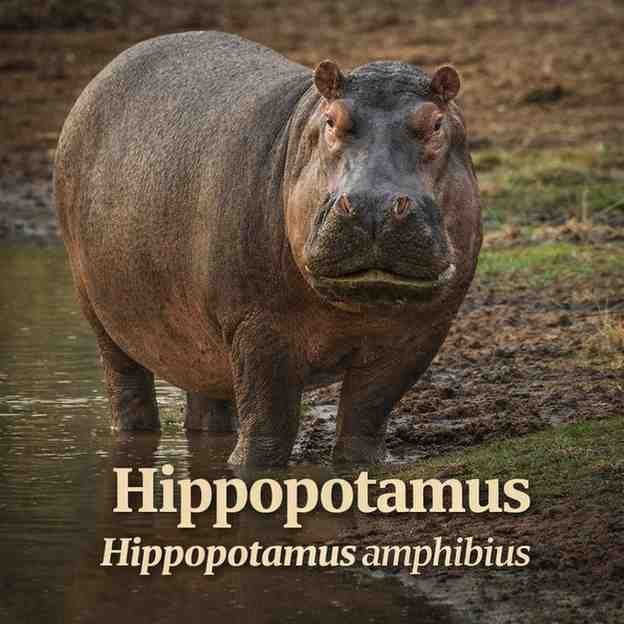
What is the scientific name of hippopotamus? The common hippopotamus scientific name is Hippopotamus amphibious.
Hippopotamus amphibius is a zoological and biological name universally accepted by scientists to refer to the common river hippopotamus. The term is derived from the ancient Greek hippos, which means horse, and potamos, which means river; thus, the scientific name literally translates to river horse. The scientific name of hippopotamus indicates its habitat as a water mammal that is partly aquatic.
Table of Contents
The Hippopotamus scientific name is important in zoological studies, conservation, and biological classification because it distinguishes the genus Hippopotamus from other mammals. Although in natural habitats, hippos may be referred to as river horses, the term “hippopotamus” gives the exact and internationally recognized taxonomic identity.
What is the scientific name of Hippopotamus?
Hippopotamus amphibius is the scientific name of the hippopotamus. This full scientific name is used in zoological research, biological databases, and international wildlife records. The genus is Hippopotamus and the species is amphibius.
Pronunciation of hippopotamus scientific name:
- Hippopotamus: hip-uh-POT-uh-muss
- Hippopotamus amphibius: hip-uh-POT-uh-muss am-FIB-ee-us
hippopotamus Scientific name meaning:
- Hippopotamus (Greek): hippos = horse, potamos = river → river horse
- Amphibius (Greek): living both in water and land → semi-aquatic mammal
Biological Classification of Hippopotamus
| Rank | Classification |
|---|---|
| Kingdom | Animalia |
| Phylum | Chordata |
| Class | Mammalia |
| Order | Artiodactyla |
| Family | Hippopotamidae |
| Genus | Hippopotamus |
| Species | amphibius |
This categorization precisely delineates the place of the hippopotamus in the biological hierarchy of terrestrial mammals. The family Hippopotamidae encompasses merely two extant members: the common hippopotamus and the pygmy hippopotamus (scientific name: Choeropsis liberiensis).
Hippopotamus Genus and Species Information
- Genus: Hippopotamus
- Species: amphibius
The genus Hippopotamus incorporates the species of river hippos. Such creatures are counted among the largest semi-aquatic mammals of Earth and are closely related to prehistoric mammals that once existed in Africa millions of years ago.
Related Zoological Facts
- Closest living relatives: Whales and dolphins
- Evolutionary ancestors: Semiaquatic artiodactyls
- Classification importance: Genus helps distinguish between common river hippos and pygmy hippos
Physical Characteristics (Size, Height, Weight)
The hippopotamus is the third-largest mammal on Earth, surpassed only by the elephant and rhinoceros. These animals are aquatic creatures with strong bones, thick skin, and webbed feet.
| Feature | Measurement (Average Adult) |
|---|---|
| Weight | 1,500 – 3,200 kg (3,300 – 7,000 lbs) |
| Height | 1.5 meters (5 feet) at the shoulder |
| Length | 3.3 – 5 meters (11 – 16 feet) |
| Color | Grayish-brown skin with pink areas |
| Skin Type | Nearly hairless andyears secretes natural sunscreen |
| Age (Wild) | 40 to 50 years |
| Age (captivity) | 50 to more years |
Hippopotamus Skin and Coloring:
The skin secretes a natural oil called hippuric acid, which serves both as a sunscreen and as an antibiotic. While hippos are thought to be grey, their skin actually secretes a pinkish-red fluid, which at times may give them the appearance of being sunburned.
Hippopotamus Habitat and Geographic Range
Hippopotamus habitats extend through all freshwater bodies across sub-Saharan African regions.
Main Hippopotamus Habitat Types
- They inhabit rivers
- They inhabit lakes
- They inhabit floodplains
- They inhabit swamps
- They inhabit wetlands
Hippos use water during the day to regulate their body temperature and protect their skin from sunlight. They depart from water at night to search for food on land.
Habitat Requirements
A stable hippopotamus habitat needs:
- Hippos require permanent water sources
- They need access to nearby grassland
- Mud banks or shallow edges
- Human activity needs to remain below certain levels
Habitat loss and river modification reduce available hippo territory in many regions.
Hippopotamus Diet and Feeding Behavior
The hippopotamus diet consists entirely of plant-based foods. Hippos do not hunt animals as a basic food source despite their large size and aggressive nature.
What do hippopotamuses eat?
Primary hippopotamus diet items:
- They eat short grasses
- They consume riverbank vegetation
- They eat ground plants
- They eat shoots and reeds
Feeding Pattern:
- Feeding time: mostly at night
- They graze up to 5 to 10 kilometers from water
- They consume approximately 30 to 40 kilograms of grass daily
Hippos use their lips to pull grass rather than using their front teeth like many grazers.
Digestive System:
The hippo possesses a stomach with multiple chambers, yet it does not qualify as a true ruminant like cattle. The stomach structure helps break down plant matter through microbial fermentation.
Types of Hippopotamus (Hippo)
The world today contains two living hippopotamus species, which scientists recognize as existing. Both species belong to the Hippopotamidae family but differ in their physical characteristics, their preferred habitats, their social behaviors, and their geographic range. Most readers use the word “hippopotamus” to refer to both species; however, scientific classification shows that these two creatures belong to different species, which exist in separate genera.
Zoological research, wildlife studies, and conservation efforts require accurate identification of hippopotamus species.
Common Hippopotamus (Hippopotamus amphibius)
The Common Hippopotamus represents the most recognized and largest member of the hippopotamus family. People who look for the scientific name of the hippopotamus usually use Hippopotamus amphibius as their reference. This species serves as an important reference species for textbooks, wildlife databases, and research articles.
Key facts about Common Hippopotamus:
- Scientific name: Hippopotamus amphibius
- Genus: Hippopotamus
- Largest living hippo species
- Third largest land mammal after elephant and rhino
- Average weight: 1,500–3,200 kg
- Animals inhabit rivers and lakes and slow-moving freshwater bodies
- Animals spend their active time in water during daytime hours and their feeding time on land during nighttime hours
- Hippos live in large social groups, which people call pods
- Group size can reach 10–30 or more individuals
- Found across sub-Saharan Africa
- Strong territorial behavior in water
The scientific name for the hippopotamus species requires the name Hippopotamus amphibius to be applied exclusively to this particular species. The scientific name for the pygmy hippopotamus does not include this name. The common hippo displays standard semi-aquatic adaptations through its high-positioned eyes, ears, and nostrils and its thick skin, which produces protective fluid.
Pygmy Hippopotamus (Choeropsis liberiensis)
The Pygmy Hippopotamus is a distinct species that exists as a smaller, more elusive, and less aquatic version of the common hippopotamus. The animal belongs to a different genus, which serves as the basis for its scientific classification. Older sources used to assign it to Hexaprotodon, but current scientific classification designates it as Choeropsis.
Key facts about Pygmy Hippopotamus:
- Latin name: Choeropsis liberiensis
- Genus: Choeropsis
- The animal exists as a smaller version of the common hippopotamus
- The typical weight range for the species is 180 to 275 kilograms
- The species has a body structure that enables it to live in forested areas
- The animal inhabits swamps, forest streams, and wetlands
- The species lives either alone or with one other member of its kind.
- The species displays more active nocturnal behavior while being more withdrawn than typical animals.
- The species exists as a native animal that inhabits West African countries of Liberia, Sierra Leone, the Ivory Coast, and Guinea.
- The organization classified the species as endangered because its habitat continues to diminish
The pygmy hippopotamus exhibits a different skull shape and has longer legs that extend beyond its body, and shows less webbing between its toes. The animal spends more time on land than common hippopotamuses do, while it uses dense forest areas to stay safe from danger.
Difference Between Common and Pygmy Hippopotamus
| Feature | Common Hippopotamus | Pygmy Hippopotamus |
|---|---|---|
| Scientific name | Hippopotamus amphibius | Choeropsis liberiensis |
| Genus | Hippopotamus | Choeropsis |
| Body size | Very large | Much smaller |
| Social structure | Large groups | Mostly solitary |
| Main habitat | Rivers and lakes | Forest wetlands |
| Geographic range | Sub-Saharan Africa | West Africa |
| Public recognition | Very high | Limited |
Taxonomy Note for Accuracy
The phrase hippopotamus scientific name correctly refers to Hippopotamus amphibius only. The pygmy hippopotamus has a different scientific name and genus, so it should not be grouped under the same species label in scientific or educational content.
Hippopotamus Summary
- Hippopotamus scientific name: Hippopotamus amphibius
- Genus: Hippopotamus
- Family: Hippopotamidae
- Habitat: African rivers and wetlands
- Diet: Herbivore, grass eater
- Types: Common hippo and pygmy hippo
- Closest relatives: Whales and dolphins
- Behavior: Semi-aquatic, social, territorial

