
What is the scientific name for the sparrows? The common and house sparrow scientific name is Passer domesticus.
Sparrows are tiny, sociable, and extremely adaptable birds that can be found almost everywhere in the world. Besides being recognized for their merry chirps and their close ties with humans, sparrows are classified as the genus Passer and the family Passeridae. Moreover, they contribute to the ecosystem greatly by reducing the number of insects and dispersing seeds.
Table of Contents
The article will cover the scientific name for the sparrow, including its genus, classification, pronunciation, types, habitat, diet, physical features, and lifespan.
What is the scientific name for the Sparrows?
The scientific name of the sparrow is Passer domesticus. The sparrow is a member of the genus Passer and the family Passeridae under the order of Passeriformes.
Sparrows are popularly referred to as Old World sparrows, and they are characterized by their small size, brown color, and the cheerful sound they make.
Meaning and Origin of the Scientific Name:
The Latin name Passer domesticus can be broken down as follows:
- Passer: small bird or sparrow
- Domesticus: “of the household”
This name highlights the bird’s strong association with the nearby human population.
Pronunciation of the Sparrow Scientific Name:
Common sparrow’s biological name, Passer domesticus, is pronounced as:
Biological Classification of Sparrow
| Taxonomic Rank | Classification |
|---|---|
| Kingdom | Animalia |
| Phylum | Chordata |
| Class | Aves |
| Order | Passeriformes |
| Family | Passeridae |
| Genus | Passer |
| Species | domesticus |
Genus, Importance, and Advantages of Sparrows
Genus and Family of Sparrow:
Sparrows belong to the genus Passer, which has more than twenty species of small birds living in Europe, Asia, and Africa. These birds are classified under the family Passeridae, also known as the Old World sparrows, which are separate from the New World sparrows (family Passerellidae).
Environmental Benefits:
- Natural Pest Control: They eat bad insects, and this is good for farmers.
- Seed Dispersal: They are part of the process that leads to the creation of new plants and the increase of different species of plants.
- Pollination Support: Some kinds do a little job of pollinating tiny plants.
Cultural and Symbolic Importance:
In many cultures, sparrows are considered to represent freedom, simplicity, and community. They are also the source of the vitality and natural balance that comes from their being around homes.
Sparrows’ Habitat and Distribution
The Most Common Habitats
Sparrows can live and do so in diverse habitats such as:
- Metro and suburban areas
- Settlements, agriculture, and vast grasslands
- Ornamental and natural places like parks and woods
Their presence is always noticeable in places where humans live because they have enough food and shelter.
Regional Variation in Distribution
Sparrows are originally from the western parts of Europe, Asia, and northwestern Africa, but their global spread happened along with human migration.
Among the birds, the house sparrow is one of the most widely distributed species and can be seen in:
- North and South America
- Australia and New Zealand
- South Asia, mainly India and Pakistan
Diet of Sparrow
What Do Sparrows Eat?
Sparrows are omnivores, implying that they consume both plants and insects. They feed on:
- Plant seeds and grains (for example, millet, rice, and corn)
- Insects and larvae (the latter especially for the growing chicks)
- Small fruits and berries
- City units of bread and food waste
Feeding Pattern:
Their habit of feeding on the ground guides them to look for food always in human neighborhoods. During the breeding season, they seek out soft insects to promote the growth of the young, providing them with excellent nutrition.
Physical Characteristics of Sparrow
General Appearance:
Sparrows are tiny, sturdy birds characterized by their round body, short beaks, and strong legs. These birds are lively, always jumping around instead of walking, and their feathers are very much in harmony with their natural habitat.
Sparrow Size, Weight, and Lifespan
| Characteristic | Details |
|---|---|
| Average Height | 14–18 cm |
| Weight | 24–40 grams |
| Wingspan | 19–25 cm |
| Lifespan | 3–5 years (can reach 10 years in captivity) |
| Color | Brown, gray, and black patterns |
| Sound | Short “chirp-chirp” calls |
Reproduction and Nesting Habits
Nesting Locations:
Sparrows have a habit of making their nests in areas close to humans. Their different places for nesting are:
- Roof spaces
- Wall crevices
- Tree branches
- Lamp posts or buildings
Breeding Cycle:
- Breeding season: Spring and summer
- Eggs per clutch: 3–5 eggs
- Incubation period: About 12–14 days
The male and female sparrows take turns to feed the chicks.
Types of Sparrows
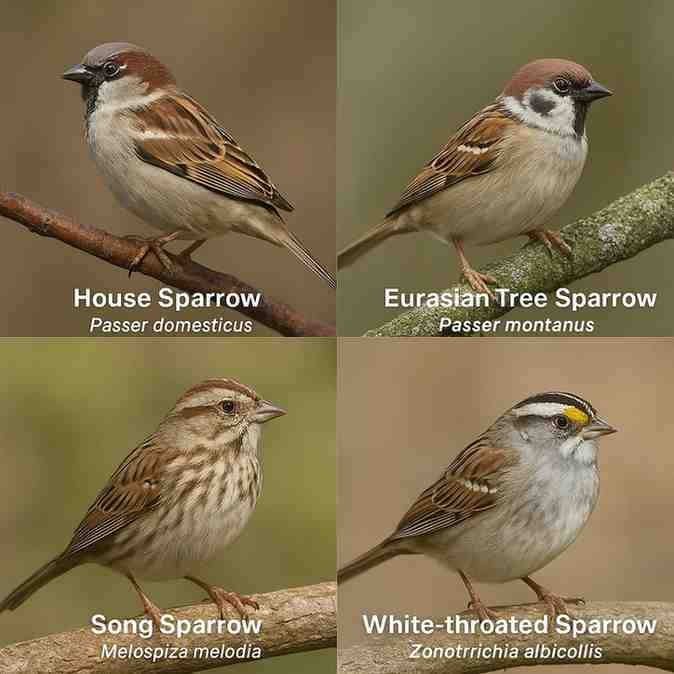
House Sparrow Scientific Name:
House Sparrows are known scientifically as Passer domesticus. This bird is the most common and widely spread species, often sighted in proximity to houses and cities.
Eurasian Tree Sparrow Scientific Name:
The scientific name of the Eurasian tree sparrow is Passer montanus. This bird has a chestnut-colored head and lives throughout Asia and Europe.
Indian Sparrow Scientific Name:
The Indian sparrow, scientifically known as Passer domesticus indicus, is a subspecies of the house sparrow found in India and its surrounding areas.
| Common Name | Scientific Name | Region |
|---|---|---|
| House Sparrow | Passer domesticus | Worldwide |
| Indian Sparrow | Passer domesticus indicus | South Asia |
| Eurasian Tree Sparrow | Passer montanus | Europe & Asia |
| Spanish Sparrow | Passer hispaniolensis | Southern Europe |
| American Tree Sparrow | Spizelloides arborea | North America |
| Cape Sparrow | Passer melanurus | Southern Africa |
| Dead Sea Sparrow | Passer moabiticus | Middle East |
| Java Sparrow | Padda oryzivora | Indonesia & Asia |
| Rock Sparrow | Petronia petronia | Europe & Central Asia |
| Yellow-throated Sparrow | Gymnoris xanthocollis | South Asia |
| Sudan Golden Sparrow | Passer luteus | Northeast Africa |
| White-winged Snowfinch | Montifringilla nivalis | Mountainous Europe & Asia |
| Russet Sparrow | Passer cinnamomeus | East Asia |
| Somali Sparrow | Passer castanopterus | East Africa |
| Chestnut Sparrow | Passer eminibey | East Africa |
Conclusion
The scientific name of the sparrow, Passer domesticus, is indicative of one of the most cherished bird species in the world. The house sparrow, Indian sparrow, and Eurasian tree sparrow, among others, have been able to adjust to any environment. They are of great ecological importance, and therefore, they should be preserved to maintain the balance and vibrancy of ecosystems.

