
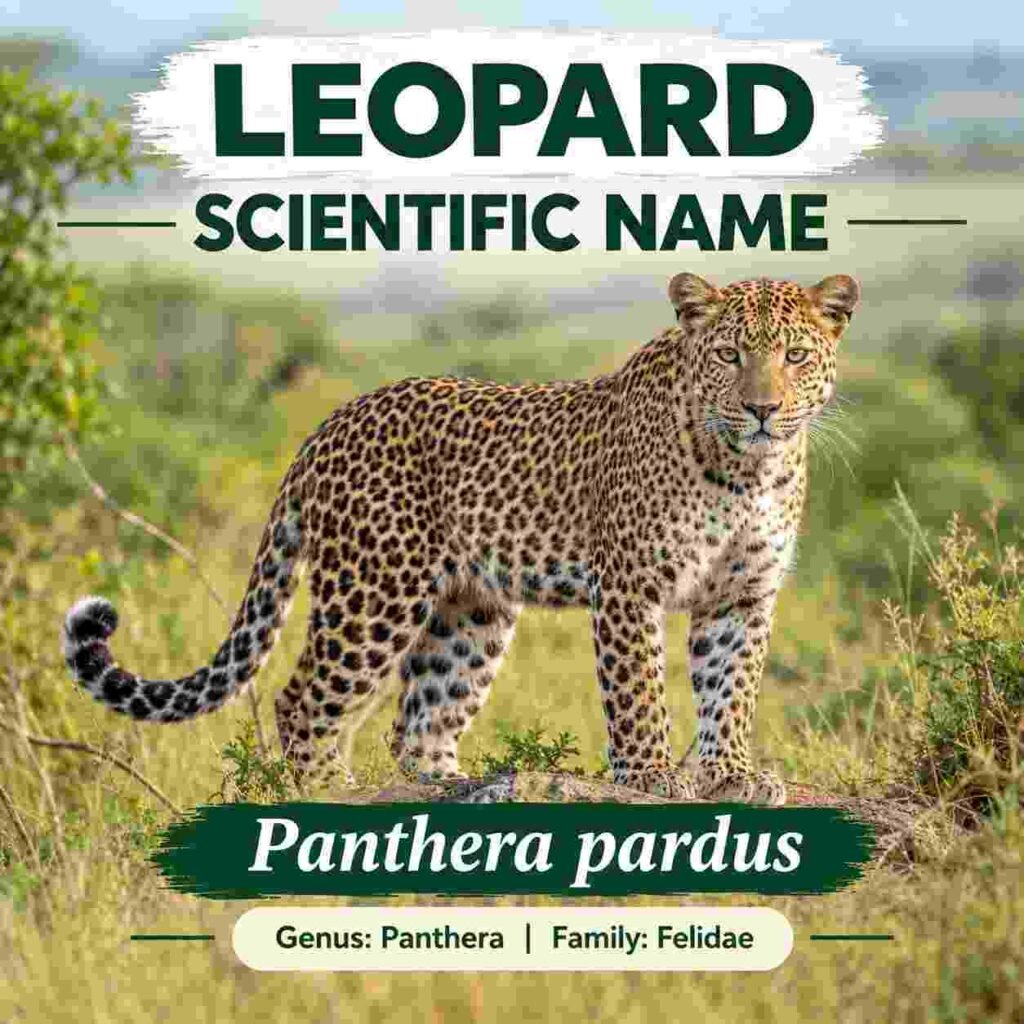
What is the Scientific Name of a Leopard? The leopard scientific name is Panthera pardus.
Wildlife lovers, researchers, and photographers have always been captivated by the African Leopard, one of the most iconic and strong big cats in the world. Noted for its spotted coat, stealthy movement, and adaptability, this article covers everything from leopards’ scientific names to snow leopards and their pronunciation, meaning, classification, types, diet, habitat, and everything else.
Table of Contents
What Is the Scientific Name of a Leopard?
Specific scientific names for leopards?
- Common name: Leopard
- Scientific name: Panthera pardus
- Pronunciation: /ˈpan-thə-rə ˈpär-dəs/.
The Meaning of Panthera Pardus
- Panthera is a Latin-Greek term for the genus that includes lions, tigers, jaguars, and leopards, with a meaning in either language of “predator” or “hunter.”
- Pardus in Greek refers to “the spotted one or the Leopard.”
In other words, the scientific name of a leopard means spotted and a strong hunter of the roaring cat family.
Snow Leopard Scientific Name and Meaning
Snow Leopard Scientific Name
- Common Name: Snow Leopard
- Scientific Name: Panthera uncia
- Pronuciation: /ˈpan-thə-rə ˈuhn-see-uh/
Meaning of Panthera uncia
- This refers to Uncia, a Latin root meaning ‘inch’ or ‘little one’, which is in comparison to the larger felids, such as tigers and lions, and is thus smaller than them, making it valuable in terms of its scientific name.
- At one time, snow leopards were called “ounces.”
Even if the name suggests a close genetic relationship to the leopard, in reality, there is no real resemblance. Snow leopards have evolved into fully adapted mountain cats.
Classification of leopards
The complete taxonomy of leopard biological nomenclature looks like this:
| Classification | Leopard |
|---|---|
| Kingdom | Animalia |
| Phylum | Chordata |
| Class | Mammalia |
| Order | Carnivora |
| Family | Felidae |
| Subfamily | Pantherinae |
| Genus | Panthera |
| Species | pardus |
Smithsonian records place the leopard in Animalia, Chordata, Mammalia, Carnivora, Feliformia, Felidae, and Pantherinae.
Leopard Genus and Species
The genus of the leopard is Panthera, while its species name is pardus.
So, when we break down the scientific name:
- Genus: Panthera
- Species: pardus
- Scientific name: Panthera pardus
The genus Panthera is important because it groups several closely related large cats. Leopards share the genus with lions (Panthera leo), tigers (Panthera tigris), jaguars (Panthera onca), and snow leopards (Panthera uncia).
Leopard Physical Characteristics
Leopards have a solid build. They move on four strong legs and use sharp claws. Their tail is long and helps with balance. Their fur color is often light yellow, but it can also look golden or more brown. Dark spots cover the coat.
Those spots form rosettes, which are repeating ring or flower-like shapes. No two leopard patterns look the same, so people in the field can tell one animal from another. Some leopards look almost fully dark. People call these animals black panthers. Black panthers are still leopards. The dark look comes from melanism, a genetic trait linked to extra dark pigment.
Leopards also have muscles built for movement. They climb, run, and haul prey. Their jaws and teeth fit the job of grabbing and eating other animals.
Leopard Age, Height, Weight, and Size
| Physical Characteristic | Male Leopard | Female Leopard |
|---|---|---|
| Scientific name | Panthera pardus | Panthera pardus |
| Average lifespan in the wild | About 10–15 years | About 10–15 years |
| Maximum recorded lifespan | Can reach around 20 years | Can reach around 20 years |
| Body length | About 1.3–1.9 m | About 1.0–1.6 m |
| Tail length | About 0.6–1.1 m | About 0.6–1.0 m |
| Shoulder height | About 60–70 cm | About 55–65 cm |
| Weight | About 30–90 kg | About 20–60 kg |
| Body size | Large, muscular cat | Large, muscular cat |
| Body shape | Strong and compact | Smaller and more slender |
| Coat color | Yellow, golden, or brown with dark rosettes | Yellow, golden, or brown with dark rosettes |
| Special coat variation | Melanistic individuals may appear black | Melanistic individuals may appear black |
| Legs | Strong, muscular legs | Strong, muscular legs |
| Paws | Broad paws with retractable claws | Broad paws with retractable claws |
| Tail | Long and muscular; helps with balance | Long and muscular; helps with balance |
| Teeth | Sharp canine and carnassial teeth | Sharp canine and carnassial teeth |
| Eyes | Forward-facing eyes adapted for hunting | Forward-facing eyes adapted for hunting |
Leopard Types and Subspecies
Leopards live across a wide area. Different taxonomic works have named several local subspecies over time. Some modern sources also split or combine certain populations in different ways.
Groups that are often listed as leopard subspecies include:
| Leopard Types | Scientific Name |
|---|---|
| African leopard | Panthera pardus pardus |
| Indian leopard | Panthera pardus fusca |
| Sri Lankan leopard | Panthera pardus kotiya |
| Javan leopard | Panthera pardus melas |
| Arabian leopard | Panthera pardus nimr |
| Amur leopard | Panthera pardus orientalis |
| Indochinese leopard | Panthera pardus delacouri |
| Persian leopard | Panthera pardus tulliana |
Taxonomic papers have also described regional types such as the African, Indian, Sri Lankan, Javan, Arabian, Indochinese, and Persian leopards.
Leopard Habitat
Leopards can live in many kinds of places. Their range covers parts of Africa and Asia. Still, today they are found in fewer areas than in the past, and many places are separated from one another.
In different regions, leopards may be found in:
- Savannas
- Grasslands
- Woodlands
- Tropical forests
- Dry forests
- Mountain areas
- Rocky country
- Scrubland
- Places close to rivers and other water sources
This ability to adapt to varied habitats helps explain why the same animal can persist in very different environments.
Leopards also need key resources. They must have food and water. They also need shelter. They rely on areas where hunting and resting are possible. Plants and rocks can act as cover as the leopard moves through its home range.
Leopard Diet
Leopards are carnivores, which means their natural diet consists mainly of other animals. Their prey varies according to location and availability.
Leopards may hunt:
- Antelope
- Gazelles
- Deer
- Wild pigs
- Monkeys
- Rodents
- Birds
- Reptiles
- Fish
- Small mammals
A leopard is an opportunistic predator. It does not depend on only one prey species. Instead, it can change its hunting behavior based on the habitat and available food.
Quick Facts About Leopard
| Category | Details |
|---|---|
| Common Name | Leopard |
| Scientific Name | Panthera pardus |
| Genus | Panthera |
| Species | pardus |
| Family | Felidae |
| Order | Carnivora |
| Class | Mammalia |
| Phylum | Chordata |
| Kingdom | Animalia |
| Diet | Carnivorous |
| Main Range | Africa and Asia |
| Snow Leopard Scientific Name | Panthera uncia |
| Black Panther | Usually a melanistic leopard or jaguar |
FAQs
What is the leopard scientific name?
The leopard scientific name is Panthera pardus.
What is the genus of a leopard?
The genus of a leopard is Panthera.
What is the family of a leopard?
The leopard belongs to the Felidae family, which includes cats.
Is a leopard a mammal?
Yes. The leopard is a mammal in the class Mammalia.
Is a leopard a carnivore?
Yes. Leopards are carnivorous mammals and mainly eat other animals.
Where do leopards live?
Leopards live in parts of Africa and Asia and can use forests, grasslands, savannas, mountains, woodlands, and other suitable habitats.

