
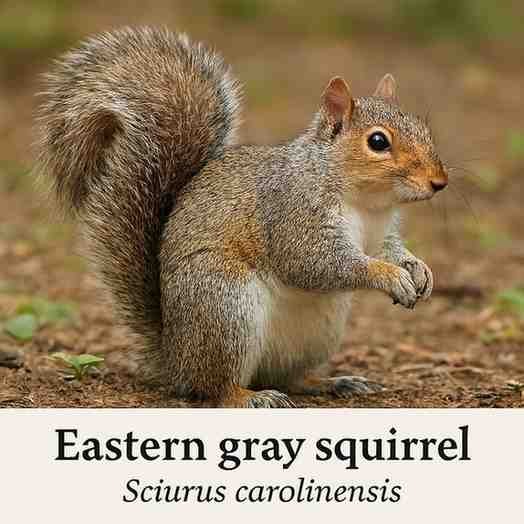
What is the scientific name of a squirrel? The squirrel scientific name is Sciurus (genus).
Squirrels, the most common and recognizable mammals, have their habitat in forests, urban parks, mountains, and backyards. They are highly regarded for their climbing skills, nut-storing practices, and brilliance. The squirrel scientific name varies with species, but the most recognized and mostly studied squirrel is the Eastern grey squirrel, with the scientific name Sciurus carolinensis. This classification made by science enables biologists to determine the species, trace its development, and investigate its behavior in a variety of ecological areas.
Table of Contents
The term Sciurus has its origins in Greek; skia refers to shadow, and oura to tail, which means squirrels live resting under their tails’ shade. The gray squirrel’s scientific name is used all over the world for research in wildlife, zoology, and conservation biology.
What Is the Scientific Name of a Squirrel?
The common scientific name of a squirrels is Sciurus. Nevertheless, every single species of squirrel has its very own unique binomial name.
| Common Name | Scientific Name | Pronunciation | Genus | Family |
|---|---|---|---|---|
| Eastern Gray Squirrel | Sciurus carolinensis | sy-oor-us ka-ro-li-NEN-sis | Sciurus | Sciuridae |
| Red Squirrel | Sciurus vulgaris | sy-oor-us vul-GA-ris | Sciurus | Sciuridae |
| Fox Squirrel | Sciurus niger | sy-oor-us NYE-jer | Sciurus | Sciuridae |
Meaning of the Squirrel Scientific Name:
- Sciurus: shadow tail (Greek origin)
- carolinensis: from Carolina, that is to say, its original area in North America.
Squirrel Scientific Name Pronunciation:
- Sciurus carolinensis is pronounced: sy-oor-us ka-ro-li-NEN-sis
Zoologists rely on this scientific name to unambiguously identify the species worldwide and separate it from other similar squirrel species.
Biological Classification of Squirrel
| Taxonomic Rank | Classification |
|---|---|
| Kingdom | Animalia |
| Phylum | Chordata |
| Class | Mammalia |
| Order | Rodentia |
| Family | Sciuridae |
| Genus | Sciurus |
| Species | carolinensis / vulgaris |
Squirrel Age, Weight, and Size
Squirrels possess various physical characteristics that give them an edge in the struggle for survival in their habitat.
Main physical attributes consist of:
- Tree bark is grasped with sharp claws.
- Jumping ability due to strong hind legs
- Long tails for maintaining balance and communicating
- Good eyesight for spotting enemies
All these characteristics together make it possible for the squirrels to flee from the predators by quickly moving up in the trees.
| Feature | Average Measurement |
|---|---|
| Age (Lifespan) | 6–12 years in the wild, up to 20 in captivity |
| Weight | 400–700 grams |
| Body Length | 23–30 cm (excluding tail) |
| Tail Length | 20–25 cm |
| Height (standing) | Around 15–20 cm |
The gray squirrel is medium-sized, agile, and adapted for swift climbing and jumping.
Habitat and Distribution
Where Do Squirrels Live?
Squirrels are present in almost every continent but not in Antarctica. The scientific name of the species, eastern gray squirrel, denotes its origin in North America; however, it has become common in Europe and South Africa due to human intervention.
Typical Habitats are:
- Deciduous forests
- Oak and pine woodlands
- Suburban areas with trees
- Mixed woodlands
- Urban parks
- Residential gardens
- Mountain forests
The trees are important for the squirrels, as they provide shelter, food, and nesting places, which are among the main roles of tree habitats.
Geographic Distribution:
The Eastern gray squirrel (Sciurus carolinensis) is native to North America but has also been introduced to parts of Europe and South Africa. The red squirrel (Sciurus vulgaris) is a European and Asian dwelling animal.
Human movement and habitat changes have affected squirrel distribution worldwide.
Squirrel Diet and Food Habits
What Do Squirrels Eat?
Squirrels belong to the omnivorous group, mostly consuming plants with occasional intake of animals for protein.
Squirrels’ favorite food includes:
- Nuts and seeds
- Fruits and berries
- Tree bark and buds
- Mushrooms and fungi
- Bird eggs (rarely)
The taxonomical classification of the squirrel’s scientific name points towards their preparedness for the food shortage season, particularly hiding nuts in the fall so that they can feed on them during winter.
Types of Squirrels
Squirrels can be divided into three main types based on their habitat, movement, and lifestyle. These categories greatly benefit the study of squirrel behavior and adaptation in various environments for scientists and wildlife researchers.
1. Tree Squirrels
The tree squirrel is the most common type of squirrel. They mainly live in trees, and their climbing and jumping ability is good.
Some main features of tree squirrels are:
- Tree-dwelling mainly
- Nesting is called drying, using leaves and twigs
- Long tails that are useful for balance
- Most tree squirrels are in the genus Sciurus.
The following are some of the common species of tree squirrels:
- Eastern gray squirrel
- Red squirrel
- Fox squirrel
The tree squirrel habitat is a combination of forests, city parks, and areas surrounded by old and tall trees.
Types of Tree Squirrels
Eastern Gray Squirrel (Sciurus carolinensis):
- Gray fur
- Long bushy tail
- Found in parks and forests
Red Squirrel (Sciurus vulgaris):
- Reddish fur
- Smaller body
- Common in Europe and Asia
Fox Squirrel (Sciurus niger):
- Large size
- Yellow-orange belly
- Native to North America
2. Ground Squirrels
Ground squirrels are animals that spend their lives primarily on or under the ground. Their lifestyle differs significantly from that of tree squirrels, as ground squirrels build complex tunnel systems that provide shelter and protection.
Some main characteristics of ground squirrels are:
- Lifestyle in built subterranean burrows
- Ground living is more than tree living
- Usually, they live in groups.
Ground squirrels consist of animals like:
- Chipmunks
- Prairie dogs
- Groundhogs
Ground squirrels prefer habitats like grasslands, deserts, and open fields.
3. Flying Squirrels
Flying squirrels aren’t flying in the real sense; instead, they are gliding and moving from one tree to another by means of a membrane of skin that is unique to them.
Flying squirrels have several key characteristics, such as:
- Gliding from one tree to another
- Having a skin membrane called the patagium
- Being mostly active during the night
The gliding squirrels are dependent on thick forests of tall trees and are seldom observed because of their nocturnal habits.
Squirrel Behavior and Reproduction
Squirrels are primarily diurnal. Their daily cycle consists of eating, fur maintenance, and patrolling their territory.
Squirrels use the following means for communication:
- Short sounds
- Moving tails
- Changing postures
These means help alert other squirrels to the threat or guard the food location.
Reproduction and Life Cycle of Squirrels:
The female squirrel usually delivers two to four pups after about 44 days of gestation.
Main phases of the squirrel life cycle:
- The pups are born blind and without fur
- Young squirrels remain in the nest for some weeks
- Later, they are taught to find food and then become independent
In some cases, depending on food availability, there is more than one litter per year.
Interesting Facts
- Squirrels can turn their ankles 180 degrees, which makes it possible for them to descend trees in a headfirst position.
- Their incisors grow continuously throughout their entire lives.
- Squirrels rely on physical markers to remember where they’ve hidden their food underground.
- Certain types of squirrels can jump over 6 meters in just one leap.

