
What is the scientific name of the octopus? The octopus scientific name is Octopoda.
Marine animals with soft bodies belonging to the class Cephalopoda, and the order Octopoda, are octopuses. More than 300 known species fall under the generic term “octopus,” and a scientific name is given to each species. The scientific name of the octopus, like any other animal, is based on its genus and species.
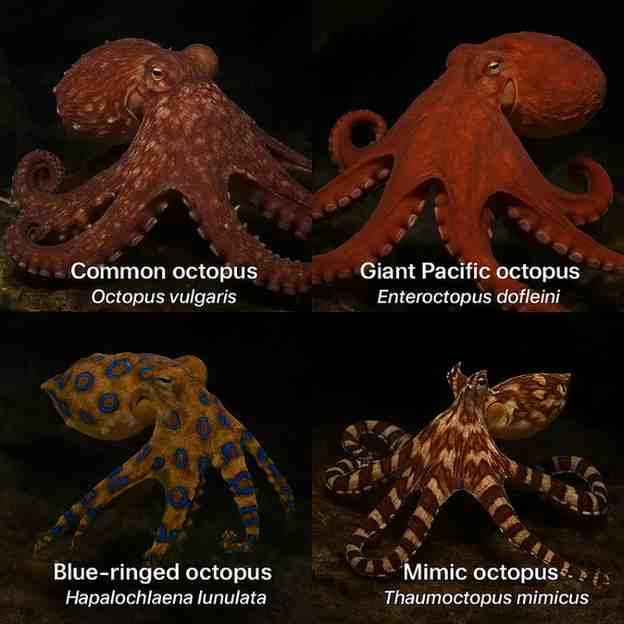
For example, the common octopus is termed Octopus vulgaris, whereas the giant Pacific octopus has the scientific name Enteroctopus dofleini. The current study discusses some of the commonly known species of octopus, including their scientific names, biological classification, and unique characteristics.
Table of Contents
What is the Scientific Name of the Octopus?
Octopus vulgaris is the scientific name of the common Octopus. However, octopuses are not a species. They are a whole group of animals in the order Octopoda, which numbers over 300 species. Each has its own scientific name.
For example:
- Common Octopus: Octopus vulgaris
- Giant Pacific Octopus: Enteroctopus dofleini
- Blue-Ringed Octopus: Hapalochlaena lunulata
- Mimic Octopus: Thaumoctopus mimicus
Biological meaning and pronunciation
Pronunciation in English: Ok-toh-pus vul-GAIR-iss.
Octopus scientific name meaning
- The Greek words deduced “okto” (eight-foot) and “pous” meaning eight-footed.
- vulgaris is Latin for common or ordinary
So, literally: “the common eight-footed inventor or contrivance,” Octopus vulgaris.
Scientific Classification of Octopus
| Rank | Classification |
|---|---|
| Kingdom | Animalia |
| Phylum | Mollusca |
| Class | Cephalopoda |
| Order | Octopoda |
| Family | Octopodidae |
| Genus | Octopus |
| Species | vulgaris |
Types of Octopus
Octopuses are amazing sea creatures with over 300 species worldwide. These animals are found in the depths of the deep ocean, down to three thousand feet, or they roam along coastlines and around coral reefs, and even as far as the North Pole. Octopus is a common term. In different languages, different types of octopus are also known by their names in reference to other marine animals.
1. Common octopus binomial names:
The most widely distributed species of octopus is the common octopus, making them relatively easy to study. The giant Pacific octopus is a common species, while the red octopus is equally common, considering its less diverse diet. They have a high intelligence, which is recognized. However, they are adaptable and curious and will show up to anyone who spends their time near the shore.
| Octopus Name | Scientific Name | Region |
|---|---|---|
| Common Octopus | Octopus vulgaris | Worldwide |
| Giant Pacific Octopus | Enteroctopus dofleini | North Pacific |
| East Pacific Red Octopus | Octopus rubescens | Pacific Coast |
| California Two-Spot | Octopus bimaculoides | California |
| Big Blue Octopus | Octopus cyanea | Indo-Pacific |
| North Pacific Giant | Enteroctopus dofleini | Alaska, Japan |
| Octopus Macropus | Octopus macropus | Mediterranean |
| Lesser Pacific Striped | Octopus chierchiae | Central America |
| Octopus Defilippi | Octopus defilippi | Mediterranean |
| Octopus Kaurna | Octopus kaurna | Australia |
2. Colorful and Unique Octopuses:
These octopuses are known for their beautiful, colorful patterns, along with some unique behaviors. Such species include the poisonous blue octopus and the mimic octopus, which mimics other marine animals.
| Octopus Name | Scientific Name | Region |
|---|---|---|
| Blue-Ringed Octopus | Hapalochlaena lunulata | Indo-Pacific |
| Southern Blue-Ringed | Hapalochlaena maculosa | Australia |
| Greater Blue-Ringed | Hapalochlaena maxima | Indo-Pacific |
| Mimic Octopus | Thaumoctopus mimicus | Indonesia |
| Wonderpus | Wunderpus photogenicus | Indo-Pacific |
| Star-Sucker Pygmy | Octopus wolfi | Indo-Pacific |
| Coconut Octopus | Amphioctopus marginatus | Indo-Pacific |
| Atlantic Pygmy | Octopus joubini | Atlantic |
| Caribbean Reef | Octopus briareus | Caribbean |
| Algae Octopus | Abdopus aculeatus | Indo-Pacific |
3. Reef and shallow-water octopuses:
In the marine waters near the coast and around coral reefs, reef octopuses hunt for crabs, shrimp, and small fish. They use coral as a hiding place among the rocks and as a currency.
| Octopus Name | Scientific Name | Region |
|---|---|---|
| Caribbean Reef Octopus | Octopus briareus | Caribbean |
| Atlantic Pygmy Octopus | Octopus joubini | Atlantic |
| Algae Octopus | Abdopus aculeatus | Indo-Pacific |
| Day Octopus | Octopus cyanea | Indo-Pacific |
| White-Spotted Octopus | Callistoctopus macropus | Atlantic |
| Octopus Hummelincki | Octopus hummelincki | Caribbean |
| Octopus Tetricus | Octopus tetricus | Australia |
| Lesser Pacific Striped | Octopus chierchiae | Central America |
| Maori Octopus | Octopus maorum | Australia |
| Amphioctopus aegina | Amphioctopus aegina | Indo-Pacific |
4. Deep-sea octopus scientific name
These octopuses are found in the dark, cold waters of the deep sea floor. Some deep-sea octopuses, such as the dumbo octopus, have unusual fins, while other deep-sea octopuses are almost completely transparent.
| Octopus Name | Scientific Name | Region |
|---|---|---|
| Dumbo Octopus | Grimpoteuthis spp. | Deep sea |
| Cirrate Octopus | Opisthoteuthis spp. | Deep oceans |
| Umbrella Octopus | Opisthoteuthis californiana | Pacific |
| Red Pacific Octopus | Graneledone boreopacifica | Pacific |
| Muusoctopus | Muusoctopus spp. | North Pacific |
| Benthoctopus | Benthoctopus spp. | Atlantic |
| Deep-Sea Arctic Octopus | Bathypolypus arcticus | Arctic |
| Seven-Arm Octopus | Haliphron atlanticus | Atlantic |
| Glass Octopus | Vitreledonella richardi | Worldwide |
| Luteuthis | Luteuthis dentatus | Pacific |
5. Unusual and rare octopuses types
Rare octopuses differ from the ordinary ones in their looks or their ways of life. On one hand, we have the blanket octopus and their flowing membranes, while we leave the glass octopus with its almost translucent semi-transparency.
| Octopus Name | Scientific Name | Region |
|---|---|---|
| Blanket Octopus | Tremoctopus violaceus | Tropics |
| Seven-Arm Octopus | Haliphron atlanticus | Atlantic |
| Glass Octopus | Vitreledonella richardi | Worldwide |
| Longarm Octopus | Macrotritopus defilippi | Mediterranean |
| Big-Fin Octopus | Magnapinna spp. | Deep sea |
| Jellyfish Octopus | Opisthoteuthis californiana | Pacific |
| Wunderpus | Wunderpus photogenicus | Indo-Pacific |
| Horned Octopus | Eledone cirrhosa | Atlantic |
| Striped Octopus | Octopus sp. | Central America |
| Starry Night Octopus | Callistoctopus luteus | Indo-Pacific |
6. Cold Water and Polar Octopus:
These cold-water octopuses are in frigid seas surrounding Antarctica and the Arctic. The blood of these cold-water octopuses has special proteins that help them survive in icy conditions.
| Octopus Name | Scientific Name | Region |
|---|---|---|
| Turquet’s Octopus | Pareledone turqueti | Antarctica |
| Antarctic Octopus | Megaleledone setebos | Antarctica |
| Pareledone charcoti | Pareledone charcoti | Antarctica |
| Pareledone albimaculata | Pareledone albimaculata | Southern Ocean |
| Arctic Octopus | Bathypolypus arcticus | Arctic |
| Muusoctopus rigbyae | Muusoctopus rigbyae | Antarctic deep sea |
| Benthoctopus piscatorum | Benthoctopus piscatorum | Atlantic |
| Pareledone adelieana | Pareledone adelieana | Antarctica |
| Graneledone antarctica | Graneledone antarctica | Antarctica |
| Pareledone aurata | Pareledone aurata | Antarctica |
Octopus Habitats and Diet
Habitat of the Octopus
Octopuses inhabit oceans throughout the world, from shallow coastal waters to the deep sea. Coral reefs, rocky crevices, and seagrass beds are habitat types preferred by most species because they provide refuge and hiding spots. The octopus will use these areas for hiding from their predators and for ambushing their prey. Some deep-sea octopuses live thousands of meters below the surface in regions where sunlight never penetrates.
Characteristics of Octopus Habitat:
- Coastal waters: rich in food and shelter.
- Coral reefs: ideal for camouflage and hiding.
- Deep-sea ranges: place of residence for unique octopus species that are adapted to dark environments.
Diet of the Octopus
Octopuses are carnivorous animals that primarily feed on small marine animals, such as crabs, shrimps, clams, or mussels, as well as small fish. They generally hunt at night and rely on stealth as well as intelligence to catch the prey.
How Octopuses Hunt:
- Arms and Suction Cups: Grabbing and holding prey tightly.
- Sharp Beak: To break shells of crabs and mollusks.
- Venom: In some species, it is injected to immobilize the prey.
Octopus Fun Fact
Did you know that an octopus has three hearts? Two pumps blood to the gills, and one to the rest of the body. Interestingly, the main heart stops beating while an octopus is swimming.
Conclusion
The octopus, more commonly known as Octopus vulgaris, is a member of the genus Octopus and thrives in many habitats in the ocean. From housekeeping in coral reefs to plunging into the abyss, it has learned to outsmart and outwit diverse environments as a cunning and crafty predator. The carnivorous lifestyle and unique hunting strategy, along with other features of its biology, make it one of the most incredible creatures in the sea.

