
What is the scientific name for a crow? The crow scientific name is Corvus.
Crows are perhaps the most intelligent and adaptable birds on Earth. Known for their manifold complex communication, tool use, and problem-solving abilities, crows belong to the generic Corvus. This guide provides an in-depth study into the crow’s scientific name, its pronunciation coupled with meaning, the biological classification, genus, and the specific scientific names of different crow species around the globe.
Table of Contents
What Is Crow Scientific Name?
- Scientific Name: Corvus
- Pronunciation: /ˈkɔːr.vəs/
- Crow Biological Name in English: Corvus, meaning “crow” or “raven” in Latin
A crow refers to any member of the scientific name Corvus, which includes crows and ravens. In the scientific community, this genus is used to refer to a large group of birds under the Corvidae family.
Genus and Species of Crow
Every crow falls under the Genus Corvus. However, each kind of crow has its distinct species name. Thus, Genus and Species together create the full scientific name of a crow.
For example:
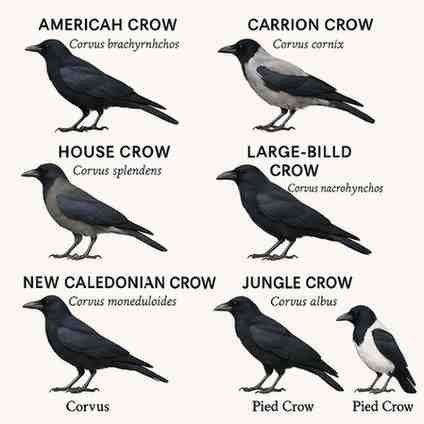
- American crow: Corvus brachyrhynchos
- House crow: Corvus splendens
- Jungle crow: Corvus macrorhynchos
Thus, when we talk about the genus, and species, of the scientific name of a crow, we are referring to the identification of any species under the great Corvus umbrella.
Pronunciation and Meaning of Scientific Name Corvus

Pronunciation of crow scientific name
The word Corvus is pronounced:
- KOR-vus
- “KOR” sounds like the word “core.”
- “vus” rhymes with “us“
Accurate scientific pronunciation is important in zoology, ornithology, and education.
Meaning Behind the Crow Biological Name
Corvus is derived from the Latin word, meaning “crow” or “raven.” It embodies their exquisite form and loud behavior: These birds are recognized for their loud “caws,” black feathers, and enigmatic presence. The scientific name include both the classifications and certain characteristics typical of all intelligence, adaptability, and social complexity.
Biological Classification of Crows
Here is the correct biological classification of crows:
| Category | Classification |
|---|---|
| Kingdom | Animalia |
| Phylum | Chordata |
| Class | Aves |
| Order | Passeriformes |
| Family | Corvidae |
| Genus | Corvus |
| Common Name | Crow |
This classification places crows among the biggest orders of birds, the Passeriformes, which are otherwise known as perching birds or songbirds.
Types of Crows and Their Scientific Names
Crows are omnipresent on the globe as crows. Each species of crow has an individual scientific name, but all belong to the same genus. Some of the more common species are as follows:
1. American Crow
- Scientific Name: Corvus brachyrhynchos
- Region: United States and Canada
- This is the most commonly seen crow in North America.
2. Carrion Crow
- Scientific Name: Corvus corone
- Region: Europe and Asia
- Said to feed on dead animals and live in rural and urban climates.
3. Fish Crow
- Scientific Name: Corvus ossifragus
- Region: Southeastern United States
- Slightly smaller than the American crow and has a nasal call.
4. Hooded Crow
- Scientific Name: Corvus cornix
- Region: Northern and Eastern Europe
- Easily distinguished due to its gray body and black head, wings, and tail.
5. Common Crow
It is essential to note that this term can refer to different species in various parts of the world. It usually refers to the American crow in the USA and, in Europe, to the carrion crow.
Note: Common Crow is a general term, not a specific term for any species.
6. House Crow
- Scientific Name: Corvus splendens
- Region: India, Southeast Asia, East Africa
- Effectively thrives in cities and near human settlements.
7.Large-Billed Crow
- Scientific Name: Corvus macrorhynchos
- Region: South Asia and Japan
- In some areas, it is known as a jungle crow.
8.Indian Crow
- An alternative name for the house crow in India.
- Scientific name: Corvus splendens
9. New Caledonian Crow
- Scientific Name: Corvus moneduloides
- Region: New Caledonia (Pacific Islands)
- Famous for tool-making and problem-solving skills.
10.Pied Crow
- Scientific Name: Corvus albus
- Region: Africa
- Black with a distinctive white chest and neck.
11. Hawaiian Crow (ʻAlalā)
- Scientific Name: Corvus hawaiiensis
- Region: Hawaii (critically endangered)
- Part of conservation efforts and reintroduction projects.
12. Black Crow
- A general term used for any crow with a dark plumage.
- The scientific name varies depending on the exact species.
Where Are Crows Found?
Crows are birds that have one of the most extensive ranges: they live in
- North America
- Europe
- Asia
- Africa
- Australia
- Pacific Islands
They reside in forests, grasslands, cities, coasts, and farms. The only continents that do not include them are South America and Antarctica.
Are All Crows the Same?
No, all crows are not the same. They all belong to one genus but differ in:
- Appearance
- Size
- Vocal patterns
- Behavior
- Levels of intelligence.
For example, an American crow is known for its memory and urban survival skills. In contrast, New Caledonian crows make and use tools, one of the few animals in the world to do so.
Brief Summary of Crow Zoological Names
Here is a summary of all those actual and interesting facts about crows.
- Scientific Name: Corvus
- Pronunciation: KOR-vus
- Meaning: Latin for crow or raven
- Family: Corvidae
- Order: Passeriformes
- Kingdom: Animalia
- Types: American crow, jungle crow, house crow, hooded crow, New Caledonian crow, Hawaiian crow, and many others.
In Conclusion
By learning the scientific name of crows and the different species classified within the genus Corvus, we are better suited to the future dimensions of knowledge that this bird presents. From the North American crow to the Pacific Hawaiian crow to the Asian house crow, each one finds significance in its respective environment. With appropriate scientific names, we shall communicate clearly about these birds all over the planet.

