
What is the scientific name for a cactus? The cactus scientific name is Cactaceae (family).
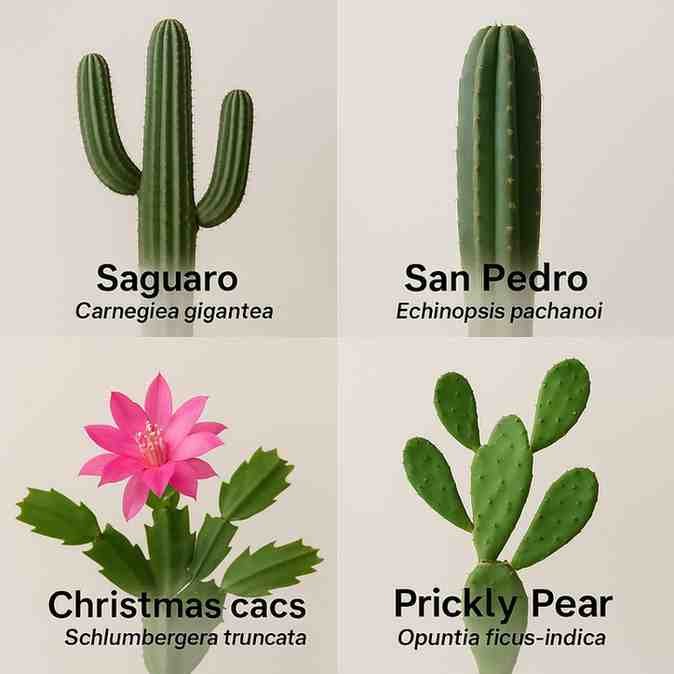
People recognize cacti for their ability to survive in dry and desert regions. The most common types of cacti are the Saguaro cactus, San Pedro cactus, Christmas cactus, and Prickly Pear cactus. Each cactus type has its own binomial name, structure, flowers, and fruits. Knowledge of cactus scientific names, types, and various uses is helpful information for gardeners, researchers, and plant enthusiasts.
This article covers cactus scientific names, classifications, flowers, fruits, and their significance.
Table of Contents
What is the Cactus Scientific Name?
The cactus’s scientific name depends on the species. A cactus belongs to the family Cactaceae under the Plantae kingdom.
- Genus: Varies (Carnegiea, Echinopsis, Schlumbergera, Opuntia, etc.)
- Species: Varies depending on type
The word cactus comes from the Greek word kaktos. Botanists prefer to name all cacti with a two-part scientific name based on genus and species. The scientific name for the Saguaro cactus is Carnegiea gigantea.
Biological Classification of Cactus
| Rank | Classification Details |
|---|---|
| Kingdom | Plantae (Plants) |
| Subkingdom | Tracheobionta (Vascular plants) |
| Superdivision | Spermatophyta (Seed plants) |
| Division | Magnoliophyta (Flowering plants) |
| Class | Magnoliopsida (Dicotyledons) |
| Subclass | Caryophyllidae |
| Order | Caryophyllales |
| Family | Cactaceae (Cactus family) |
| Genera | ~127 genera (Carnegiea, Opuntia, Echinopsis, Mammillaria, Schlumbergera, etc.) |
| Species | ~1,750 species |
Cactus Types and Scientific Names
There are over 1,700 species of cacti, which can be broadly categorized into main types based on their shape, size, and growth habits. Knowledge of cactus classifications is useful for making determinations, gardening, and studying the scientific names of cacti.
1. Columnar Cactus Scientific Names
- These are tall-in-the-air cacti, which stand erect like columns.
- Features of Columnar Cactus: Tall-stemmed, with several arms, flowers on top, adapted to desert regions.
| Common Name | Scientific Name |
|---|---|
| Saguaro Cactus | Carnegiea gigantea |
| San Pedro Cactus | Echinopsis pachanoi |
| Organ Pipe Cactus | Stenocereus thurberi |
| Blue Torch Cactus | Pilosocereus azureus |
| Peruvian Apple Cactus | Cereus repandus |
| Mexican Fence Post | Pachycereus marginatus |
| Totem Pole Cactus | Pachycereus schottii |
| Hedge Cactus | Cereus hildmannianus |
| Queen of the Night | Cereus jamacaru |
| Cardón Cactus | Pachycereus pringlei |
2. Globular Cactus Botanical Names
- Cactus in a round or ball shape.
- Features of globular cactus: Spherical body; spines rimming the body; small flowers on the top.
| Common Name | Scientific Name |
|---|---|
| Golden Barrel Cactus | Echinocactus grusonii |
| Fishhook Barrel | Ferocactus wislizeni |
| Bishop’s Cap | Astrophytum myriostigma |
| Turk’s Cap | Melocactus matanzanus |
| Ball Cactus | Parodia magnifica |
| Chin Cactus | Gymnocalycium mihanovichii |
| Star Cactus | Astrophytum asterias |
| Powder Puff Cactus | Mammillaria bocasana |
| Pincushion Cactus | Mammillaria spinosissima |
| Notocactus | Parodia leninghausii |
3. Opuntia or Pad Cactus Latin Names
- These are either flat pads or jointed stems, known as prickly pears.
- Features: Pads store water, produce edible fruits called tunas, and flowers grow from the edges of pads.
| Common Name | Scientific Name |
|---|---|
| Prickly Pear Cactus | Opuntia ficus-indica |
| Bunny Ear Cactus | Opuntia microdasys |
| Cow’s Tongue Cactus | Opuntia engelmannii |
| Pancake Prickly Pear | Opuntia chlorotica |
| Mojave Prickly Pear | Opuntia erinacea |
| Texas Prickly Pear | Opuntia lindheimeri |
| Beavertail Cactus | Opuntia basilaris |
| Indian Fig Cactus | Opuntia ficus-indica |
| Desert Prickly Pear | Opuntia phaeacantha |
| Orange Prickly Pear | Opuntia aurea |
4.Epiphytic Cactus Biological Names
- Cactuses that grow on trees and rocks and do not grow in soil.
- Epiphytic Cactus Features: The rainforest habitat, shade-loving, colourful flowers, chief ones for interiors.
| Common Name | Scientific Name |
|---|---|
| Christmas Cactus | Schlumbergera truncata |
| Easter Cactus | Hatiora gaertneri |
| Thanksgiving Cactus | Schlumbergera bridgesii |
| Orchid Cactus | Epiphyllum oxypetalum |
| Moonlight Cactus | Selenicereus grandiflorus |
| Fishbone Cactus | Epiphyllum anguliger |
| Rick Rack Cactus | Disocactus anguliger |
| Jungle Cactus | Rhipsalis baccifera |
| Coral Cactus | Rhipsalis cassutha |
| Night Blooming Cereus | Hylocereus undatus |
5. Creeping and Climbing Cactus
- Cacti that spread along the ground or climb by long stems.
- Features: Thin-stemmed, climbing type, large flowers, fruits including dragon fruit.
| Common Name | Scientific Name |
|---|---|
| Dragon Fruit Cactus | Hylocereus undatus |
| Queen of the Night | Epiphyllum oxypetalum |
| Pereskia Cactus | Pereskia aculeata |
| Climbing Cactus | Hylocereus costaricensis |
| Creeping Devil | Stenocereus eruca |
| Rope Cactus | Rhipsalis campos-portoana |
| Leaf Cactus | Pereskia grandifolia |
| Pitaya Amarilla | Hylocereus megalanthus |
| Night Queen Cactus | Selenicereus anthonyanus |
| Snake Cactus | Rhipsalis paradoxa |
6. Rare and Decorative Cactus
- Unique species grown for decoration or collection.
- Decorative features: Small, colorful, often grafted, grown as an ornamental cactus.
| Common Name | Scientific Name |
|---|---|
| Moon Cactus | Gymnocalycium mihanovichii |
| Star Cactus | Astrophytum asterias |
| Bishop’s Cap | Astrophytum myriostigma |
| Peanut Cactus | Echinopsis chamaecereus |
| Fairy Castle Cactus | Acanthocereus tetragonus |
| Red Cap Cactus | Gymnocalycium friedrichii |
| Totem Pole Cactus | Lophocereus schottii |
| Button Cactus | Ariocarpus fissuratus |
| Sea Urchin Cactus | Astrophytum ornatum |
| Feather Cactus | Mammillaria plumosa |
Cactus Flower and Fruit
Cactus Flowers:
Cactus flowers are important for pollination and survival purposes. The scientific name of a cactus is closely related to its flower pattern. Most cactus flowers bloom in the morning and evening, depending on the species they belong to.
- Saguaro cactus flowers were declared the official state flower of Arizona.
- San Pedro cactus flowers have been specialized for night opening to attract moths and bats.
- Christmas cactus flowers open to bloom during the winter holiday.
- Prickly Pear cactus flowers would lure bees and insects to pollinate.
Cactus flowers do have the shortest period within their life cycle; however, they play a significant role in reproduction.
Cactus Fruits:
Cactus fruits are edible in many species. Cactus fruit contains seeds for reproduction and is food for animals and humans.
- Saguaro fruits are red and eaten by desert birds and native people.
- Prickly Pear fruits are sweet and juicy. It is used for jams, drinks, and medicine.
- San Pedro fruits are small and are less commonly used to make food.
- Christmas cactus fruits grow rarely at home, but come up under natural conditions.
Cactus fruits are excellent sources of vitamins, minerals, and antioxidants. They are used for hydration and nutrition in arid regions.
Uses of Cactus Fruits and Pads
- Food: Prickly Pear pads (called nopal) and fruits-they are eaten as vegetables and fruits.
- Medicine: Cactus fruit extracts in digestion, skin care, and hydration.
- Decoration: The Christmas cactus is much appreciated as an indoor plant.
- Support wildlife: The Saguaro cactus fruits provide food to birds, bats, and animals.
Adaptations and Growth of Cactus
Cactus survives because of its special adaptations:
- Stems store water because they are thick.
- Water loss occurs in the spines of the cactus that protect its interior from animals.
- Root systems are shallow, spreading wide to collect the rainwater that falls.
- It flowers at particular times to attract pollinators.
These features, make cacti some of the toughest plants in the desert.
Names of cactus in Different Languages
| Language | Common Name |
|---|---|
| English | Cactus |
| Spanish | Cacto |
| French | Cactus |
| German | Kaktus |
| Italian | Cactus |
| Portuguese | Cacto |
| Arabic | صبار (Sabbar) |
| Hindi | नागफनी (Nagfani) |
| Chinese (Mandarin) | 仙人掌 (Xiānrénzhǎng) |
| Japanese | サボテン (Saboten) |
| Russian | Кактус (Kaktus) |
| Urdu | ناگ پھنی (Naag Phani) |
Conclusion
The scientific name of a cactus helps us establish an identity for each species. Plants such as the Saguaro cactus, San Pedro cactus, Christmas cactus, and Prickly Pear cactus differ in their flowers and fruits, serving an array of purposes. Cacti are plants that live in the desert. They are also grown as indoor plants. Knowledge of scientific names, types, flowers, and fruits of cactus gives insight to plant enthusiasts, gardeners, and researchers.
Cacti aren’t just desert survivors. They also provide food, medicine, and attractions.
best for everyone