
What is the scientific name for a camel? The camel scientific name is Camelus (genus).
The camel is unique among desert animals in that it survives at the end of a short, dry, and barren stretch of wilderness. It is often referred to as the “ship of the desert” for its strength, endurance, and adaptability. In this article, we will thoroughly discuss the scientific name of the camel, its binomial name, gender, classification, definition, pronunciation, habitat, diet, types, and surprising facts.
Table of Contents
What is the Scientific Name For a Camel?
Camelus is the scientific name for a camel. The genus Camelus includes all species of camel. The word originates from Latin and Greek roots, meaning “camel” in its simplest form, reflecting its long association with human civilizations.
Binomial meaning of camel scientific name:
A camel (from Latin: camelus and Ancient Greek: κάμηλος (kamēlos) from Ancient Semitic: gāmāl) is an even-toed ungulate in the genus Camelus that bears distinctive fatty deposits known as “humps” on its back.
Pronounce of camel scientific name:
The common word “camel” is pronounced KAM-ul. The scientific name would be in the form of genus Camelus (KAH-myoo-lus) followed by the species, such as bactrianus (bak-TRI-AN-us) for the Bactrian camel or dromedarius (droh-MED-a-ri-us) for the dromedary camel.”
Biological Classification of Camel
| Rank | Classification |
|---|---|
| Kingdom | Animalia |
| Phylum | Chordata |
| Class | Mammalia |
| Order | Artiodactyla |
| Family | Camelidae |
| Genus | Camelus |
| Species | C. dromedarius and C. bactrianus |
This scientific classification shows that camels are mammals, even-toed ungulates, and are closely related to other desert herbivores.
Camels’ Habitat
Camels are very adaptable creatures that can live in extreme weather conditions, even when most other species die. Therefore, their habitat comprises:
- Main Regions Where Camels Live (Bullet List)
- Hot deserts (Sahara Desert, Arabian Desert)
- Cold deserts (Gobi Desert in Mongolia)
- Semi-arid regions
- Dry steppe and grassland
- Mountainous and desolate terrains
Habitat Comparison Table:
| Camel Type | Primary Habitat | Temperature Range | Geographic Location |
|---|---|---|---|
| Dromedary Camel | Hot deserts, arid sand dunes | 20°C to 50°C (68°F to 122°F) | Africa, Middle East, India |
| Bactrian Camel | Cold deserts, rocky terrains | -20°C to 30°C (-4°F to 86°F) | Mongolia, China, Central Asia |
| Wild Bactrian Camel | Remote salt deserts, mountainous areas | -30°C to 40°C (-22°F to 104°F) | China, Gobi Desert, Mongolia |
Camels’ Diet
The unique digestive system of camels helps to draw nutrients from the plants that other animals cannot eat.
Common Foods Camels Eat (Bullet List):
- Dry grasses and desert shrubs
- Thorny bushes
- Leaves and grains
- Seeds and flowers
- Plants rich in salt
- Occasionally, dry branches and desert herbs
Camel Diet Features (Bullet List):
- Herbivorous but extremely adaptable
- Can go without water for up to two weeks
- Eats salty or prickly plants, which other animals typically avoid.
- Regains energy quickly by storing fat in their humps
Eat Comparison Table:
| Food Type | Availability in Desert | Nutritional Benefit | Adaptation Advantage |
|---|---|---|---|
| Dry shrubs | High | Fiber, basic nutrients | Helps survive during drought |
| Thorny plants | Medium | Minerals | Special mouth lining prevents injury |
| Salty plants | Low | Sodium, water retention | Allows hydration in salt-rich environments |
| Grains and seeds | Seasonal | Energy and fat | Supports fat storage in hump |
| Flowers and leaves | Medium | Vitamins | Improves immunity and reproductive health |
Types of Camels with Binomial Names
The global camel species can be classified into three main types:
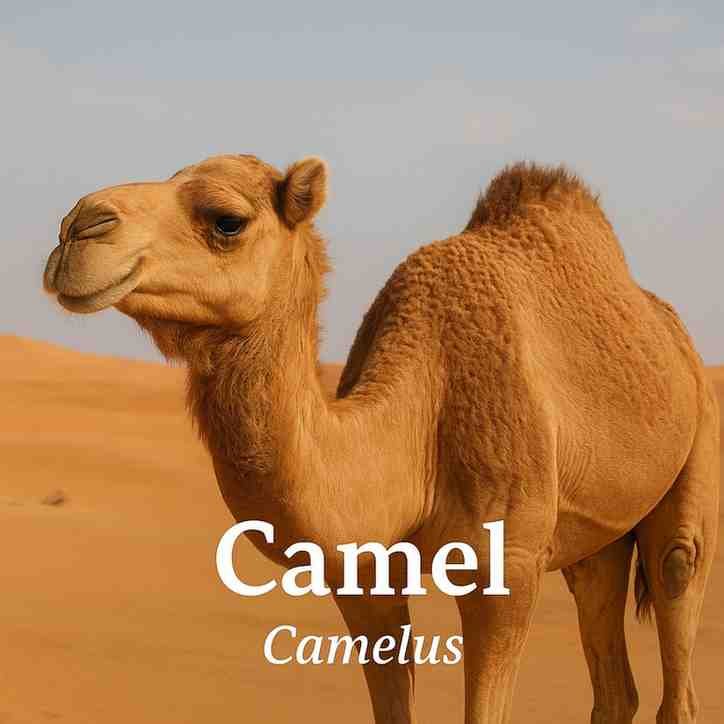
- Dromedary Camel (Camelus dromedarius): This is the most prevalent camel species that constitutes around 90% of the worldwide camel population. One-humped and mainly distributed in the Middle East and Africa.
- Bactrian Camel (Camelus bactrianus): This camel is distinguished by the presence of two humps and is native to the Central Asian region. Its fur coat acts as a protective cover, allowing it to hibernate in freezing deserts.
- Wild Bactrian Camel (Camelus ferus): A scarce and critically endangered animal that occupies the most inhospitable and harshest terrains of the Gobi desert and Meath, skimming the shore of drinking salty water.
| Camel Type | Scientific Name | Average Lifespan | Average Weight | Average Size (Height at Shoulder) |
|---|---|---|---|---|
| Dromedary Camel | Camelus dromedarius | 40–50 years | 400–600 kg (880–1320 lbs) | 1.8–2.0 m (5.9–6.6 ft) |
| Bactrian Camel | Camelus bactrianus | 40–50 years | 450–650 kg (990–1430 lbs) | 1.8–2.3 m (5.9–7.5 ft) |
| Wild Bactrian Camel | Camelus ferus | 30–40 years | 400–600 kg (880–1320 lbs) | 1.8–2.1 m (5.9–6.9 ft) |
Physical Characteristics and Sound
At the end of the day, camels are huge and strong animals that were created for endurance. Normally, donkey-size and horse-size camels stand at around 6-7 feet high, that is, their shoulder level, and weigh between 900 and 1,600 pounds approximately. Camel’s famous hump is filled with fat that is their energy reserve used during food deprivation for periods that may last long. Camels have long legs and wide, padded feet that are suitable for walking on sand; besides, they have double-row eyelashes that are joined at the base and nostrils that can be closed to protect against the storm of sand.
Camel lifespan:
The life expectancy of a wild camel is usually around 30 to 40 years, while those that are domesticated can live much longer with proper human care. Some camels live for over 50 years. Thus, they are among the longest-lived mammals compared to other large animals.
Voice and communication:
As communicative creatures, camels have different vocalizations among themselves. They can be heard rumbling, roaring, grunting, and bleating very loudly, especially when mating season arrives. Male camels usually make very low and deep sounds to attract females or to prove their superiority. Vocal bars and signals are key to maintaining social order in the herd.
Interesting Fact About the Camel
- Camels have such a great ability to maintain their vitality that they will survive even if they lose 25% of their body weight through dehydration.
- Fat is a stored substance in their humps, not water, and it is actually used for energy in times of scarcity.
- Camels can completely close their nostrils during dust storms to prevent dust from getting in.
- Camel milk is very rich in vitamins and is considered a survival food in deserts.
- Of all wild Bactrian camels, they are the only mammals that can safely drink very salty water.
Conclusion
The camel scientific name, Camelus, is a metaphor for the most adaptable animal on our planet, a creature perfectly made for living in arid desert regions. The single-humped dromedary camel, Camelus dromedarius, or the double-humped Bactrian camel, Camelus bactrianus, all contribute significantly to the areas of human life, ecosystems, and biodiversity. Knowing the camel’s scientific name, its taxonomy, and physical traits will clarify its importance in evolution, culture, and conservation. Camels are not only desert survivors—they are a crucial part of the natural world and human history.


wonderful post, very informative. I ponder why the other specialists of this sector do not notice this. You should continue your writing. I’m sure, you have a huge readers’ base already!