
What is the scientific name for a beetle? The beetle scientific name is Lucanidae (family).
Beetles represent one of the most diverse groups of insects in the entire world, with an estimated millions of species in the worldwide environment. Aside from this, they are decomposers, pollinators, and one of the natural pest controllers, serving a significant role in the various ecosystems. In this article, we will explore the beetle’s scientific name, genus, habitat, diet, types, and amazing facts about these fascinating creatures.
Table of Contents
What is the Beetle Scientific Name?
The general scientific name for a beetle belongs to the order Coleoptera, derived from the Greek words koleos (sheath) and pteron (wing). This highlights their uniquely modified wings, with hardened front wings (elytra) that cover and protect the more delicate wings underneath.
Biological Classification of Beetles
| Taxonomic Rank | Classification |
|---|---|
| Kingdom | Animalia |
| Phylum | Arthropoda |
| Class | Insecta |
| Order | Coleoptera |
| Suborders | Adephaga, Polyphaga, Archostemata, Myxophaga |
| Families | 180+ families (e.g., Carabidae, Scarabaeidae, Coccinellidae, Cerambycidae) |
| Genera | 30,000+ |
| Species | 400,000+ (and still counting) |
Types of Beetles with Binomial Names
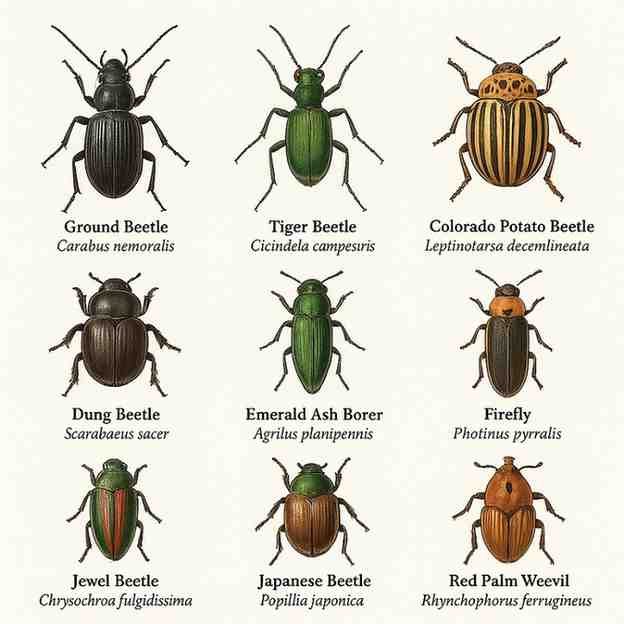
1. Predatory Beetle Types List
Predatory beetles are predators that live in forests, grasslands, and fields. They help control pest populations by feeding on insects.
| Common Name | Scientific Name | Habitat |
|---|---|---|
| Ground Beetle | Carabus nemoralis | Forest floors, gardens |
| Fiery Searcher | Calosoma scrutator | Woodlands, fields |
| Bombardier Beetle | Brachinus crepitans | Grasslands, under stones |
| Tiger Beetle | Cicindela campestris | Sandy areas, riverbanks |
| Caterpillar Hunter | Calosoma sycophanta | Forests, orchards |
| Ant Nest Beetle | Paussus favieri | Ant nests, underground |
| False Bombardier Beetle | Galerita bicolor | Decayed logs, leaf litter |
| Metallic Ground Beetle | Chlaenius vestitus | Grasslands, wetlands |
| Woodland Ground Beetle | Pterostichus melanarius | Forest floors |
| Cliff Tiger Beetle | Cicindela dorsalis | Sandy cliffs, dunes |
2. Herbivorous Beetle Species
Herbivorous beetles feed on crops, vegetables, and plants. Many of them are serious agricultural pests.
| Common Name | Scientific Name | Habitat |
|---|---|---|
| Colorado Potato Beetle | Leptinotarsa decemlineata | Potato fields, farms |
| Cucumber Beetle | Diabrotica undecimpunctata | Vegetable crops, gardens |
| Red Palm Weevil | Rhynchophorus ferrugineus | Palm trees |
| Pea Weevil | Bruchus pisorum | Pea fields, crops |
| Boll Weevil | Anthonomus grandis | Cotton fields |
| Grape Vine Beetle | Pelidnota punctata | Vineyards, orchards |
| Cottonwood Leaf Beetle | Chrysomela scripta | Cottonwood trees |
| Sweet Potato Weevil | Cylas formicarius | Sweet potato fields |
| Bean Leaf Beetle | Cerotoma trifurcata | Legume fields, crops |
| Rice Weevil | Sitophilus oryzae | Stored grains, rice fields |
3. Scavenger and Decomposer Beetle Types
These beetles feed on decaying matter, carrion, and animal waste. They recycle nutrients in ecosystems.
| Common Name | Scientific Name | Habitat |
|---|---|---|
| Dung Beetle | Scarabaeus sacer | Grasslands, pastures |
| Rainbow Scarab | Phanaeus vindex | Fields, meadows |
| Tumblebug | Canthon pilularius | Open grasslands |
| Sexton Beetle | Nicrophorus vespilloides | Forests, under logs |
| American Carrion Beetle | Necrophila americana | Near carrion, woodlands |
| Hide Beetle | Dermestes maculatus | Animal remains, houses |
| Larder Beetle | Dermestes lardarius | Stored food, animal hides |
| Black Dung Beetle | Onthophagus taurus | Farms, pastures |
| Minotaur Beetle | Typhaeus typhoeus | Sandy soils, heathlands |
| Tropical Dung Beetle | Onthophagus gazella | Grasslands, tropical regions |
4. Wood-Boring Beetle Types List
Wood-boring beetles inhabit trees and wooden buildings, frequently damaging forests and homes.
| Common Name | Scientific Name | Habitat |
|---|---|---|
| Asian Longhorn Beetle | Anoplophora glabripennis | Hardwood trees, forests |
| Red Oak Borer | Enaphalodes rufulus | Oak trees |
| Southern Pine Beetle | Dendroctonus frontalis | Pine forests |
| Emerald Ash Borer | Agrilus planipennis | Ash trees |
| Powderpost Beetle | Lyctus brunneus | Furniture, dry wood |
| Old House Borer | Hylotrupes bajulus | Houses, wooden beams |
| Metallic Wood-Borer | Buprestis aurulenta | Dead trees, forest wood |
| Hickory Borer | Megacyllene caryae | Hickory trees |
| Pine Sawyer Beetle | Monochamus scutellatus | Pine trees |
| Chestnut Borer | Agrilus bilineatus | Chestnut trees |
5. Light-Producing and Decorative Beetles
These beetles glow in the dark or are famous for their metallic and colorful appearance.
| Common Name | Zoological Name | Habitat |
|---|---|---|
| Eastern Firefly | Photinus pyralis | Meadows, forests |
| Glowworm Beetle | Lampyris noctiluca | Grasslands, gardens |
| Click Beetle | Pyrophorus noctilucus | Tropical forests |
| Railroad Worm | Phrixothrix hirtus | Tropical regions |
| Blue Mint Beetle | Chrysolina coerulans | Mint plants, gardens |
| Green Metallic Beetle | Chrysina gloriosa | Pine-oak forests |
| Golden Tortoise Beetle | Charidotella sexpunctata | Sweet potato, morning glory |
| Japanese Beetle | Popillia japonica | Gardens, farmlands |
| Green June Beetle | Cotinis nitida | Lawns, gardens, orchards |
| Jewel Beetle | Chrysochroa fulgidissima | Tropical forests |
Diet and Habitat of Beetles
The beetle order known as Coleoptera is considered the largest group of insects on Earth, with approximately 400,000 described species and possibly millions more yet to be discovered. Beetles can be found almost anywhere: in forests and grasslands, deserts and wetlands, and within the nooks and corners of human habitation. Understanding beetle habitats is important because the presence of beetles is directly dependent on the environment in which they live and the behavioral adaptations they exhibit in relation to their functions within the ecosystem.
General Habitat of Beetles:
Beetles are found in virtually every habitat except the open ocean and polar ice caps. Habitat variation is driven by food availability, climate, and ecological niches.
The Common Habitats of Beetles:
- Forests: Rely mainly on tree bark, under logs, leaf litter, etc.
- Grasslands and grasslands: In the place of plants, soil, and flowers.
- Agricultural fields: Where beetles feed on or protect crops.
- Wetlands and riverbanks: In mud and ponds, including aquatic plants.
- Urban areas: Orchards, wooden furniture, stored grain.
- Deserts: Living there almost without water.
Examples:
- 1. Forest Beetles:
- Stag Beetle: lives in rotting wood.
- Emerald Ash Borer: bores into ash trees.
- 2. Grassland & Agricultural Beetles:
- Ladybird Beetle: eats crop pests.
- Colorado Potato Beetle: harmful to potatoes.
- 3. Aquatic Beetles:
- Diving Beetle: swims in ponds and streams.
- Whirligig Beetle: spins on water surfaces.
- 4. Decomposer Beetles:
- Dung Beetle: rolls and buries animal waste.
- Carrion Beetle: feeds on dead animals.
- 5. Desert Beetles:
- Darkling Beetle: collects dew for water.
- Tok-Tok Beetle: hides in burrows.
- 6. Urban Beetles:
- Carpet Beetle: damages fabric.
- Rice Weevil: infests stored grains.
Interesting Facts about Beetles
- Diversity:
- They represent about 25% of all known animals on Earth, approximately 400,000 species.
- They belong to the order Coleoptera, which means “sheathed wings.”
- Wings:
- Beetles typically have two pairs of wings: a hard front pair (elytra), which protects the delicate flying wings underneath.
- Strength:
- The rhinoceros beetle can lift 850 times more than its body weight, making it one of the strongest animals on the planet.
- Adaptability:
- Beetles live almost everywhere, from tropical rainforests to high and low deserts, mountains, and even inside our homes.
- Glow in the dark:
- Just like fireflies are beetles, some beetles produce natural light (bioluminescence) to attract mates.
- Defense:
- A bombardier beetle sprays hot, poisonous chemicals from its abdomen to frighten predators.
- Human Impact:
- With some beetles, ladybugs (that control pests) can be considered beneficial.
- Others are harmful, such as the Colorado potato beetle, which destroys crops.
- Antiquity:
- Among the many examples of beetles in ancient history, they featured prominently in Egyptian mythology. Therefore, they were represented by the scarab beetle as a symbol of rebirth and protection.
Fun Fact: It has been noted that if you picked up every fourth animal on Earth, it would probably come out as a beetle!

