What is the scientific name of chilli? The chilli scientific name is Capsicum annuum.
Chili is one of the most popular spices around the world and for flavoring and heating a number of dishes. It is loved not only in the kitchen but also a culture and medicinal aspect. In this article, will take you through the chilli scientific name, biological classification, pronunciation, meaning, types, uses, benefits, and some other important details.
Table of Contents
What is the Scientific Name of Chilli?
The scientific name of chili is Capsicum, which is the genus for all peppers. Among the most common species of all commercially significant species, Capsicum annuum and Capsicum frutescens are the commercially penetrated.
Chilli scientific name pronunciation:
Capsicum annuum is pronounced as:
- /ˈkæp.sɪ.kəm ˈæn.ju.əm/
- CAP-sih-kuhm AN-uh-muhm
This is helpful in correctly identifying the chilli plant in both scientific and educational contexts.
Meaning of chilli scientific name:
- Capsicum in English is derived from the Greek word kapto, which means ‘to bite’. That means that it is about the biting feeling caused by capsaicin.
- The word annuum indicates that the species is annual. However, in tropical areas, some pepper plants can survive for more than one season.
Biological Classification of Chilli
| Rank | Classification |
|---|---|
| Kingdom | Plantae |
| Clade | Angiosperms |
| Clade | Eudicots |
| Clade | Asterids |
| Order | Solanales |
| Family | Solanaceae |
| Genus | Capsicum |
| Species | annuum |
Chilli Plant and Fruit
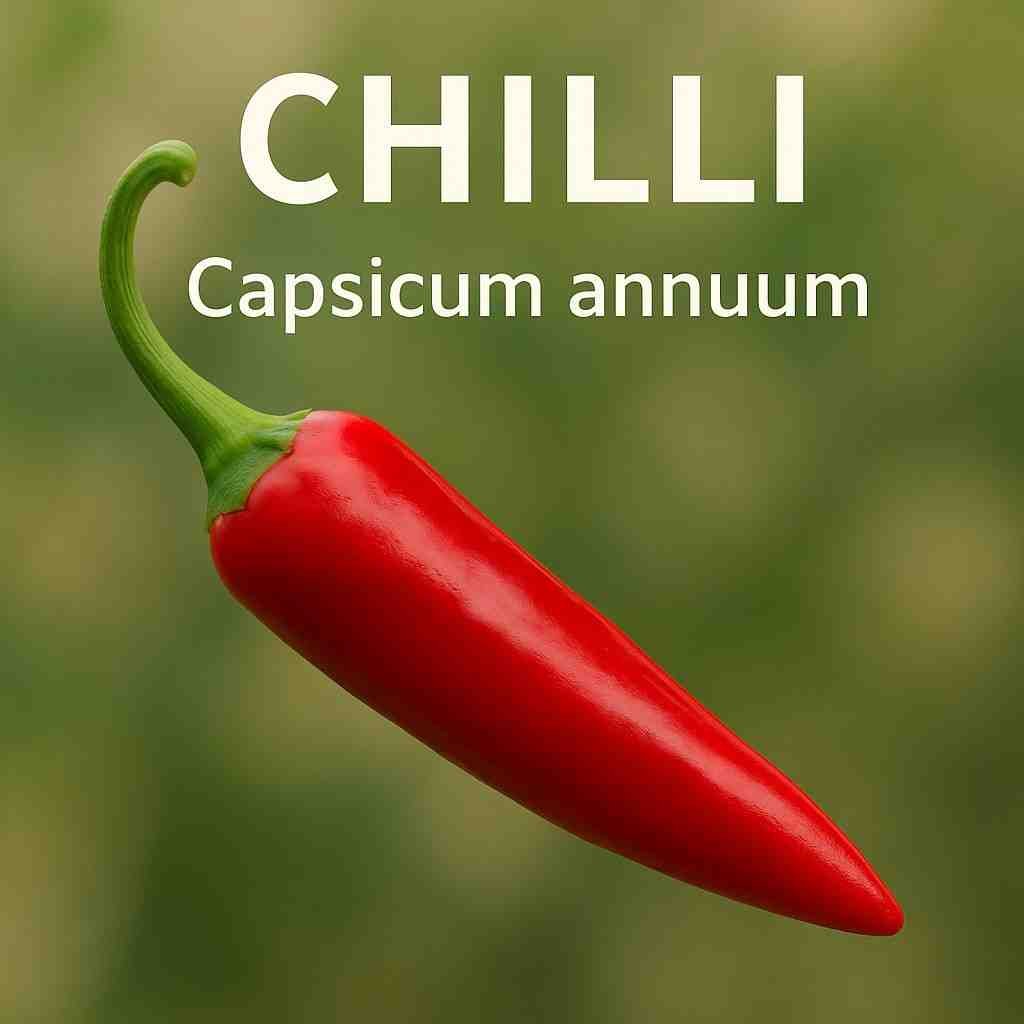
Chilli Plant Characteristics:
- Height: 60-120 cm
- Stem: Green, woody at the base
- Leaves: Broad green leaves that are smooth
- Flowers: Tiny white star-shaped Flowers
- Fruits: Pods of red, green, yellow, or purple colour.
It grows in tropical and subtropical climates, requiring well-drained soil and ample sunlight.
Characteristics of Chilli Fruit:
- Shape: ranging from long and slender to round and plump.
- Colour: green (unripe), red, yellow, or purple (ripe).
- Heat: Capsaicin is responsible for this and is mostly found in the seeds and inner walls.
Uses of Chili
Chillies are used not just as spices. They explore the use of medicines and treatments in various ways.
For cooking:
- Fresh chillies are used in cooking for curries, salads, and sauces
- Dried chilli flakes and powders go into spice mixture preparations
- Chilli Pickles and Chutneys
- Hot sauces and chilli oils
Medicinal Uses and Household Applications:
- Pain relief (capsaicin creams for arthritis)
- Aids metabolism and digestion
- Natural preservative
- Useful in pest deterrence in farming
Nutrition of chilli and its Benefits
Chillies provide an essential source of vitamins, minerals, and several health-promoting compounds.
Health Benefits of Chilli
- Vitamin C, Vitamin A, and Antioxidants are in abundance.
- Strengthens the immune system.
- Increases the blood circulation.
- Aids in weight management by accelerating metabolism.
- Proffers analgesic benefits from capsaicin.
- Lowers infection risks due to antibacterial properties.
Nutritional Value of Chilli (per 100g)
Chili peppers are low in calories, carbohydrates, fat, and protein, but they are rich in vitamins and minerals, especially vitamin C and vitamin A. They also contain beneficial compounds like capsaicin and antioxidants.
| Nutrient | Amount |
|---|---|
| Energy | 40 kcal |
| Carbohydrates | 9 g |
| Protein | 2 g |
| Vitamin C | 143 mg |
| Vitamin A | 48 µg |
| Iron | 1.2 mg |
| Calcium | 18 mg |
Types of Chili Peppers
There are hundreds of varieties of chili peppers worldwide, ranging from mild to extremely hot.
| Type of Chilli | Origin | Heat Level (Scoville Units) | Usage |
|---|---|---|---|
| Jalapeño | Mexico | 2,500 – 8,000 SHU | Salsas, sauces, pickling |
| Bird’s Eye Chilli | Southeast Asia | 50,000 – 100,000 SHU | Curries, stir-fries, Asian dishes |
| Habanero | South America | 100,000 – 350,000 SHU | Hot sauces, marinades, chutneys |
| Kashmiri Chilli | India | 1,000 – 2,000 SHU | Color in curries, mild spice |
| Carolina Reaper | USA | 1,500,000 – 2,200,000 SHU | Extreme spice challenges |
| Serrano | Mexico | 10,000 – 25,000 SHU | Salsas, fresh toppings |
| Cayenne | French Guiana | 30,000 – 50,000 SHU | Powder, sauces, seasoning |
| Poblano | Mexico | 1,000 – 1,500 SHU | Roasting, stuffing (Chiles Rellenos) |
| Thai Chilli | Thailand | 50,000 – 100,000 SHU | Soups, curries, dipping sauces |
| Ghost Pepper (Bhut Jolokia) | India (Assam) | 800,000 – 1,041,427 SHU | Pickles, chutneys, extreme spice |
Names of chilli in Different Languages
| Language | Common Name |
|---|---|
| English | Chilli / Chili Pepper |
| Hindi | Mirchi (मिर्च) |
| Spanish | Chile |
| French | Piment |
| Chinese (Mandarin) | Làjiāo (辣椒) |
| Arabic | Filfil (فلفل) |
| Portuguese | Pimenta |
| German | Chili |
| Italian | Peperoncino |
| Japanese | Tōgarashi (唐辛子) |
Quick Facts About Chillies
- Chillies are not fruits; they are vegetables.
- Belongs to the Solanaceae family (same as tomato, potato, eggplant).
- Originally came from Central and South America, but now spreads worldwide.
- Contains capsaicin that burns through its derivation.
- In both folk medicine and modern pharmaceuticals.
Conclusion
The scientific name for chili peppers is Capsicum annuum, a plant that has influenced food cultures around the world. From the scientific name for the chili leaf to the scientific name for the chili fruit, every part of this plant has its own significance. It enhances food with flavor, provides valuable health benefits, and is one of the most widely used spices globally.
Whether it’s a mild Kashmiri chili or a fiery Carolina Reaper, this remarkable fruit shows that bold flavor can come in the smallest of packages.
Also read:
- Potato Scientific Name, Genus, Types, Uses, and Benefits
- Aloe Vera Scientific Name, Nutrition, Types, Uses, and Benefits
- Tomato Scientific Name, Types, Uses, Benefits, and Plant
Frequently Asked Questions About Chilli
What is the scientific name of chilli?
The scientific name of chilli is Capsicum annuum. It belongs to the family Solanaceae, the same family as tomatoes, potatoes, and eggplants.
What are the health benefits of chilli?
Chillies are rich in Vitamin C, Vitamin A, potassium, and antioxidants. They help boost immunity, improve metabolism, and may reduce inflammation.
Is chilli a fruit or a vegetable?
Botanically, chilli is a fruit because it develops from the ovary of a flower and contains seeds. However, in cooking, it is commonly treated as a vegetable or spice.
What is the origin of chilli?
Chillies originated in Central and South America and were later spread across the world by Portuguese and Spanish traders. Today, they are grown worldwide.
What is the difference between red chilli and green chilli?
Green Chilli: Unripe stage of the fruit, milder in taste.
Red Chilli: Ripe stage, usually spicier and richer in antioxidants like capsaicin.