What is the scientific name of maple tree? The maple scientific name is Acer(genus).
The maple tree is indeed one of the world’s most popular and important trees, and the reason for this is its distinctive leaves, brilliant fall colors, and the richness of its symbolism in various cultures. Its scientific name, Acer, groups maple trees into the family Sapindaceae. The scientific name for maple represents a genus consisting of more than 130 species of trees and shrubs found in North America, Europe, and Asia.
Table of Contents
Through this article, we will discuss the scientific name of maple, its meaning, pronunciation, classification, varieties such as red and sugar maple, and its many applications and advantages.
What is The Scientific Name of Maple?
Acer spp is the scientific name that encompasses all the varieties of the maple tree. (plural form denoting all species of maple)
- Genus: Acer
- Family: Sapindaceae
Scientific Name Meaning and Pronunciation
- Meaning: The Latin word Acer means “sharp,” which refers to the pointed form of the maple leaf.
Pronunciation of the maple scientific name:
AY-ser (IPA: /ˈeɪ.sər/)
The scientific name of maple covers a wide area of species, each with its own unique colors, leaf shapes, and uses.
Biological classification of Maple Tree
| Rank | Classification |
|---|---|
| Kingdom | Plantae |
| Division | Magnoliophyta |
| Class | Magnoliopsida |
| Order | Sapindales |
| Family | Sapindaceae |
| Genus | Acer |
Maples are also referred to as deciduous trees, as they lose their leaves in the fall season. They prefer to grow in temperate regions with the best growing conditions, to be the ones with the sap, which is the only product derived from them, and that is what maple syrup is made of.
Maple Tree Age and Lifespan
Maple trees have different ages because their growth depends on their species and the conditions of their surrounding ecosystem. Maple trees exist as multiple species that live for between 30 and 100 years, while certain species reach their centennial mark and continue to live beyond that point.
Average Maple Tree Age:
- Small maple species: 40–60 years
- Medium maple species: 80–100 years
- Large maple species: 150–300 years
The sugar maple (Acer saccharum) is known for its long life span. Sugar maple trees can reach an age range of 200 to 300 years when they grow in ideal conditions.
Maple tree age depends on several elements, which include:
- soil quality
- water supply
- sunlight exposure
- climate conditions
- pest and disease control
Forestry experts often study maple tree age because older maple trees produce more sap and provide stronger wood.
Maple Tree Genus (Acer)
The genus Acer is the scientific group that includes all maple trees. The genus contains more than 130 species, which scientists have officially recognized as tree and shrub varieties.
Characteristics of Genus: Acer
The maple species, which belong to the genus Acer, show specific biological characteristics through their shared physical attributes. The seeds of maple trees spin in the air when they fall. Maple trees use their winged seeds as a natural method for forest propagation.
Botanists classify maple trees under the genus Acer because these shared traits appear across many maple species.
Types of Maple Tree
There exist many different maple tree species that belong to the scientific genus of Acer. The various species display distinct variations due to their different leaf structures and bark compositions, as well as their unique growth patterns and capacity to withstand diverse environmental conditions.
| Common Name | Scientific Name |
|---|---|
| Sugar Maple | Acer saccharum |
| Red Maple | Acer rubrum |
| Silver Maple | Acer saccharinum |
| Japanese Maple | Acer palmatum |
| Norway Maple | Acer platanoides |
| Box Elder Maple | Acer negundo |
| Bigleaf Maple | Acer macrophyllum |
| Black Maple | Acer nigrum |
| Amur Maple | Acer ginnala |
| Field Maple | Acer campestre |
| Sycamore Maple | Acer pseudoplatanus |
| Paperbark Maple | Acer griseum |
| Trident Maple | Acer buergerianum |
| Hedge Maple | Acer campestre |
| Mountain Maple | Acer spicatum |
| Vine Maple | Acer circinatum |
| Korean Maple | Acer pseudosieboldianum |
| Tatarian Maple | Acer tataricum |
| Chalk Maple | Acer leucoderme |
| Striped Maple | Acer pensylvanicum |
The following section presents the most commonly encountered species of maple trees.
Red Maple (Acer rubrum)
Red maple trees represent one of the most widely distributed maple species throughout North America.
Red Maple Characteristics:
- Scientific name: Acer rubrum
- Native region: North America
- Leaf color in fall: red
- Height: 40–70 feet
Red maple trees adapt to many soil types. Landscapers often plant red maple trees along streets and parks because they grow quickly and provide shade.
Sugar Maple (Acer saccharum)
The sugar maple tree serves as the primary source for producing maple syrup.
Sugar Maple Characteristics:
- Scientific name: Acer saccharum
- Native region: North America
- Sap use: maple syrup production
- Average height: 60–100 feet
Farmers collect sap from sugar maple trees during the early spring season. The process of sap boiling leads to the production of maple syrup.
The sugar maple leaf serves as a national emblem for Canada.
Japanese Maple (Acer palmatum)
The Japanese maple tree functions as an attractive decorative tree that people plant in their gardens.
Japanese Maple Characteristics:
- Scientific name: Acer palmatum
- Native region: Japan, Korea, China
- Growth type: small tree or shrub
- Landscape use: decorative garden tree
Japanese maple trees maintain a compact growth pattern, which produces delicate leaf structures. People use them in landscape design because of their compact growth pattern and delicate leaf structure.
Silver Maple (Acer saccharinum)
The silver maple tree grows rapidly and shows the ability to grow in a variety of environmental conditions.
Silver Maple Characteristics:
- Scientific name: Acer saccharinum
- Native region: North America
- Growth rate: fast
- Habitat: riverbanks and wetlands
Silver maple trees thrive in environments with saturated soil conditions, which leads to their frequent growth near rivers and floodplains.
Maple Tree Habitat and Growing Conditions
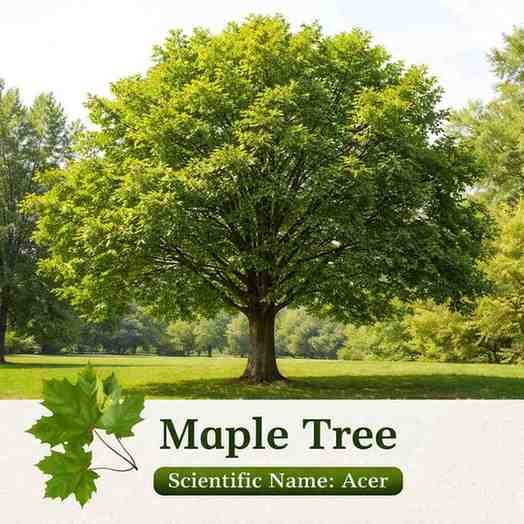
The maples prefer their growth environment to be found in temperate climate regions. The maple species exhibit their highest growth preference during moderate temperature conditions that receive seasonal rainfall.
The ideal conditions for maple tree growth require these specific elements.
- Climate: temperate climate
- Soil: well-drained soil
- Sunlight: full sun to partial shade
- Water: moderate water supply
The trees shed their leaves in autumn. The seasonal process of leaf shedding leads botanists to identify maple trees as deciduous trees.
Maple Tree Benefits
The environmental benefits, together with the economic advantages and cultural value of maple trees, create multiple advantages for society.
Environmental Benefits:
Maple trees provide multiple ecosystem advantages through their following functions.
- improve air quality
- absorb carbon dioxide
- provide oxygen
- protect soil from erosion
The extensive maple forest areas create diverse habitats that support various forms of life.
Economic Benefits:
The multiple industries depend on maple trees for their business operations, which include
- Maple syrup production
- Timber industry
- Landscaping industry
- Tourism in autumn seasons
The various regions generate profits through their maple forest products.
Cultural Benefits:
The trees represent important cultural meanings for various societies.
The following things demonstrate this value.
- The maple leaf symbol of Canada
- Use of maple leaves in art and design
- Seasonal tourism during autumn foliage
People view maple trees as symbols of the changing seasons, which showcase the beauty of nature.
Maple Tree Uses
The maple scientific name Acer, represents trees that provide many economic and ecological uses.
1. Maple Syrup Production
The most well-known use of maple trees is maple syrup production.
Farmers collect sap from sugar maple trees. The sap contains natural sugar that becomes maple syrup after heating.
Maple syrup production is common in:
- Canada
- United States
- Northern forests
2. Maple Wood
Maple wood is strong and dense. Manufacturers use maple wood to produce:
- furniture
- flooring
- musical instruments
- cabinets
Hard maple wood is especially valued in the woodworking industry.
3. Landscaping and Urban Planting
Many cities plant maple trees because they grow well in parks and on streets.
Benefits for landscaping include:
- shade production
- seasonal color change
- moderate maintenance
Japanese maple and red maple are widely planted in landscape design.
4. Wildlife Habitat
Maple trees provide food and shelter for wildlife.
Animals that use maple trees include:
- birds
- squirrels
- insects
The seeds and leaves support small animals in forest ecosystems.
Maple common names in different countries
| Country | Language | Maple Common Name |
|---|---|---|
| United States | English | Maple Tree |
| Canada | English / French | Maple Tree / Érable |
| United Kingdom | English | Maple |
| Australia | English | Maple Tree |
| New Zealand | English | Maple |
| Japan | Japanese | Momiji |
| China | Chinese | Feng Shu |
| South Korea | Korean | Danpung Namu |
| India | English / Hindi | Maple / मेपल |
| Pakistan | English / Urdu | Maple Tree / میپل |
| Germany | German | Ahorn |
| France | French | Érable |
| Spain | Spanish | Arce |
| Italy | Italian | Acero |
| Netherlands | Dutch | Esdoorn |
| Turkey | Turkish | Akçaağaç |
| Iran | Persian | Afra (افرا) |
| Russia | Russian | Klyon (Клён) |
| Poland | Polish | Klon |
| Sweden | Swedish | Lönn |
Conclusion
The maple scientific name Acer, represents a diverse group of more than 130 tree and shrub species. The trees grow in temperate regions across North America, Europe, and Asia because they belong to the Sapindaceae family. The scientific name of maple trees enables botanists to identify different types of maple trees through their shared traits of lobed leaves and winged seeds, and their ability to lose leaves in winter.
Maple trees provide many uses and benefits. People use maple trees for maple syrup production, wood products, landscaping, and wildlife habitat. Red maple, sugar maple, Japanese maple, and silver maple are essential species for both ecosystem functioning and forestry practices.